
곧(got)
An adverb indicating something will happen in the near future
When to use
everyday conversation, immediate future, scheduled event
The nuance
Used when something will happen very soon; natural in both spoken and written Korean.
곧 (got) · 머지않아 (meo-ji-an-a, meojiana) · 이내 (i-nae, inae)
곧, 머지않아, and 이내 all mean 'soon' but differ in usage and nuance, so choosing the right one matters.
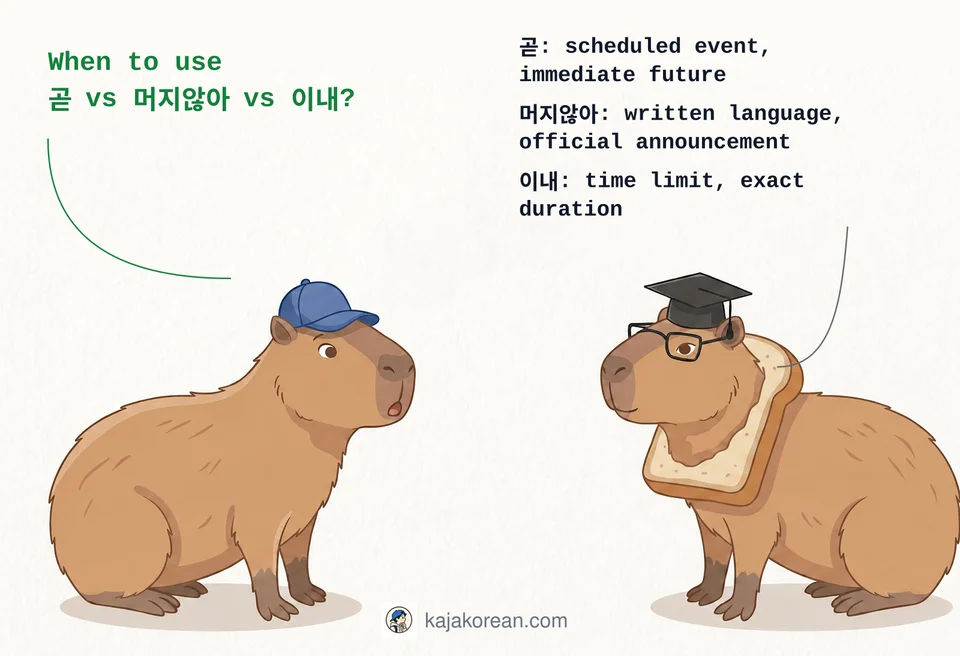
One lane per word — no nested boxes, just the gist.
An adverb indicating something will happen in the near future
When to use
everyday conversation, immediate future, scheduled event
The nuance
Used when something will happen very soon; natural in both spoken and written Korean.
An adverb emphasizing that not much time remains before something happens
When to use
official announcement, written language, emphasis on imminent time
The nuance
More formal than 곧, mainly used in official or written contexts; emphasizes near future without specifying exact time.
An adverb indicating something will happen within a specific time frame
When to use
time limit, documents or regulations, exact duration
The nuance
Used when specifying a clear time limit; mainly written and often combined with numbers like 'within 5 minutes'.
곧 비가 올 거예요.
got bi-ga ol geo-ye-yo., got bi ga ol geo ye yo.
Naturally expresses rain coming very soon in the near future.
곧 3년이 지났어요.
got 3nyeon-i ji-nass-eo-yo., got 3nyeon i ji nass eo yo.
곧 is mainly for future events, not past durations; 머지않아 or 이내 are also inappropriate here.
머지않아 대통령이 연설할 것입니다.
meo-ji-an-a dae-tong-ryeong-i yeon-seol-hal geos-ip-ni-da., meo ji an a dae tong ryeong i yeon seol hal geos ip ni da.
Appropriate formal expression emphasizing near future in official/written context.
머지않아 친구를 만났어요.
meo-ji-an-a chin-gu-reul man-nass-eo-yo., meo ji an a chin gu reul man nass eo yo.
머지않아 is for future events, so cannot be used with past tense.
5분 이내에 답변해 주세요.
5bun i-nae-e dap-byeon-hae ju-se-yo., 5bun i nae e dap byeon hae ju se yo.
Proper formal sentence indicating a clear time limit.
이내에 도착했어요.
i-nae-e do-chak-haess-eo-yo., i nae e do chak haess eo yo.
이내 must be used with a specific time frame (number); standalone use is unnatural.
머지않아 봄이 올 거예요.
meo-ji-an-a bom-i ol geo-ye-yo., meo ji an a bom i ol geo ye yo.
Suitable for formally expressing a near future event.
곧 시험이 끝났어요.
got si-heom-i kkeut-nass-eo-yo., got si heom i kkeut nass eo yo.
곧 is for future tense, so cannot be used with past perfect.
Which word can replace '곧' in formal documents?
Which word fits in 'You must arrive within 10 ___'?
Which is natural in '___ it looks like it will rain.'?
What does it mean?