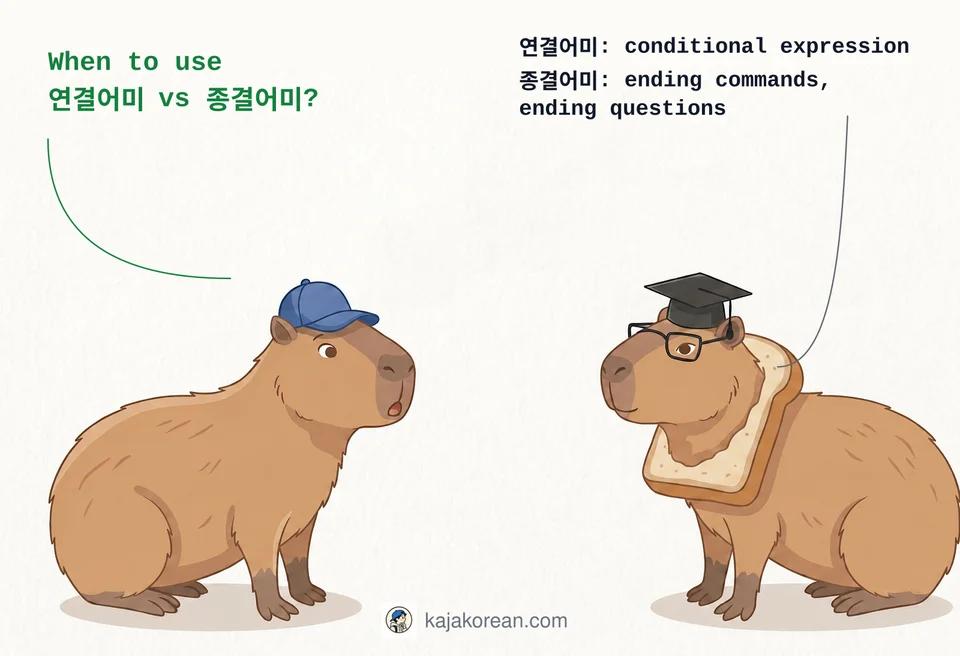
Connecting Endings vs. Sentence Endings

연결어미 (yeon-gyeol-eo-mi, yeongyeoleomi) · 종결어미 (jong-gyeol-eo-mi, jonggyeoleomi)

Connecting endings link clauses smoothly, while sentence endings complete sentences and mark their finality.

Comparison of Korean 연결어미 and 종결어미 usage

Word-by-word breakdown

One lane per word — no nested boxes, just the gist.

연결어미(yeon-gyeol-eo-mi, yeongyeoleomi)

Endings that connect clauses or sentences within a sentence

When to use

complex sentence connection, conditional expression, cause and effect connection, temporal sequence connection

The nuance

Used to connect clauses or sentences smoothly without ending the sentence; typically appears in the middle of a sentence.

종결어미(jong-gyeol-eo-mi, jonggyeoleomi)

Endings that mark the end of a sentence and complete it

When to use

sentence completion, ending commands, ending questions, ending exclamations

The nuance

Used to finish a sentence and clearly mark its end; appears at the end of a sentence.

Real-world examples

  • 비가 오면 우산을 써야 한다.

    bi-ga o-myeon u-san-eul sseo-ya han-da., bi ga o myeon u san eul sseo ya han da.

    ‘-으면’ is a connecting ending expressing condition, used correctly.

  • 비가 오면.

    bi-ga o-myeon., bi ga o myeon.

    ‘-으면’ is a connecting ending and cannot end a sentence alone; a sentence ending is required.

  • 나는 밥을 먹고 학교에 갔다.

    na-neun bap-eul meok-go hak-gyo-e gass-da., na neun bap eul meok go hak gyo e gass da.

    ‘-고’ connects two actions smoothly, used correctly.

  • 나는 밥을 먹고.

    na-neun bap-eul meok-go., na neun bap eul meok go.

    ‘-고’ is a connecting ending and cannot end a sentence alone; sentence ending needed.

  • 오늘은 날씨가 좋다.

    o-neul-eun nal-ssi-ga joh-da., o neul eun nal ssi ga joh da.

    ‘-다’ is a sentence ending that completes the sentence, used correctly.

  • 오늘은 날씨가 좋고.

    o-neul-eun nal-ssi-ga joh-go., o neul eun nal ssi ga joh go.

    ‘-고’ is a connecting ending and cannot end a sentence; a sentence ending like ‘-다’ is required.

  • 가라!

    ga-ra!, ga ra!

    ‘-라’ is a sentence ending used to finish commands, correct usage.

  • 가고!

    ga-go!, ga go!

    ‘-고’ is a connecting ending and cannot end a command; ‘가라’ is correct.

Quick quiz

  1. Which is NOT a connecting ending?

    다음 중 연결어미가 아닌 것은?(da-eumjungyeon-gyeol-eo-mi-gaa-ningeos-eun?, daeumjungyeongyeoleomigaaningeoseun?)
  2. What type of ending should follow ‘비가 오면’?

    ‘비가 오면’ 다음에 올 어미는?(‘bi-gao-myeon’da-eum-eoleo-mi-neun?, ‘bigaomyeon’daeumeoleomineun?)
  3. In ‘오늘은 날씨가 좋다.’ what is ‘다’?

    ‘오늘은 날씨가 좋다.’에서 ‘다’는?(‘o-neul-eunnal-ssi-gajoh-da.’e-seo‘da’neun?, ‘oneuleunnalssigajohda.’eseo‘da’neun?)

More comparisons to explore

View all word comparisons →