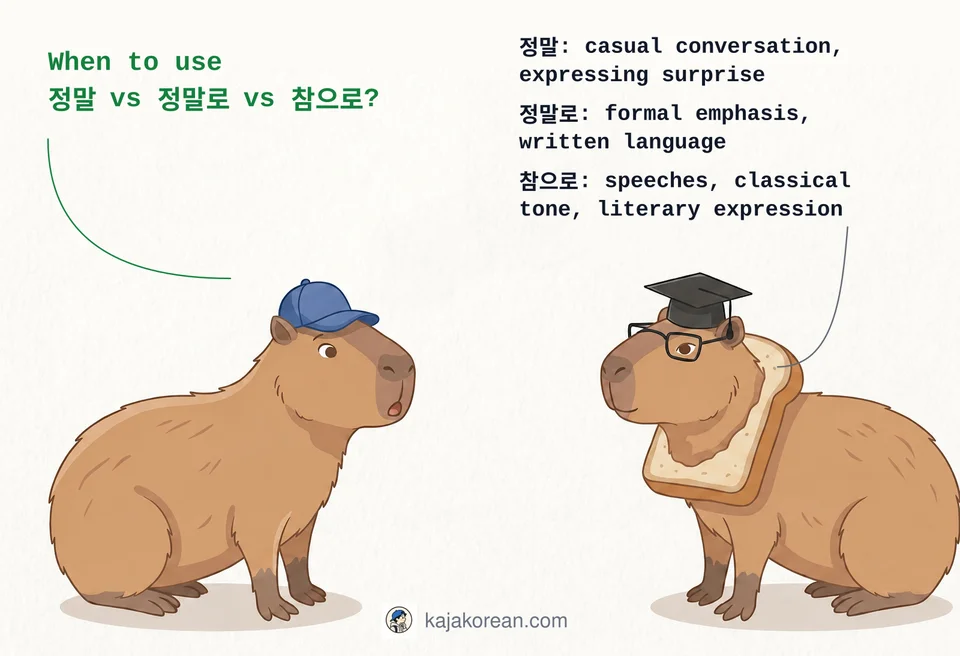
정말 vs 정말로 vs 참으로: Nuances of 'Really' in Korean

정말 (jeong-mal, jeongmal) · 정말로 (jeong-mal-ro, jeongmalro) · 참으로 (cham-eu-ro, chameuro)

정말, 정말로, and 참으로 all mean 'really,' but differ subtly in usage contexts and tone.

Comparison of Korean words 정말, 정말로, 참으로 with usage examples

Word-by-word breakdown

One lane per word — no nested boxes, just the gist.

정말(jeong-mal, jeongmal)

A common adverb emphasizing truth or reality, meaning 'really' or 'truly'

When to use

casual conversation, expressing surprise, emphasizing questions

The nuance

Used naturally in everyday speech and writing, fits well in exclamations and questions

정말로(jeong-mal-ro, jeongmalro)

An adverb used to emphasize truth formally and strongly

When to use

formal emphasis, written language, serious situations

The nuance

Mainly used in formal contexts or written language, suitable for serious emphasis

참으로(cham-eu-ro, chameuro)

An old-fashioned adverb expressing sincere admiration or awe

When to use

literary expression, speeches, classical tone

The nuance

Used mainly in literary works, speeches, or classical styles; awkward in casual speech

Real-world examples

  • 정말 맛있어요! ⭕

    jeong-mal mas-iss-eo-yo! ⭕, jeong mal mas iss eo yo! ⭕

    A natural and common exclamation in daily conversation

  • 정말로 맛있어요! ⭕

    jeong-mal-ro mas-iss-eo-yo! ⭕, jeong mal ro mas iss eo yo! ⭕

    Appropriate for stronger, more formal emphasis

  • 참으로 맛있어요! ⭕

    cham-eu-ro mas-iss-eo-yo! ⭕, cham eu ro mas iss eo yo! ⭕

    Expresses sincere admiration in a literary or classical style

  • 정말로 친구야? ⭕

    jeong-mal-ro chin-gu-ya? ⭕, jeong mal ro chin gu ya? ⭕

    Can be used naturally in questions with formal tone

  • 참으로 친구야? ❌

    cham-eu-ro chin-gu-ya? ❌, cham eu ro chin gu ya? ❌

    Old-fashioned style is awkward in casual questions

  • 정말로 내일 올 거야? ❌

    jeong-mal-ro nae-il ol geo-ya? ❌, jeong mal ro nae il ol geo ya? ❌

    Too formal for casual talk; '정말' fits better

  • 참으로 감사합니다. ⭕

    cham-eu-ro gam-sa-hap-ni-da. ⭕, cham eu ro gam sa hap ni da. ⭕

    Fits formal and sincere expressions of thanks

  • 정말 감사합니다! ⭕

    jeong-mal gam-sa-hap-ni-da! ⭕, jeong mal gam sa hap ni da! ⭕

    Natural and sincere gratitude in everyday speech

Quick quiz

  1. Which is most natural for 'really' in casual talk?

    일상 대화에서 가장 자연스러운 '진짜' 강조는?(il-sangdae-hwa-e-seoga-jangja-yeon-seu-reo-un'jin-jja'gang-jo-neun?, ilsangdaehwaeseogajangjayeonseureoun'jinjja'gangjoneun?)
  2. Which expression gives a literary or classical tone?

    문학적이고 고전적인 느낌을 주는 표현은?(mun-hak-jeok-i-gogo-jeon-jeok-inneu-kkim-eulju-neunpyo-hyeon-eun?, munhakjeokigogojeonjeokinneukkimeuljuneunpyohyeoneun?)
  3. Which is suitable for strong truth emphasis in formal settings?

    공식적인 자리에서 강한 진실 강조를 할 때 적합한 표현은?(gong-sik-jeok-inja-ri-e-seogang-hanjin-silgang-jo-reulhalttaejeok-hap-hanpyo-hyeon-eun?, gongsikjeokinjarieseoganghanjinsilgangjoreulhalttaejeokhaphanpyohyeoneun?)

What does it mean?

More comparisons to explore

View all word comparisons →