서로 vs 맞서 vs 서로서로: Confusing Relationship Expressions

서로 (seo-ro, seoro) · 맞서 (maj-seo, majseo) · 서로서로 (seo-ro-seo-ro, seoroseoro)

서로, 맞서, and 서로서로 all express relationships, but differ in mutuality, opposition, and reciprocal interaction nuances.

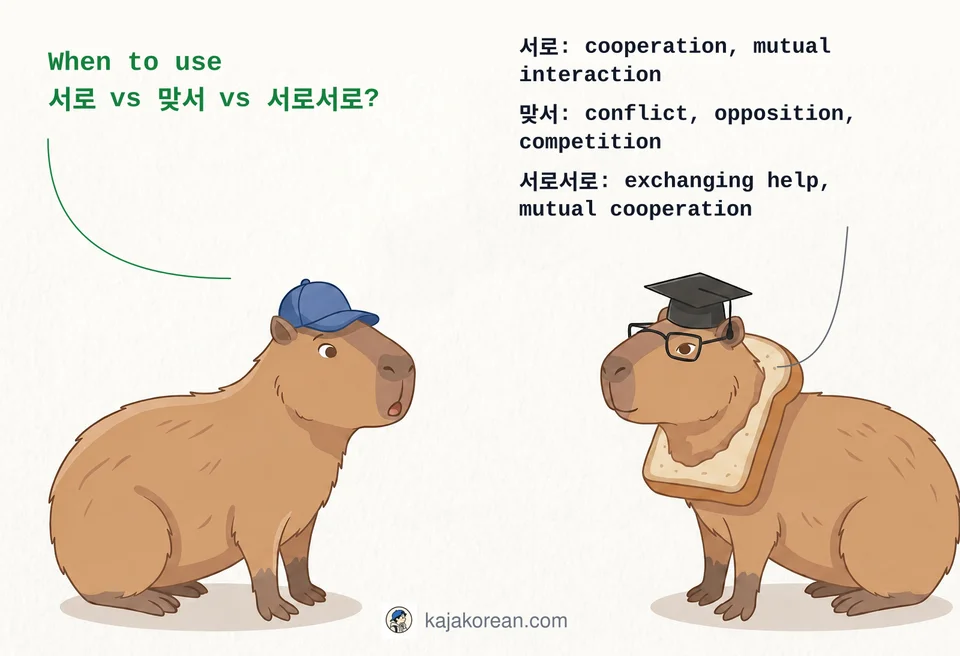
Comparison of Korean words 서로, 맞서, 서로서로 showing nuances of mutuality, opposition, and reciprocity

Word-by-word breakdown

One lane per word — no nested boxes, just the gist.

서로(seo-ro, seoro)

Indicates mutual relationship or action exchanged between both sides

When to use

mutual interaction, cooperation, emotional exchange

The nuance

Used when two parties interact or relate mutually; suitable for positive or neutral contexts.

맞서(maj-seo, majseo)

Describes two parties standing opposite each other in confrontation or opposition

When to use

opposition, conflict, competition

The nuance

Used in conflict, opposition, or competition contexts, indicating physical or metaphorical confrontation.

서로서로(seo-ro-seo-ro, seoroseoro)

Emphasizes alternating or joint actions between parties

When to use

mutual cooperation, exchanging help, repetitive interaction

The nuance

Used when mutual actions are repeated or alternating, emphasizing cooperation or reciprocal help.

Real-world examples

  • 우리는 서로 도와야 한다.

    u-ri-neun seo-ro do-wa-ya han-da., u ri neun seo ro do wa ya han da.

    서로 properly indicates mutual help.

  • 우리는 맞서 도와야 한다.

    u-ri-neun maj-seo do-wa-ya han-da., u ri neun maj seo do wa ya han da.

    맞서 implies confrontation, so unsuitable for help context.

  • 그들은 서로서로 의견을 나누었다.

    geu-deul-eun seo-ro-seo-ro ui-gyeon-eul na-nu-eoss-da., geu deul eun seo ro seo ro ui gyeon eul na nu eoss da.

    서로서로 emphasizes reciprocal exchange, fitting here.

  • 그들은 맞서 의견을 나누었다.

    geu-deul-eun maj-seo ui-gyeon-eul na-nu-eoss-da., geu deul eun maj seo ui gyeon eul na nu eoss da.

    맞서 is for opposition, not neutral opinion exchange.

  • 두 팀이 경기장에서 맞서 싸웠다.

    du tim-i gyeong-gi-jang-e-seo maj-seo ssa-woss-da., du tim i gyeong gi jang e seo maj seo ssa woss da.

    맞서 correctly expresses confrontation and fighting.

  • 두 팀이 서로서로 싸웠다.

    du tim-i seo-ro-seo-ro ssa-woss-da., du tim i seo ro seo ro ssa woss da.

    서로서로 implies cooperation, inappropriate for fighting.

  • 친구들이 서로서로 선물을 주고받았다.

    chin-gu-deul-i seo-ro-seo-ro seon-mul-eul ju-go-bat-ass-da., chin gu deul i seo ro seo ro seon mul eul ju go bat ass da.

    서로서로 fits alternating reciprocal gift-giving.

  • 친구들이 맞서 선물을 주고받았다.

    chin-gu-deul-i maj-seo seon-mul-eul ju-go-bat-ass-da., chin gu deul i maj seo seon mul eul ju go bat ass da.

    맞서 implies opposition, unsuitable for gift exchange.

Quick quiz

  1. What is the difference between 서로 and 맞서?

    서로와 맞서의 차이는 무엇인가?(seo-ro-wamaj-seo-uicha-i-neunmu-eos-in-ga?, seorowamajseouichaineunmueosinga?)
  2. When should you use 서로서로?

    서로서로를 사용할 상황은?(seo-ro-seo-ro-reulsa-yong-halsang-hwang-eun?, seoroseororeulsayonghalsanghwangeun?)
  3. Which sentence correctly uses 맞서?

    다음 중 맞서가 적절한 문장은?(da-eumjungmaj-seo-gajeok-jeol-hanmun-jang-eun?, daeumjungmajseogajeokjeolhanmunjangeun?)

More comparisons to explore

View all word comparisons →