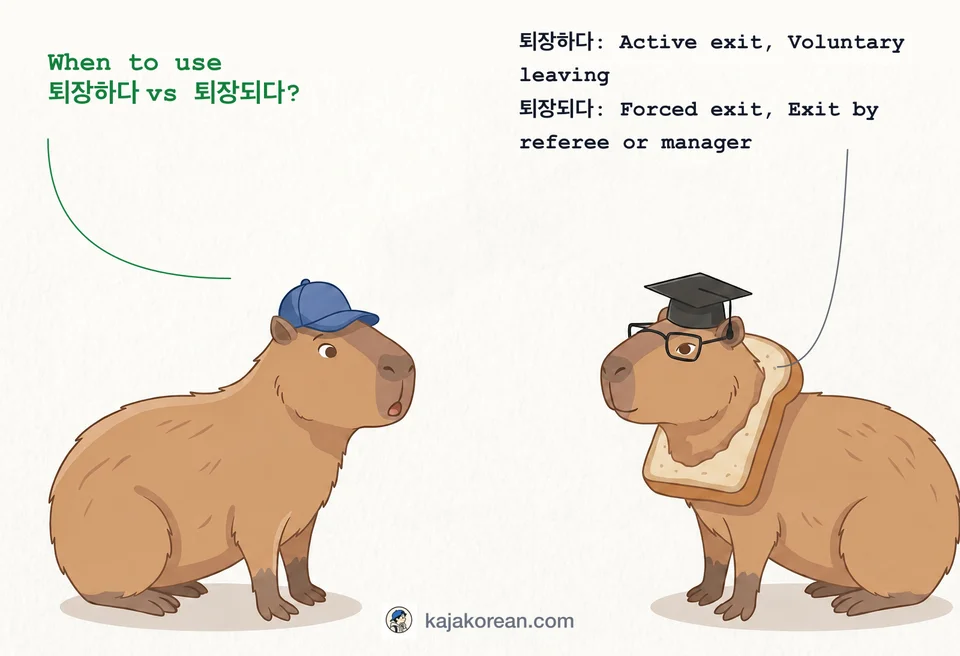
Refers to the subject actively leaving a place by their own action.
When to use
Active exit, Voluntary leaving, Leaving during performance or game
The nuance
Use when the subject actively leaves or exits; the agent is clearly performing the action.
퇴장하다 (toe-jang-ha-da, toejanghada) · 퇴장되다 (toe-jang-doe-da, toejangdoeda)
퇴장하다 (to exit actively) means the subject leaves by their own action, while 퇴장되다 (to be exited) indicates a passive situation caused by external factors.

One lane per word — no nested boxes, just the gist.
Refers to the subject actively leaving a place by their own action.
When to use
Active exit, Voluntary leaving, Leaving during performance or game
The nuance
Use when the subject actively leaves or exits; the agent is clearly performing the action.
Indicates a passive situation where the subject is forced to leave due to external factors or decisions by others.
When to use
Forced exit, Exit by referee or manager, Exit due to rule violation
The nuance
Use when the subject does not act themselves but is forced to exit by someone or something else; passive voice.
그 배우는 무대에서 퇴장했다.
geu bae-u-neun mu-dae-e-seo toe-jang-haess-da., geu bae u neun mu dae e seo toe jang haess da.
The actor actively left the stage, so '퇴장하다' is correct.
그 배우는 무대에서 퇴장되었다.
geu bae-u-neun mu-dae-e-seo toe-jang-doe-eoss-da., geu bae u neun mu dae e seo toe jang doe eoss da.
If the actor was forced off stage by an external factor (like a director), '퇴장되다' is appropriate.
관객이 자발적으로 퇴장되었다.
gwan-gaek-i ja-bal-jeok-eu-ro toe-jang-doe-eoss-da., gwan gaek i ja bal jeok eu ro toe jang doe eoss da.
If the audience left voluntarily, passive form '퇴장되다' is incorrect; use '퇴장하다'.
선수가 반칙으로 퇴장되었다.
seon-su-ga ban-chik-eu-ro toe-jang-doe-eoss-da., seon su ga ban chik eu ro toe jang doe eoss da.
The player was forced out due to a foul, so passive '퇴장되다' fits.
선수가 경기장에서 퇴장했다.
seon-su-ga gyeong-gi-jang-e-seo toe-jang-haess-da., seon su ga gyeong gi jang e seo toe jang haess da.
If the player left the field on their own, active '퇴장하다' is correct.
그는 퇴장되었다, 왜냐하면 규칙을 어겼다.
geu-neun toe-jang-doe-eoss-da, wae-nya-ha-myeon gyu-chik-eul eo-gyeoss-da., geu neun toe jang doe eoss da, wae nya ha myeon gyu chik eul eo gyeoss da.
He was forced to exit for rule violation, so '퇴장되다' is appropriate.
그는 퇴장했다, 왜냐하면 규칙을 어겼다.
geu-neun toe-jang-haess-da, wae-nya-ha-myeon gyu-chik-eul eo-gyeoss-da., geu neun toe jang haess da, wae nya ha myeon gyu chik eul eo gyeoss da.
If forced out due to rule violation, active '퇴장하다' is inappropriate.
공연이 끝나고 배우들이 모두 퇴장했다.
gong-yeon-i kkeut-na-go bae-u-deul-i mo-du toe-jang-haess-da., gong yeon i kkeut na go bae u deul i mo du toe jang haess da.
Actors left on their own, so '퇴장하다' is correct.
Which word to use when a player leaves the field due to a foul?
An actor voluntarily left the stage during a performance. Correct expression?
When a referee orders a player to exit, which expression fits?