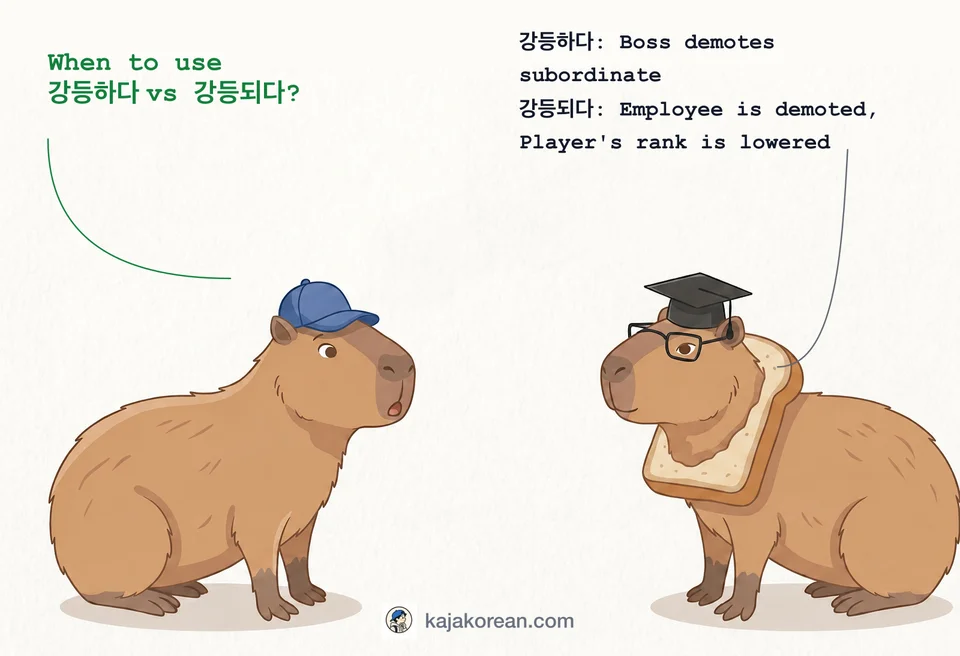
강등하다 vs 강등되다: Active vs Passive Nuances

강등하다 (gang-deung-ha-da, gangdeunghada) · 강등되다 (gang-deung-doe-da, gangdeungdoeda)

'강등하다' expresses the active act of demoting someone, while '강등되다' indicates being passively demoted.

Comparison of Korean verbs 강등하다 (active demote) and 강등되다 (passive demoted)

Word-by-word breakdown

One lane per word — no nested boxes, just the gist.

강등하다(gang-deung-ha-da, gangdeunghada)

To actively demote someone to a lower position or rank.

When to use

Boss demotes subordinate, Manager lowers employee rank, Active action expression

The nuance

Used when the subject actively performs the act of demotion; an active verb.

강등되다(gang-deung-doe-da, gangdeungdoeda)

To be demoted, indicating a passive state or situation where the subject is the receiver of demotion.

When to use

Employee is demoted, Player's rank is lowered, Passive state expression

The nuance

Used when the subject is the receiver of demotion, expressing a passive state.

Real-world examples

  • 사장은 직원을 강등했다.

    sa-jang-eun jik-won-eul gang-deung-haess-da., sa jang eun jik won eul gang deung haess da.

    The subject (boss) actively performed the action, so active verb '강등하다' is correct.

  • 사장은 직원이 강등되었다.

    sa-jang-eun jik-won-i gang-deung-doe-eoss-da., sa jang eun jik won i gang deung doe eoss da.

    The subject and verb's agent mismatch; correct would be '직원이 강등되었다'.

  • 그는 강등되었다.

    geu-neun gang-deung-doe-eoss-da., geu neun gang deung doe eoss da.

    The subject is the receiver of demotion, so passive '강등되다' is correct.

  • 그는 강등했다.

    geu-neun gang-deung-haess-da., geu neun gang deung haess da.

    The subject is not actively demoting anyone, so active '강등하다' is incorrect.

  • 회사는 문제 있는 직원을 강등했다.

    hoe-sa-neun mun-je iss-neun jik-won-eul gang-deung-haess-da., hoe sa neun mun je iss neun jik won eul gang deung haess da.

    The subject actively performs demotion, so '강등하다' is correct.

  • 문제 있는 직원이 강등되었다.

    mun-je iss-neun jik-won-i gang-deung-doe-eoss-da., mun je iss neun jik won i gang deung doe eoss da.

    The subject receives demotion, so passive '강등되다' is correct.

  • 회사는 강등되었다.

    hoe-sa-neun gang-deung-doe-eoss-da., hoe sa neun gang deung doe eoss da.

    Companies usually do not get demoted; passive form here is unnatural.

  • 직원은 상사에게 강등되었다.

    jik-won-eun sang-sa-e-ge gang-deung-doe-eoss-da., jik won eun sang sa e ge gang deung doe eoss da.

    Subject is passively demoted, so passive '강등되다' is correct.

Quick quiz

  1. Which word to use when actively demoting someone?

    누군가를 낮은 직위로 직접 내릴 때 어떤 단어를 써야 할까요?(nu-gun-ga-reulnaj-eunjik-wi-rojik-jeopnae-rilttaeeo-tteondan-eo-reulsseo-yahal-kka-yo?, nugungareulnajeunjikwirojikjeopnaerilttaeeotteondaneoreulsseoyahalkkayo?)
  2. Which word to use when you are passively demoted?

    자신이 수동적으로 낮은 직위로 내려졌을 때 어떤 단어를 써야 할까요?(ja-sin-isu-dong-jeok-eu-ronaj-eunjik-wi-ronae-ryeo-jyeoss-eulttaeeo-tteondan-eo-reulsseo-yahal-kka-yo?, jasinisudongjeokeuronajeunjikwironaeryeojyeosseulttaeeotteondaneoreulsseoyahalkkayo?)
  3. In 'The company ___ the employee', which word fits?

    ‘회사가 직원을 ___’ 문장에서 빈칸에 들어갈 알맞은 단어는?(‘hoe-sa-gajik-won-eul___’mun-jang-e-seobin-kan-edeul-eo-galal-maj-eundan-eo-neun?, ‘hoesagajikwoneul___’munjangeseobinkanedeuleogalalmajeundaneoneun?)

More comparisons to explore

View all word comparisons →