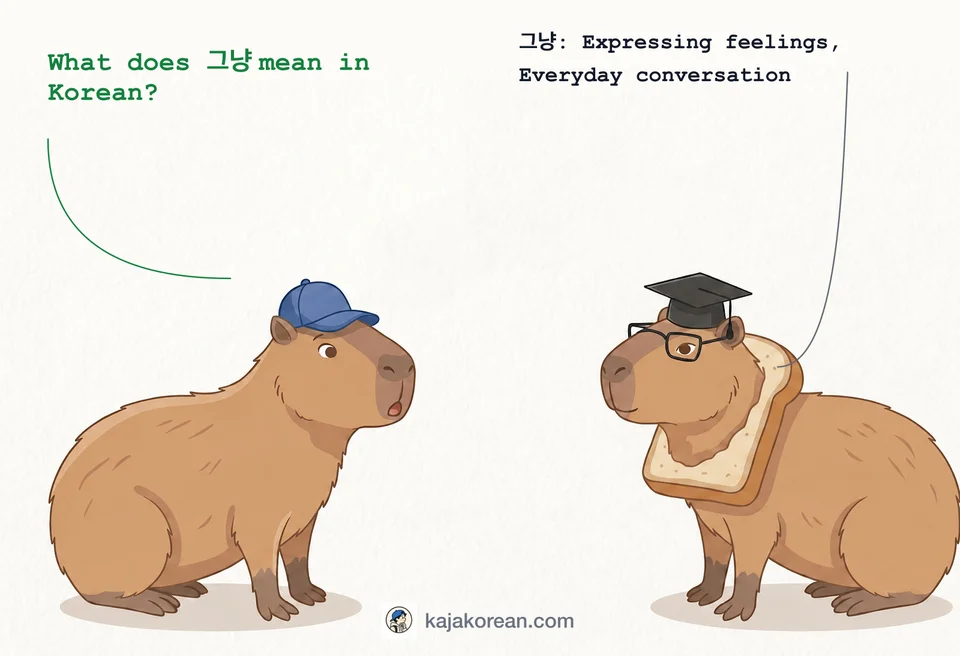
What does 그냥 mean?

그냥 (geu-nyang, geunyang)

'그냥' is a very common Korean adverb used to express actions or states without any special reason or purpose.

Korean word 그냥 meaning explanation

Definition & nuance

Core meaning and shades learners miss.

그냥(geu-nyang, geunyang)

'그냥' is an adverb used to indicate an action or state happening naturally or without any special reason or purpose.

Nuances

  • Indicates action without special reason
  • Sometimes implies 'without thinking' or 'as is'
  • Used as a casual or indifferent response to questions or expectations
  • Can carry both negative and positive nuances

When to use

Everyday conversation, Expressing feelings, Action without explanation

In context

'그냥' usually precedes verbs or adjectives to emphasize that the action or state occurs without special intention or plan. It is commonly used in spoken Korean and fits casual conversation better than formal contexts.

Real-world examples

  • 그냥 가고 싶었어요.

    geu-nyang ga-go sip-eoss-eo-yo., geu nyang ga go sip eoss eo yo.

    '그냥' is naturally used to mean 'without special reason'.

  • 그냥 아무것도 안 했어요.

    geu-nyang a-mu-geos-do an haess-eo-yo., geu nyang a mu geos do an haess eo yo.

    '그냥' emphasizes the lack of special purpose in the action.

  • 그냥 먹었어요, 맛있어서요.

    geu-nyang meok-eoss-eo-yo, mas-iss-eo-seo-yo., geu nyang meok eoss eo yo, mas iss eo seo yo.

    '그냥' indicates the action was done simply.

  • 그냥이 좋아요.

    geu-nyang-i joh-a-yo., geu nyang i joh a yo.

    '그냥' is an adverb and cannot stand alone as a subject or modify a noun directly.

  • 그냥 쉬어요.

    geu-nyang swi-eo-yo., geu nyang swi eo yo.

    '그냥' is naturally used in imperative sentences meaning 'just' or 'without special reason'.

  • 그냥 왜 그래?

    geu-nyang wae geu-rae?, geu nyang wae geu rae?

    '그냥' is used to ask about a state without reason.

Quick quiz

  1. What is the main meaning of '그냥'?

    '그냥'은 주로 어떤 의미로 쓰이나요?('geu-nyang'eunju-roeo-tteonui-mi-rosseu-i-na-yo?, 'geunyang'eunjuroeotteonuimirosseuinayo?)
  2. Which sentence is correct?

    다음 중 올바른 문장은?(da-eumjungol-ba-reunmun-jang-eun?, daeumjungolbareunmunjangeun?)
  3. Can '그냥' carry a negative nuance?

    '그냥'이 부정적인 뉘앙스를 가질 수 있나요?('geu-nyang'ibu-jeong-jeok-innwi-ang-seu-reulga-jilsuiss-na-yo?, 'geunyang'ibujeongjeokinnwiangseureulgajilsuissnayo?)

More meaning guides

View all meaning guides →