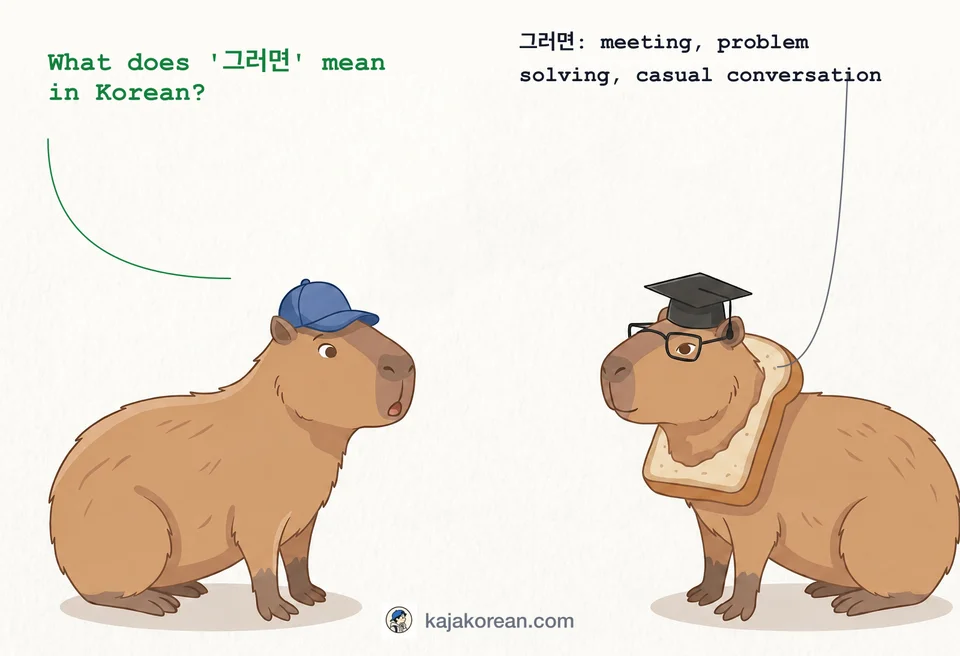
What does 그러면 mean?

그러면 (geu-reo-myeon, geureomyeon)

그러면 is a Korean expression used to indicate a result based on a condition or situation.

Korean word 그러면 meaning conditional result

Definition & nuance

Core meaning and shades learners miss.

그러면(geu-reo-myeon, geureomyeon)

'그러면' is an adverb similar to '그렇다면' that shows a result or next action based on a given condition or situation.

Nuances

  • connects result based on condition
  • used formally and informally
  • similar to '그렇다면' but more concise

When to use

casual conversation, meeting, problem solving

In context

'그러면' is usually placed at the beginning of a sentence to connect the result or next action based on the previous condition or situation. It is natural in both casual conversations and formal contexts.

Real-world examples

  • 그러면 내일 만나는 걸로 할게요.

    geu-reo-myeon nae-il man-na-neun geol-ro hal-ge-yo., geu reo myeon nae il man na neun geol ro hal ge yo.

    '그러면' naturally connects the next action based on the previous situation.

  • 비가 오면 그러면 우산을 가져가세요.

    bi-ga o-myeon geu-reo-myeon u-san-eul ga-jyeo-ga-se-yo., bi ga o myeon geu reo myeon u san eul ga jyeo ga se yo.

    Connects condition (if it rains) and result (take an umbrella) with '그러면'.

  • 그러면, 지금 출발해요.

    geu-reo-myeon, ji-geum chul-bal-hae-yo., geu reo myeon, ji geum chul bal hae yo.

    Expresses an immediate action suggestion based on the situation.

  • 그러면이 좋겠어요.

    geu-reo-myeon-i joh-gess-eo-yo., geu reo myeon i joh gess eo yo.

    '그러면' is an adverb and cannot be used as a noun, so this sentence is ungrammatical.

  • 그러면 어떻게 해야 할까요?

    geu-reo-myeon eo-tteoh-ge hae-ya hal-kka-yo?, geu reo myeon eo tteoh ge hae ya hal kka yo?

    Naturally connects the previous situation to a question about the next action.

  • 그러면 안 돼요.

    geu-reo-myeon an dwae-yo., geu reo myeon an dwae yo.

    Can also be used to express negative results or prohibitions.

Quick quiz

  1. Where is '그러면' usually placed in a sentence?

    '그러면'은 문장에서 주로 어디에 위치하나요?('geu-reo-myeon'eunmun-jang-e-seoju-roeo-di-ewi-chi-ha-na-yo?, 'geureomyeon'eunmunjangeseojuroeodiewichihanayo?)
  2. '그러면' is closest in meaning to which expression?

    '그러면'의 의미와 가장 가까운 표현은?('geu-reo-myeon'uiui-mi-waga-jangga-kka-unpyo-hyeon-eun?, 'geureomyeon'uiuimiwagajanggakkaunpyohyeoneun?)
  3. What is the role of '그러면' in this sentence? '비가 오면 그러면 우산을 가져가세요.'

    다음 문장에서 '그러면'의 역할은? '비가 오면 그러면 우산을 가져가세요.'(da-eummun-jang-e-seo'geu-reo-myeon'uiyeok-hal-eun?'bi-gao-myeongeu-reo-myeonu-san-eulga-jyeo-ga-se-yo.', daeummunjangeseo'geureomyeon'uiyeokhaleun?'bigaomyeongeureomyeonusaneulgajyeogaseyo.')

More meaning guides

View all meaning guides →