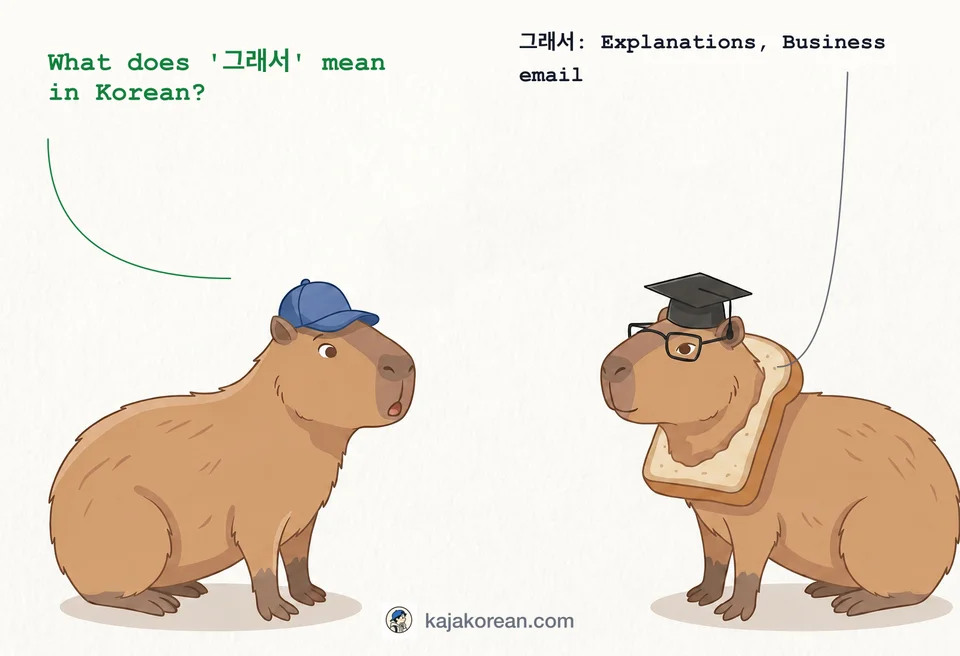
What does 그래서 mean?

그래서 (geu-rae-seo, geuraeseo)

'그래서' is a basic conjunction linking cause and effect, commonly used in daily and formal Korean.

Korean word 그래서 meaning cause and effect

Definition & nuance

Core meaning and shades learners miss.

그래서(geu-rae-seo, geuraeseo)

'그래서' is a conjunction used to connect a cause or reason from the previous sentence to the resulting situation or effect in the following sentence.

Nuances

  • Simple cause-and-effect link
  • Emphasizes speaker's logical flow
  • Friendly and natural connector
  • Used in both formal and informal contexts

When to use

Casual conversation, Business email, Explanations

In context

'그래서' naturally connects two sentences, typically placed between them. It is used in both spoken and written Korean to state a cause or reason first, then the resulting effect.

Real-world examples

  • 비가 많이 왔어요. 그래서 길이 막혔어요.

    bi-ga man-i wass-eo-yo. geu-rae-seo gil-i mak-hyeoss-eo-yo., bi ga man i wass eo yo. geu rae seo gil i mak hyeoss eo yo.

    Naturally connects cause (heavy rain) and effect (traffic jam).

  • 저는 배고파요. 그래서 밥 먹었어요.

    jeo-neun bae-go-pa-yo. geu-rae-seo bap meok-eoss-eo-yo., jeo neun bae go pa yo. geu rae seo bap meok eoss eo yo.

    Cause and effect are clearly connected.

  • 그래서, 저는 학교에 갔어요.

    geu-rae-seo, jeo-neun hak-gyo-e gass-eo-yo., geu rae seo, jeo neun hak gyo e gass eo yo.

    Comma creates a natural flow at the start.

  • 그래서 그는 집에 있었어요.

    geu-rae-seo geu-neun jip-e iss-eoss-eo-yo., geu rae seo geu neun jip e iss eoss eo yo.

    Serves to connect cause and effect.

  • 나는 피곤해. 그래서 잠을 잤어.

    na-neun pi-gon-hae. geu-rae-seo jam-eul jass-eo., na neun pi gon hae. geu rae seo jam eul jass eo.

    Connects two sentences as cause and effect naturally.

  • 그래서 왜 갔어요?

    geu-rae-seo wae gass-eo-yo?, geu rae seo wae gass eo yo?

    '그래서' connects cause and effect; using it before a question is unnatural.

Quick quiz

  1. What is the role of '그래서'?

    '그래서'는 어떤 역할을 하나요?('geu-rae-seo'neuneo-tteonyeok-hal-eulha-na-yo?, 'geuraeseo'neuneotteonyeokhaleulhanayo?)
  2. Which sentence uses '그래서' correctly?

    다음 문장에서 '그래서'가 올바르게 쓰인 문장은?(da-eummun-jang-e-seo'geu-rae-seo'gaol-ba-reu-gesseu-inmun-jang-eun?, daeummunjangeseo'geuraeseo'gaolbareugesseuinmunjangeun?)
  3. In which sentence is '그래서' mainly used?

    '그래서'는 어떤 문장에서 주로 쓰이나요?('geu-rae-seo'neuneo-tteonmun-jang-e-seoju-rosseu-i-na-yo?, 'geuraeseo'neuneotteonmunjangeseojurosseuinayo?)

More meaning guides

View all meaning guides →