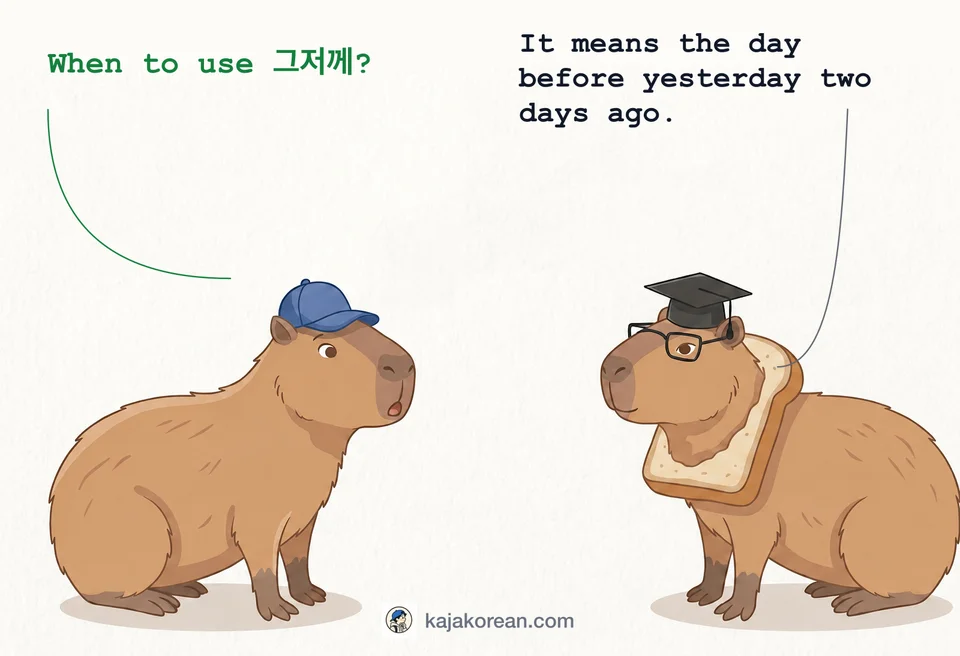
What does 그저께 mean?

그저께 (geu-jeo-kke, geujeokke)

그저께 (geujeokke) means 'the day before yesterday' in Korean. It's commonly used in everyday conversation to talk about past days.

Calendar showing the day before yesterday

Definition & nuance

Core meaning and shades learners miss.

그저께(geu-jeo-kke, geujeokke)

그저께 means 'the day before yesterday,' two days before today, used as an adverb.

Nuances

  • Specifically means two days before today.
  • Always used with past tense verbs.
  • More common in casual than formal speech.

When to use

Everyday conversation, Writing diaries, Describing past events

In context

그저께 is an adverb indicating time, typically used with past tense verbs. It fits naturally in both formal and informal contexts to specify when an action occurred.

Real-world examples

  • 그저께 친구를 만났어요.

    geu-jeo-kke chin-gu-reul man-nass-eo-yo., geu jeo kke chin gu reul man nass eo yo.

    그저께 correctly indicates two days ago and fits with the past tense verb 'met'.

  • 그저께는 날씨가 좋을 거예요.

    geu-jeo-kke-neun nal-ssi-ga joh-eul geo-ye-yo., geu jeo kke neun nal ssi ga joh eul geo ye yo.

    그저께 is a past time adverb and cannot be used with future tense verbs.

  • 그저께 저녁에 영화를 봤어요.

    geu-jeo-kke jeo-nyeok-e yeong-hwa-reul bwass-eo-yo., geu jeo kke jeo nyeok e yeong hwa reul bwass eo yo.

    The time adverb '그저께' pairs naturally with the past tense verb 'watched'.

  • 그저께 내일 시험이 있어요.

    geu-jeo-kke nae-il si-heom-i iss-eo-yo., geu jeo kke nae il si heom i iss eo yo.

    '그저께' indicates past, but '내일' refers to future, so they conflict.

Quick quiz

  1. When does '그저께' refer to?

    '그저께'는 언제를 의미하나요?('geu-jeo-kke'neuneon-je-reului-mi-ha-na-yo?, 'geujeokke'neuneonjereuluimihanayo?)
  2. Which tense should '그저께' be used with?

    어떤 시제와 함께 쓰여야 하나요?(eo-tteonsi-je-waham-kkesseu-yeo-yaha-na-yo?, eotteonsijewahamkkesseuyeoyahanayo?)
  3. Which sentence is correct?

    다음 문장 중 올바른 문장은?(da-eummun-jangjungol-ba-reunmun-jang-eun?, daeummunjangjungolbareunmunjangeun?)

More meaning guides

View all meaning guides →