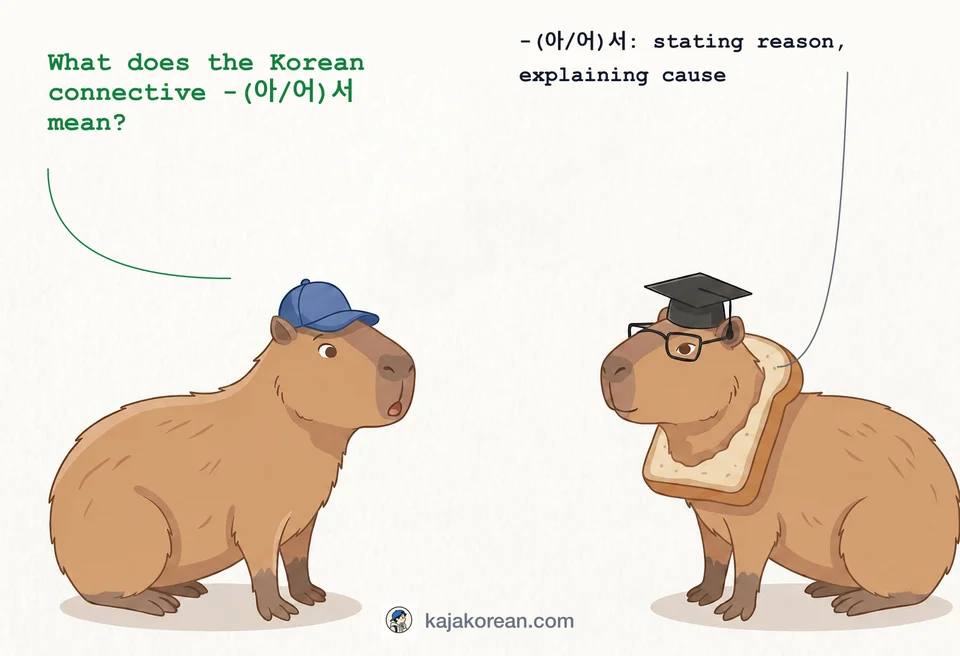
How to use 아서/어서 in Korean

Pattern: -(아/어)서

-(아/어)서 (-(a, (a, eo)seo)

-(아/어)서 is a Korean connective ending used to express cause, reason, or sequence. It's common in daily speech and writing.

Korean grammar connective -(아/어)서 usage

Usage guide

When and how native speakers actually use it.

-(아/어)서(-(a, (a, eo)seo)

A connective ending indicating cause, reason, result, or sequence

When to use

explaining cause, stating reason, expressing action sequence, connecting result

The nuance

Attach '-아/어서' to the verb or adjective stem to indicate cause, reason, or sequence. Use '-아서' after stems ending with no final consonant or vowels 'ㅏ, ㅗ'; use '-어서' otherwise. The preceding clause shows cause or reason, and the following clause shows result or action. It is also used to express temporal sequence.

Real-world examples

  • 비가 와서 길이 미끄러워요.

    bi-ga wa-seo gil-i mi-kkeu-reo-wo-yo., bi ga wa seo gil i mi kkeu reo wo yo.

    The first clause shows cause, the second describes result.

  • 친구를 만나서 영화를 봤어요.

    chin-gu-reul man-na-seo yeong-hwa-reul bwass-eo-yo., chin gu reul man na seo yeong hwa reul bwass eo yo.

    Expresses sequence: one action after another.

  • 배가 고파서 밥을 먹었어요.

    bae-ga go-pa-seo bap-eul meok-eoss-eo-yo., bae ga go pa seo bap eul meok eoss eo yo.

    Properly connects cause and effect.

  • 책을 읽어서 공부했어요.

    chaek-eul ik-eo-seo gong-bu-haess-eo-yo., chaek eul ik eo seo gong bu haess eo yo.

    Can indicate cause or method.

  • 학교에 가서 공부했어요.

    hak-gyo-e ga-seo gong-bu-haess-eo-yo., hak gyo e ga seo gong bu haess eo yo.

    Natural sequential connection.

  • 피곤해서 일찍 잤어요.

    pi-gon-hae-seo il-jjik jass-eo-yo., pi gon hae seo il jjik jass eo yo.

    Correct use after adjective stem to explain cause.

  • 영화를 봐서 친구를 만났어요.

    yeong-hwa-reul bwa-seo chin-gu-reul man-nass-eo-yo., yeong hwa reul bwa seo chin gu reul man nass eo yo.

    Illogical cause-effect relationship.

  • 밥을 먹고서 학교에 갔어요.

    bap-eul meok-go-seo hak-gyo-e gass-eo-yo., bap eul meok go seo hak gyo e gass eo yo.

    '-아서/어서' is unnatural for this sequence; '-고서' is correct.

Quick quiz

  1. Which sentence correctly uses '-아서/어서'?

    다음 중 '-아서/어서'를 올바르게 사용한 문장은?(da-eumjung'-a-seo, daeumjung'aseo, eo-seo'reulol-ba-reu-gesa-yong-hanmun-jang-eun?, eoseo'reulolbareugesayonghanmunjangeun?)
  2. Which is NOT a use of '-아서/어서'?

    '-아서/어서'의 용도가 아닌 것은?('-a-seo, 'aseo, eo-seo'uiyong-do-gaa-ningeos-eun?, eoseo'uiyongdogaaningeoseun?)
  3. Which rule is correct for attaching '-아서/어서'?

    다음 중 '-아서/어서'를 붙일 때 맞는 규칙은?(da-eumjung'-a-seo, daeumjung'aseo, eo-seo'reulbut-ilttaemaj-neungyu-chik-eun?, eoseo'reulbutilttaemajneungyuchikeun?)

More usage guides

View all usage guides →