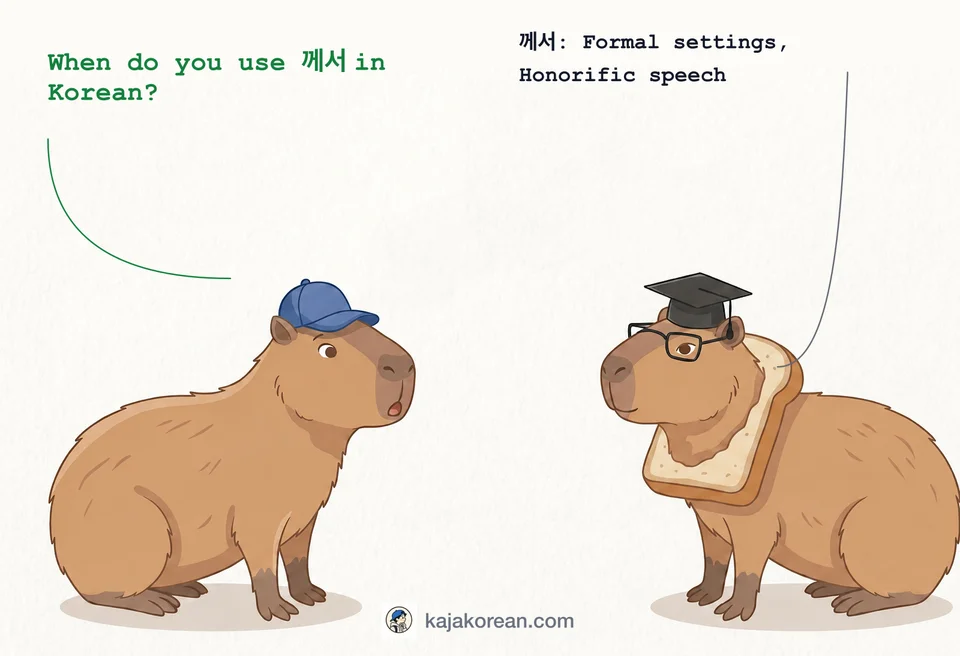
How to use 께서 in Korean

께서 (kke-seo, kkeseo)

께서 is an honorific subject particle in Korean used to show respect.

Example of Korean honorific subject particle 께서

Usage guide

When and how native speakers actually use it.

께서(kke-seo, kkeseo)

An honorific subject particle used to show respect to the subject.

When to use

Honorific speech, Formal settings, Talking to elders

The nuance

Use 께서 to honor the subject, usually attached to a person's name or title, replacing the regular subject particles '이/가'. Example: 아버지께서 (father + 께서), 선생님께서 (teacher + 께서).

Real-world examples

  • 아버지께서 집에 계세요.

    a-beo-ji-kke-seo jip-e gye-se-yo., a beo ji kke seo jip e gye se yo.

    '께서' appropriately honors the subject 'father'.

  • 선생님께서 말씀하셨어요.

    seon-saeng-nim-kke-seo mal-sseum-ha-syeoss-eo-yo., seon saeng nim kke seo mal sseum ha syeoss eo yo.

    '께서' correctly honors the teacher as the subject.

  • 할아버지가 시장에 가셨어요.

    hal-a-beo-ji-ga si-jang-e ga-syeoss-eo-yo., hal a beo ji ga si jang e ga syeoss eo yo.

    '가' is informal; use '께서' to honor grandfather.

  • 어머니가 요리하세요.

    eo-meo-ni-ga yo-ri-ha-se-yo., eo meo ni ga yo ri ha se yo.

    '가' is informal; '께서' is needed to show respect.

  • 사장님께서 회의에 참석하셨습니다.

    sa-jang-nim-kke-seo hoe-ui-e cham-seok-ha-syeoss-seup-ni-da., sa jang nim kke seo hoe ui e cham seok ha syeoss seup ni da.

    Formal and respectful use of '께서' for the boss.

  • 친구께서 도와줬어요.

    chin-gu-kke-seo do-wa-jwoss-eo-yo., chin gu kke seo do wa jwoss eo yo.

    '께서' is for honorifics; not used for casual friends.

Quick quiz

  1. What kind of particle is '께서'?

    '께서'는 어떤 조사인가요?('kke-seo'neuneo-tteonjo-sa-in-ga-yo?, 'kkeseo'neuneotteonjosaingayo?)
  2. Which is the honorific expression? '어머니께서' or '어머니가'?

    '어머니께서'와 '어머니가' 중 존댓말 표현은?('eo-meo-ni-kke-seo'wa'eo-meo-ni-ga'jungjon-daes-malpyo-hyeon-eun?, 'eomeonikkeseo'wa'eomeoniga'jungjondaesmalpyohyeoneun?)
  3. When should you use '께서'?

    다음 중 '께서'를 써야 하는 경우는?(da-eumjung'kke-seo'reulsseo-yaha-neungyeong-u-neun?, daeumjung'kkeseo'reulsseoyahaneungyeonguneun?)

More usage guides

View all usage guides →