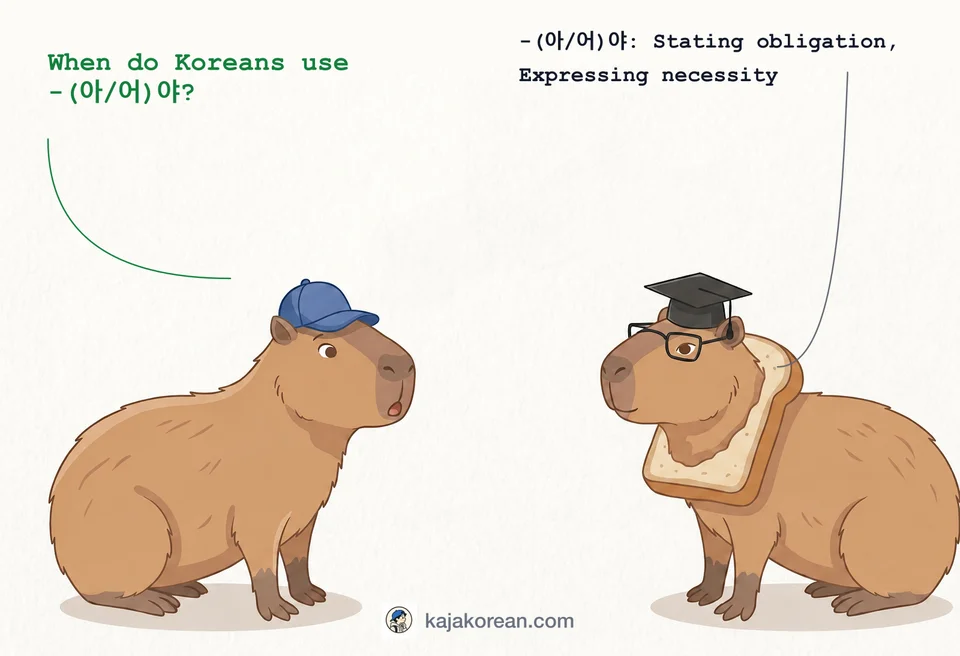
How to use 아야/어야 in Korean

Pattern: -(아/어)야

-(아/어)야 (-(a, (a, eo)ya)

-(아/어)야 expresses necessity or obligation in Korean. It's common in daily and formal speech.

Korean grammar pattern -(아/어)야 explained

Usage guide

When and how native speakers actually use it.

-(아/어)야(-(a, (a, eo)ya)

Expresses necessity or obligation to do something

When to use

Expressing necessity, Stating obligation, Giving advice or recommendations

The nuance

Attach '-아야' or '-어야' to the verb stem depending on the vowel harmony rules: use '-아야' if the last vowel is ㅏ or ㅗ, otherwise '-어야'. It expresses that an action must or should be done.

Real-world examples

  • 공부해야 시험에 합격할 수 있어.

    gong-bu-hae-ya si-heom-e hap-gyeok-hal su iss-eo., gong bu hae ya si heom e hap gyeok hal su iss eo.

    '-해야' attaches to '공부하다' to clearly express obligation.

  • 일찍 자야 내일 피곤하지 않아.

    il-jjik ja-ya nae-il pi-gon-ha-ji an-a., il jjik ja ya nae il pi gon ha ji an a.

    '-자야' attaches to '자다' to express condition and necessity.

  • 음식을 먹어야 건강하다.

    eum-sik-eul meok-eo-ya geon-gang-ha-da., eum sik eul meok eo ya geon gang ha da.

    '-어야' attaches to '먹다' expressing a condition for health.

  • 내일 회의에 참석해야 해요.

    nae-il hoe-ui-e cham-seok-hae-ya hae-yo., nae il hoe ui e cham seok hae ya hae yo.

    '-해야' attaches to '참석하다' to indicate obligation.

  • 운동해야 몸이 좋아져요.

    un-dong-hae-ya mom-i joh-a-jyeo-yo., un dong hae ya mom i joh a jyeo yo.

    '-해야' attaches to '운동하다' to express necessity.

  • 책을 읽어야 지식이 늘어요.

    chaek-eul ik-eo-ya ji-sik-i neul-eo-yo., chaek eul ik eo ya ji sik i neul eo yo.

    '-어야' attaches to '읽다' to show an essential condition.

  • 시험 준비 안 해야 돼요.

    si-heom jun-bi an hae-ya dwae-yo., si heom jun bi an hae ya dwae yo.

    Negative obligation requires '-지 말아야 해요', so this is incorrect.

  • 밥 먹어야야 해요.

    bap meok-eo-ya-ya hae-yo., bap meok eo ya ya hae yo.

    '-어야야' is a redundant form and incorrect.

Quick quiz

  1. Which sentence correctly uses -(아/어)야?

    다음 중 -(아/어)야를 올바르게 사용한 문장은?(da-eumjung-(a, daeumjung(a, eo)ya-reulol-ba-reu-gesa-yong-hanmun-jang-eun?, eo)yareulolbareugesayonghanmunjangeun?)
  2. Find the mistake in: '내일 일찍 일어나야야 해요.'

    다음 문장에서 틀린 부분은? '내일 일찍 일어나야야 해요.'(da-eummun-jang-e-seoteul-rinbu-bun-eun?'nae-ilil-jjikil-eo-na-ya-yahae-yo.', daeummunjangeseoteulrinbubuneun?'naeililjjikileonayayahaeyo.')
  3. What meaning does -(아/어)야 express?

    -(아/어)야는 어떤 의미를 나타내나요?(-(a, (a, eo)ya-neuneo-tteonui-mi-reulna-ta-nae-na-yo?, eo)yaneuneotteonuimireulnatanaenayo?)

More usage guides

View all usage guides →