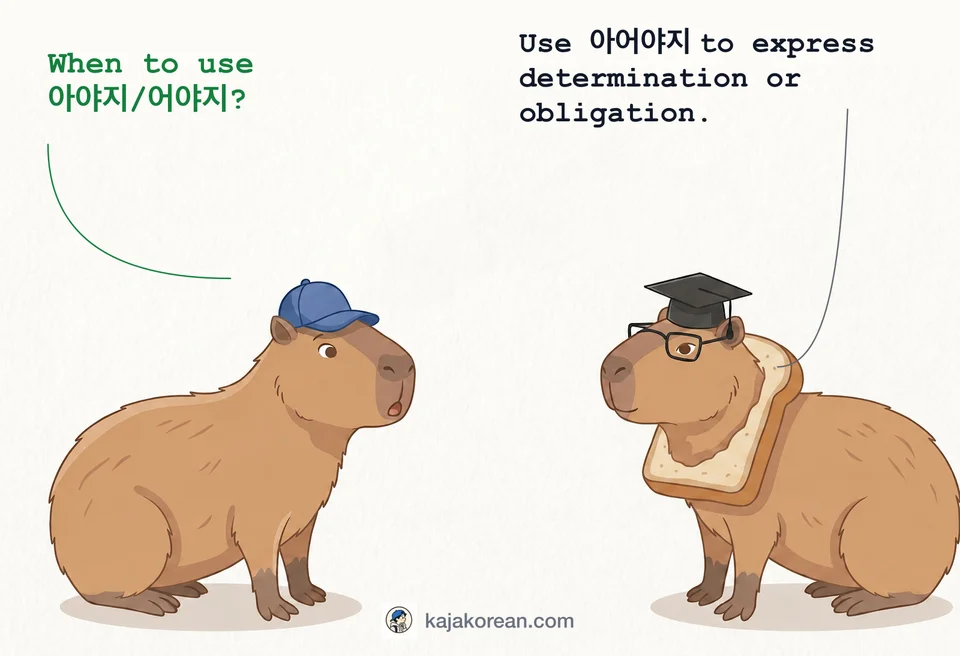
How to use 아야지/어야지 in Korean

Pattern: -(아/어)야지

-(아/어)야지 (-(a, (a, eo)ya-ji, eo)yaji)

-(아/어)야지 shows determination or obligation to do something.

Korean grammar 아어야지 usage explanation

Usage guide

When and how native speakers actually use it.

-(아/어)야지(-(a, (a, eo)ya-ji, eo)yaji)

A sentence ending expressing obligation or determination

When to use

self-determination, making plans, expressing will

The nuance

Attach '-아야지' or '-어야지' to the verb stem depending on vowel harmony. It expresses personal determination or obligation, not past or imperative moods. For example, '공부하다' becomes '공부해야지'. It is rarely used in negative forms.

Real-world examples

  • 내일부터 꼭 운동해야지.

    nae-il-bu-teo kkok un-dong-hae-ya-ji., nae il bu teo kkok un dong hae ya ji.

    Correct use expressing personal determination.

  • 오늘은 일찍 자야지.

    o-neul-eun il-jjik ja-ya-ji., o neul eun il jjik ja ya ji.

    Natural expression of obligation.

  • 내일은 비가 와야지.

    nae-il-eun bi-ga wa-ya-ji., nae il eun bi ga wa ya ji.

    아어야지 is for personal will, not for natural phenomena.

  • 밥을 먹어야지!

    bap-eul meok-eo-ya-ji!, bap eul meok eo ya ji!

    Simple and natural expression of will.

  • 숙제를 안 해야지.

    suk-je-reul an hae-ya-ji., suk je reul an hae ya ji.

    Negative form requires '-지 말아야지', '안 해야지' is awkward.

  • 더 열심히 공부해야지.

    deo yeol-sim-hi gong-bu-hae-ya-ji., deo yeol sim hi gong bu hae ya ji.

    Well expresses determination.

Quick quiz

  1. Which sentence correctly uses '-아/어야지'?

    다음 중 '-아/어야지'를 올바르게 사용한 문장은?(da-eumjung'-a, daeumjung'a, eo-ya-ji'reulol-ba-reu-gesa-yong-hanmun-jang-eun?, eoyaji'reulolbareugesayonghanmunjangeun?)
  2. Which is NOT a meaning of '-아/어야지'?

    '-아/어야지'의 의미가 아닌 것은?('-a, 'a, eo-ya-ji'uiui-mi-gaa-ningeos-eun?, eoyaji'uiuimigaaningeoseun?)
  3. How to correctly form the negative of '-아/어야지'? (e.g., 해야지)

    '-아/어야지'를 부정형으로 올바르게 바꾸면? (예: 해야지)('-a, 'a, eo-ya-ji'reulbu-jeong-hyeong-eu-rool-ba-reu-geba-kku-myeon?(ye:hae-ya-ji), eoyaji'reulbujeonghyeongeuroolbareugebakkumyeon?(ye:haeyaji))

More usage guides

View all usage guides →