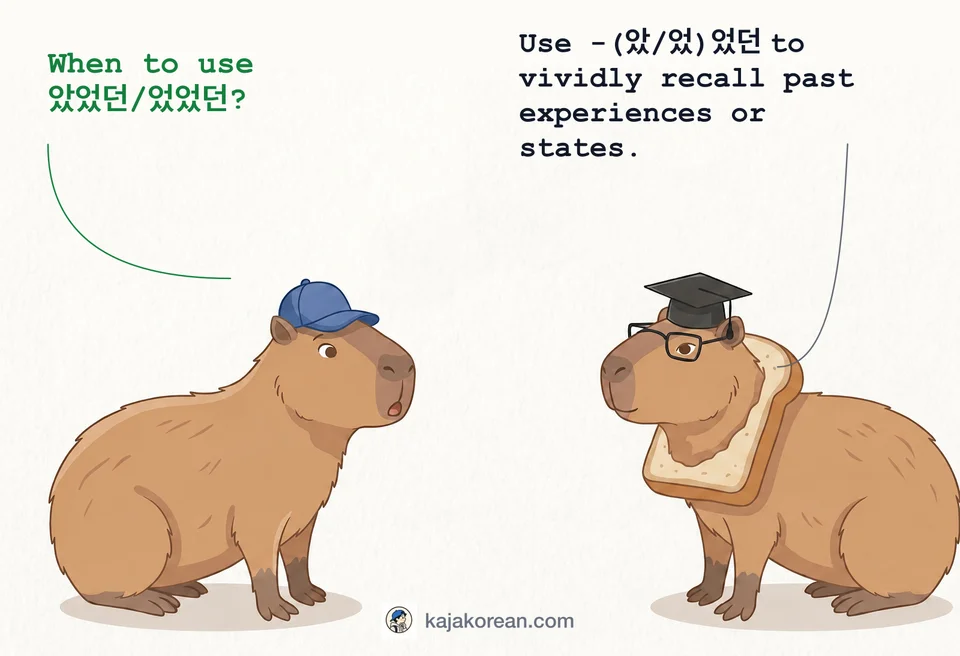
How to use 았었던/었었던 in Korean

Pattern: -(았/었)었던

-(았/었)었던 (-(ass, (ass, eoss)eoss-deon, eoss)eossdeon)

-(았/었)었던 emphasizes past experiences or states in Korean. Use it to recall specific moments or repeated past events naturally.

Explanation of Korean -(았/었)었던 usage

Usage guide

When and how native speakers actually use it.

-(았/었)었던(-(ass, (ass, eoss)eoss-deon, eoss)eossdeon)

Expresses experiences or states that happened in the past.

When to use

Recalling past experiences, Describing repeated past situations, Emphasizing states that have ended

The nuance

Attach -(았/었)었던 to verb stems to emphasize past experiences or states. It conveys a more vivid or reflective memory than simple past tense. For example, '가다' becomes '갔었던'. It's suitable for talking about repeated experiences or states that have ended.

Real-world examples

  • 어렸을 때 살았었던 집이 아직 기억나요.

    eo-ryeoss-eul ttae sal-ass-eoss-deon jip-i a-jik gi-eok-na-yo., eo ryeoss eul ttae sal ass eoss deon jip i a jik gi eok na yo.

    Appropriate for vividly recalling the experience of living in a house in the past.

  • 지난주에 갔었던 식당은 정말 맛있었어요.

    ji-nan-ju-e gass-eoss-deon sik-dang-eun jeong-mal mas-iss-eoss-eo-yo., ji nan ju e gass eoss deon sik dang eun jeong mal mas iss eoss eo yo.

    Emphasizes the experience of visiting a place at a specific past time.

  • 그 사람이 했었던 말이 기억나지 않아요.

    geu sa-ram-i haess-eoss-deon mal-i gi-eok-na-ji an-a-yo., geu sa ram i haess eoss deon mal i gi eok na ji an a yo.

    Used when recalling what someone said in the past.

  • 어제 먹었었던 음식이 맛있었어요.

    eo-je meok-eoss-eoss-deon eum-sik-i mas-iss-eoss-eo-yo., eo je meok eoss eoss deon eum sik i mas iss eoss eo yo.

    Suitable for emphasizing the experience of eating something in the past.

  • 어렸을 때 갔었던 곳을 다시 가고 싶어요.

    eo-ryeoss-eul ttae gass-eoss-deon gos-eul da-si ga-go sip-eo-yo., eo ryeoss eul ttae gass eoss deon gos eul da si ga go sip eo yo.

    Natural when recalling a place visited in the past.

  • 나는 어제 갔었던.

    na-neun eo-je gass-eoss-deon., na neun eo je gass eoss deon.

    Incomplete sentence; -(았/었)었던 cannot be used alone without a noun or complement.

  • 그가 먹었었던 사과는 맛있다.

    geu-ga meok-eoss-eoss-deon sa-gwa-neun mas-iss-da., geu ga meok eoss eoss deon sa gwa neun mas iss da.

    Incorrect because the apple was already eaten; cannot describe current taste.

Quick quiz

  1. Which sentence uses -(았/었)었던 correctly?

    다음 중 -(았/었)었던이 올바르게 쓰인 문장은?(da-eumjung-(ass, daeumjung(ass, eoss)eoss-deon-iol-ba-reu-gesseu-inmun-jang-eun?, eoss)eossdeoniolbareugesseuinmunjangeun?)
  2. What does -(았/었)었던 mainly emphasize?

    -(았/었)었던을 사용할 때 주로 어떤 의미를 강조하나요?(-(ass, (ass, eoss)eoss-deon-eulsa-yong-halttaeju-roeo-tteonui-mi-reulgang-jo-ha-na-yo?, eoss)eossdeoneulsayonghalttaejuroeotteonuimireulgangjohanayo?)

More usage guides

View all usage guides →