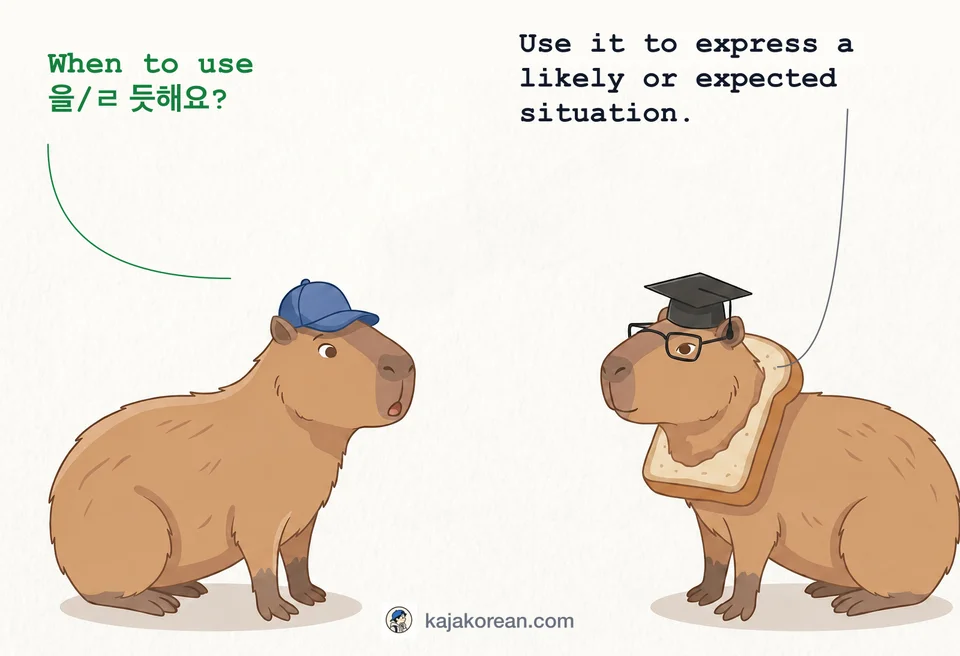
How to use 을/ㄹ 듯해요 in Korean

Pattern: -(으)ㄹ 듯해요

-(으)ㄹ 듯해요 (-(eu)ㄹdeus-hae-yo, (eu)ㄹdeushaeyo)

-(으)ㄹ 듯해요 expresses a strong likelihood or appearance that something will happen.

Example of Korean grammar -(으)ㄹ 듯해요 usage

Usage guide

When and how native speakers actually use it.

-(으)ㄹ 듯해요(-(eu)ㄹdeus-hae-yo, (eu)ㄹdeushaeyo)

An expression to guess or expect that something will likely happen

When to use

future prediction, situation guess, uncertain information

The nuance

Attach '-(으)ㄹ 듯해요' to the verb or adjective stem to express a guess or expectation about the future or current situation. Use '-을 듯해요' if the stem ends with a consonant, '-ㄹ 듯해요' if it ends with a vowel.

Real-world examples

  • 비가 올 듯해요.

    bi-ga ol deus-hae-yo., bi ga ol deus hae yo.

    The verb stem ends with a vowel, so '-ㄹ 듯해요' is correct.

  • 그 사람이 올 듯해요.

    geu sa-ram-i ol deus-hae-yo., geu sa ram i ol deus hae yo.

    The verb stem ends with a vowel, so '-ㄹ 듯해요' is correct.

  • 오늘은 눈이 올 듯해요.

    o-neul-eun nun-i ol deus-hae-yo., o neul eun nun i ol deus hae yo.

    The verb stem ends with a vowel, so '-ㄹ 듯해요' is correct.

  • 그는 피곤할 듯해요.

    geu-neun pi-gon-hal deus-hae-yo., geu neun pi gon hal deus hae yo.

    Attach '-ㄹ 듯해요' to the adjective stem to express a guess about condition.

  • 내일 회의가 취소될 듯해요.

    nae-il hoe-ui-ga chwi-so-doel deus-hae-yo., nae il hoe ui ga chwi so doel deus hae yo.

    The verb stem ends with a vowel, so '-ㄹ 듯해요' is correct.

  • 그 영화는 재미있을 듯해요.

    geu yeong-hwa-neun jae-mi-iss-eul deus-hae-yo., geu yeong hwa neun jae mi iss eul deus hae yo.

    The adjective stem ends with a consonant, so '-을 듯해요' is correct.

  • 그가 늦을 듯해요.

    geu-ga neuj-eul deus-hae-yo., geu ga neuj eul deus hae yo.

    The verb stem ends with a consonant, so '-을 듯해요' is correct.

  • 비가 오을 듯해요.

    bi-ga o-eul deus-hae-yo., bi ga o eul deus hae yo.

    The verb stem ends with a vowel, so '-을 듯해요' is incorrect here.

Quick quiz

  1. Choose the correct form: "내일 날씨가 ___ 듯해요."

    다음 문장에서 올바른 표현은? "내일 날씨가 ___ 듯해요."(da-eummun-jang-e-seool-ba-reunpyo-hyeon-eun?"nae-ilnal-ssi-ga___deus-hae-yo.", daeummunjangeseoolbareunpyohyeoneun?"naeilnalssiga___deushaeyo.")
  2. Which sentence is incorrect?

    다음 중 틀린 문장은?(da-eumjungteul-rinmun-jang-eun?, daeumjungteulrinmunjangeun?)
  3. Fill in the blank: "그 영화는 재미있___ 듯해요."

    다음 문장에서 빈칸에 들어갈 알맞은 표현은? "그 영화는 재미있___ 듯해요."(da-eummun-jang-e-seobin-kan-edeul-eo-galal-maj-eunpyo-hyeon-eun?"geuyeong-hwa-neunjae-mi-iss___deus-hae-yo.", daeummunjangeseobinkanedeuleogalalmajeunpyohyeoneun?"geuyeonghwaneunjaemiiss___deushaeyo.")

More usage guides

View all usage guides →