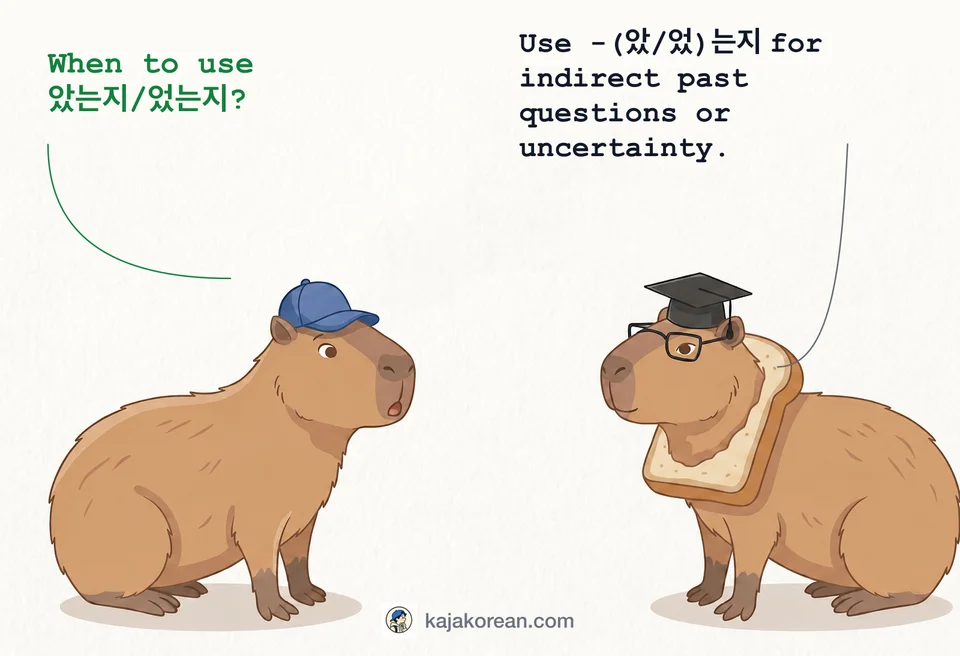
How to use 았는지/었는지 in Korean

Pattern: -(았/었)는지

-(았/었)는지 (-(ass, (ass, eoss)neun-ji, eoss)neunji)

-(았/었)는지 expresses indirect questions or uncertainty about past situations or facts.

Explanation of Korean grammar -(았/었는지

Usage guide

When and how native speakers actually use it.

-(았/었)는지(-(ass, (ass, eoss)neun-ji, eoss)neunji)

Indicates doubt or curiosity about something that happened or was true in the past.

When to use

Indirect questions, Guessing past facts, Unclear memory

The nuance

Attach -(았/었)는지 to the past stem of verbs or adjectives. It's mainly used for indirect questions, guesses, or when memory is unclear. Example: 'I don't know where he went.'

Real-world examples

  • 그가 왜 그렇게 했는지 모르겠어요.

    geu-ga wae geu-reoh-ge haess-neun-ji mo-reu-gess-eo-yo., geu ga wae geu reoh ge haess neun ji mo reu gess eo yo.

    Correct because it expresses an indirect question about a past action.

  • 그 사람이 어디에 갔는지 알려 주세요.

    geu sa-ram-i eo-di-e gass-neun-ji al-ryeo ju-se-yo., geu sa ram i eo di e gass neun ji al ryeo ju se yo.

    Correct as it is an indirect question about a past place.

  • 내가 그 말을 했는지 몰라요.

    nae-ga geu mal-eul haess-neun-ji mol-ra-yo., nae ga geu mal eul haess neun ji mol ra yo.

    Correct because it expresses uncertainty about one's past action.

  • 그가 왜 그렇게 했는지 모르겠어요.

    geu-ga wae geu-reoh-ge haess-neun-ji mo-reu-gess-eo-yo., geu ga wae geu reoh ge haess neun ji mo reu gess eo yo.

    -(았/었)는지 attaches to past action to form indirect question.

  • 내일 비가 올는지 궁금해요.

    nae-il bi-ga ol-neun-ji gung-geum-hae-yo., nae il bi ga ol neun ji gung geum hae yo.

    -(았/었)는지 cannot be used for future tense.

  • 그가 지금 어디에 있는지 몰라요.

    geu-ga ji-geum eo-di-e iss-neun-ji mol-ra-yo., geu ga ji geum eo di e iss neun ji mol ra yo.

    For present tense, use -(는지, not -(았/었)는지.

Quick quiz

  1. Which expression do you use to indirectly ask about past facts?

    과거 사실에 대해 간접적으로 묻고 싶을 때 어떤 표현을 쓰나요?(gwa-geosa-sil-edae-haegan-jeop-jeok-eu-romut-gosip-eulttaeeo-tteonpyo-hyeon-eulsseu-na-yo?, gwageosasiledaehaeganjeopjeokeuromutgosipeulttaeeotteonpyohyeoneulsseunayo?)
  2. Which sentence is incorrect?

    다음 문장 중 틀린 문장은?(da-eummun-jangjungteul-rinmun-jang-eun?, daeummunjangjungteulrinmunjangeun?)
  3. What is the role of -(았/었)는지 in the sentence "I don't know why he did that"?

    "그가 왜 그렇게 했는지 모르겠어요." 문장에서 -(았/었)는지의 역할은?("geu-gawaegeu-reoh-gehaess-neun-jimo-reu-gess-eo-yo."mun-jang-e-seo-(ass, "geugawaegeureohgehaessneunjimoreugesseoyo."munjangeseo(ass, eoss)neun-ji-uiyeok-hal-eun?, eoss)neunjiuiyeokhaleun?)

More usage guides

View all usage guides →