
topik upgrade · topik, upgrade, emotion
Emotions (formal): TOPIK I → II in Korean
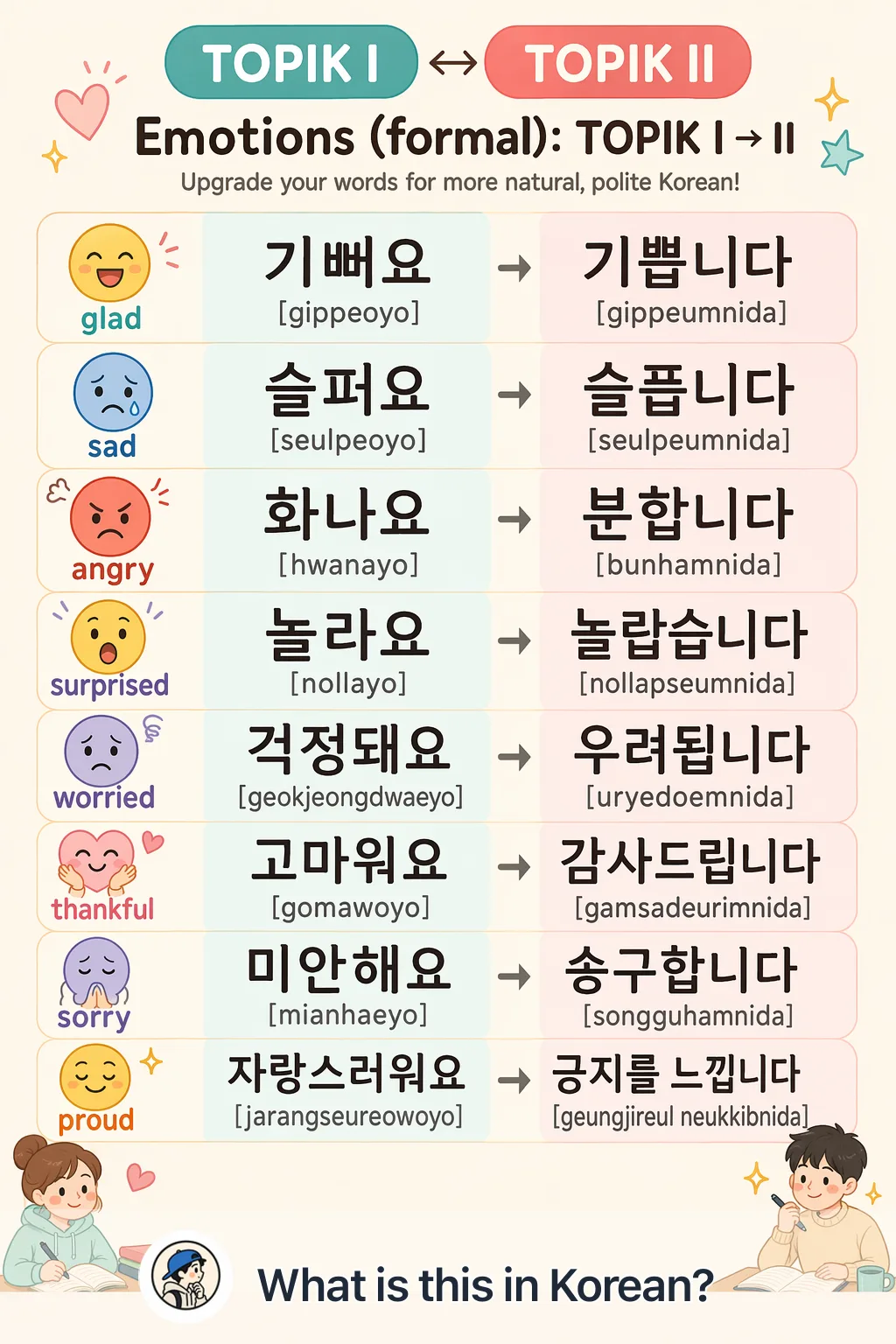
Want to sound more formal in Korean? Upgrade your emotions from TOPIK I to II like this: 🔴 기뻐요 [gippeoyo] - glad
How these words work together
This chart shows formal and informal ways to express emotions in Korean, focusing on vocabulary used in TOPIK I and TOPIK II levels. TOPIK I words are more casual and commonly used in everyday conversations, while TOPIK II words are formal and polite, suitable for official or respectful situations. Learning both forms helps you upgrade your Korean skills and communicate appropriately depending on the context.
Words in this chart
| Korean | Romanization | English |
|---|---|---|
| 기뻐요 | gippeoyo | glad (TOPIK I) |
| 기쁩니다 | gippeumnida | glad (TOPIK II) |
| 슬퍼요 | seulpeoyo | sad (TOPIK I) |
| 슬픕니다 | seulpeumnida | sad (TOPIK II) |
| 화나요 | hwanayo | angry (TOPIK I) |
| 분합니다 | bunhamnida | angry (TOPIK II) |
| 놀라요 | nollayo | surprised (TOPIK I) |
| 놀랍습니다 | nollapseumnida | surprised (TOPIK II) |
| 걱정돼요 | geokjeongdwaeyo | worried (TOPIK I) |
| 우려됩니다 | uryedoemnida | worried (TOPIK II) |
| 고마워요 | gomawoyo | thankful (TOPIK I) |
| 감사드립니다 | gamsadeurimnida | thankful (TOPIK II) |
| 미안해요 | mianhaeyo | sorry (TOPIK I) |
| 송구합니다 | songguhamnida | sorry (TOPIK II) |
| 자랑스러워요 | jarangseureowoyo | proud (TOPIK I) |
| 긍지를 느낍니다 | geungjireul neukkibnida | proud (TOPIK II) |
Example sentences
시험에 합격해서 정말 기뻐요.
I am really glad that I passed the exam.
회의에서 좋은 결과가 나와서 기쁩니다.
I am glad that we got good results in the meeting.
친구가 도와줘서 고마워요.
Thank you for helping me, friend.
Practice these words in context? Open the vocab quiz · Browse how-to-say word guides.