
topik upgrade · topik, upgrade, news
News verbs: TOPIK I → II in Korean
Upgrade your news verbs from TOPIK I to II 👇 🔴 생기다 [saenggida] - happen
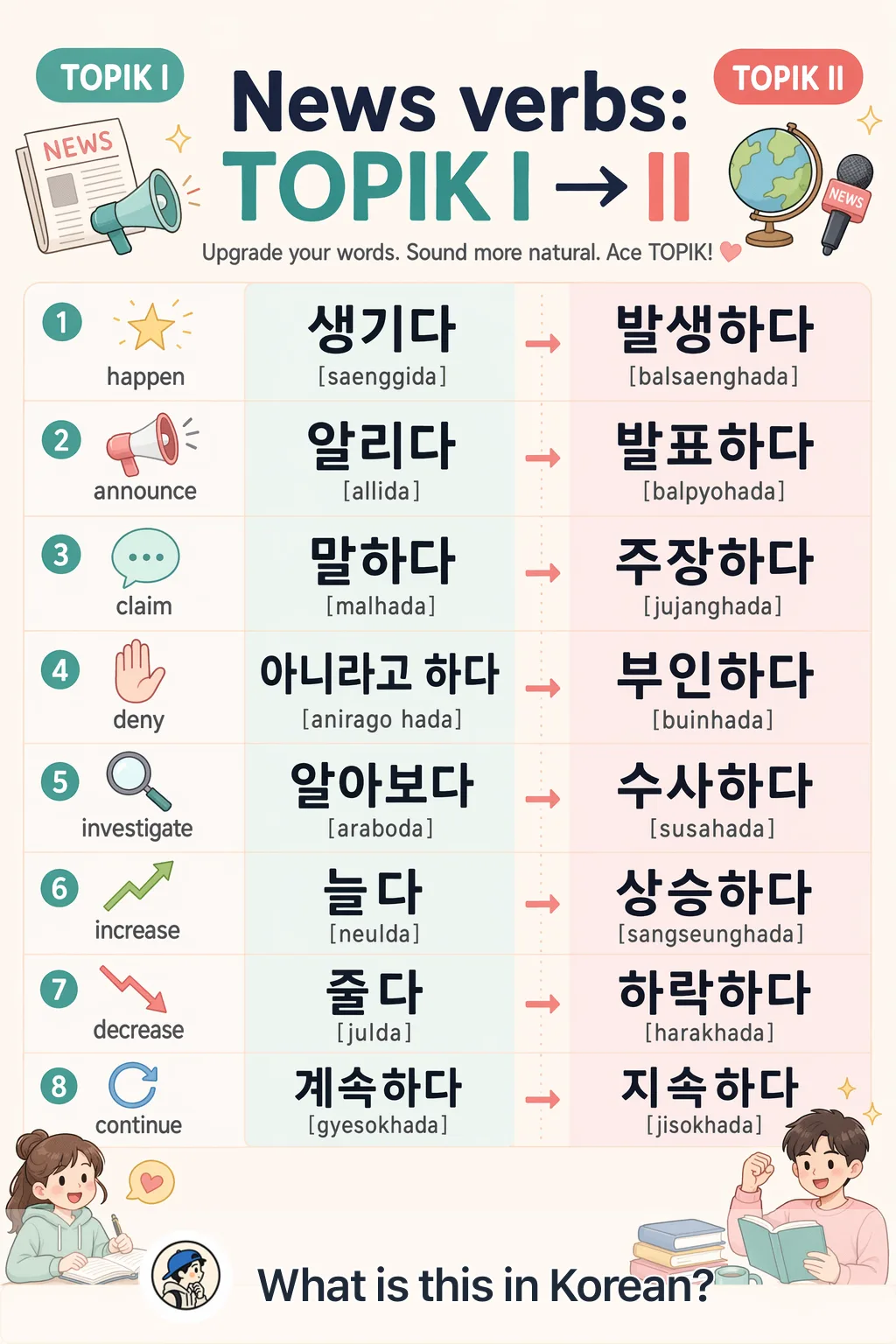
How these words work together
This chart shows pairs of Korean verbs used in news contexts, comparing simpler TOPIK I words with more advanced TOPIK II words. Both verbs in each pair have similar meanings but differ in formality and complexity. Learning these pairs helps you upgrade your Korean vocabulary for reading and understanding news articles better. Use the TOPIK I verbs for basic conversations and the TOPIK II verbs for more formal or written language.
Words in this chart
| Korean | Romanization | English |
|---|---|---|
| 생기다 | saenggida | happen (TOPIK I) |
| 발생하다 | balsaenghada | happen (TOPIK II) |
| 알리다 | allida | announce (TOPIK I) |
| 발표하다 | balpyohada | announce (TOPIK II) |
| 말하다 | malhada | claim (TOPIK I) |
| 주장하다 | jujanghada | claim (TOPIK II) |
| 아니라고 하다 | anirago hada | deny (TOPIK I) |
| 부인하다 | buinhada | deny (TOPIK II) |
| 알아보다 | araboda | investigate (TOPIK I) |
| 수사하다 | susahada | investigate (TOPIK II) |
| 늘다 | neulda | increase (TOPIK I) |
| 상승하다 | sangseunghada | increase (TOPIK II) |
| 줄다 | julda | decrease (TOPIK I) |
| 하락하다 | harakhada | decrease (TOPIK II) |
| 계속하다 | gyesokhada | continue (TOPIK I) |
| 지속하다 | jisokhada | continue (TOPIK II) |
Example sentences
사고가 생겼어요. 경찰이 수사하고 있어요.
An accident happened. The police are investigating.
정부가 새로운 정책을 발표했습니다. 국민들에게 알렸어요.
The government announced a new policy. They informed the public.
범인은 범죄를 부인하고 있습니다. 경찰은 계속 수사할 거예요.
The suspect is denying the crime. The police will continue the investigation.
Practice these words in context? Open the vocab quiz · Browse how-to-say word guides.