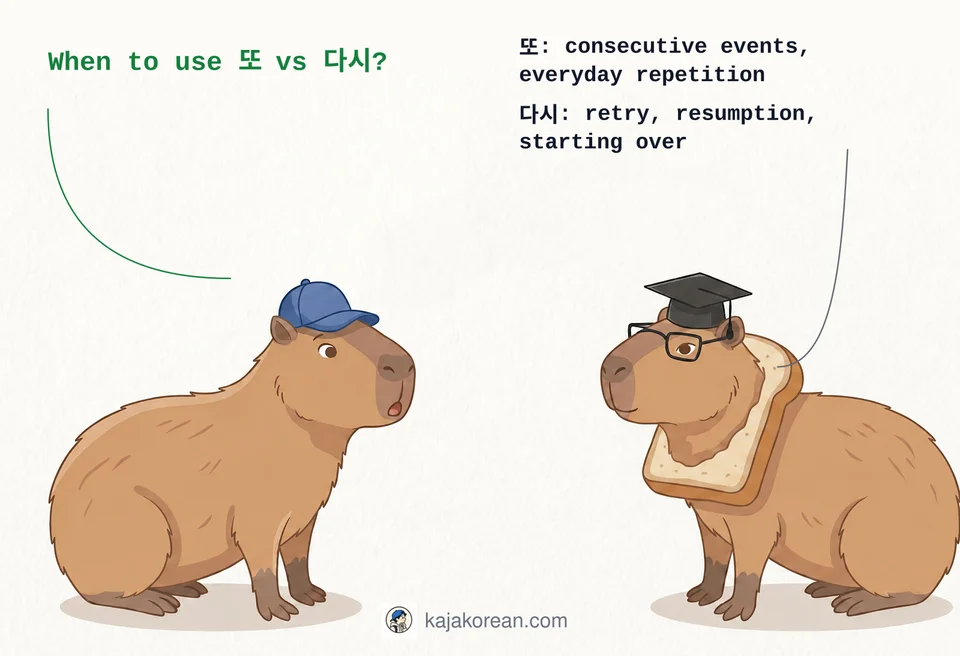
An adverb used when something that has happened once happens again
When to use
everyday repetition, additional occurrence, consecutive events
The nuance
Used when the same event repeats, mainly in everyday repeated or additional occurrence contexts.
또 (tto) · 다시 (da-si, dasi)
또 is used when an action or event repeats one or more times, while 다시 is used when an action or state restarts anew from the beginning.

One lane per word — no nested boxes, just the gist.
An adverb used when something that has happened once happens again
When to use
everyday repetition, additional occurrence, consecutive events
The nuance
Used when the same event repeats, mainly in everyday repeated or additional occurrence contexts.
An adverb used when an action or state restarts anew from the beginning
When to use
retry, resumption, starting over
The nuance
Used when something stopped or ended is started again from the beginning; suitable for retrying or resuming situations.
나는 또 그 영화를 봤어.
na-neun tto geu yeong-hwa-reul bwass-eo., na neun tto geu yeong hwa reul bwass eo.
Because the movie was watched once before and now again, 또 is appropriate.
나는 다시 그 영화를 봤어.
na-neun da-si geu yeong-hwa-reul bwass-eo., na neun da si geu yeong hwa reul bwass eo.
Implies the movie was stopped and then watched again from the start, so 다시 fits.
또 시험을 봐야 해.
tto si-heom-eul bwa-ya hae., tto si heom eul bwa ya hae.
You took the exam once and have to take it again, matching a repetition context.
다시 시험을 봐야 해.
da-si si-heom-eul bwa-ya hae., da si si heom eul bwa ya hae.
Appropriate when you must retake the exam from the beginning after failing or stopping.
또 시작해.
tto si-jak-hae., tto si jak hae.
Starting an action anew requires 다시, not 또.
다시 비가 와.
da-si bi-ga wa., da si bi ga wa.
For rain happening repeatedly, 또 is more natural than 다시.
또 늦었어.
tto neuj-eoss-eo., tto neuj eoss eo.
Being late repeatedly fits the use of 또.
다시 늦었어.
da-si neuj-eoss-eo., da si neuj eoss eo.
It doesn't mean starting lateness anew, so 다시 is inappropriate.
In which situation should you use '또'?
Which sentence correctly uses '다시'?
Which sentence cannot use '또'?