
데(de)
Used to indicate a specific situation, environment, or abstract place
When to use
situational place, abstract environment, action connection
The nuance
'데' expresses situational or abstract places, often linked to actions or states
데 (de) · 곳 (gos)
'데' and '곳' both indicate places, but '데' emphasizes specific situations or environments, while '곳' highlights physical locations or spots.
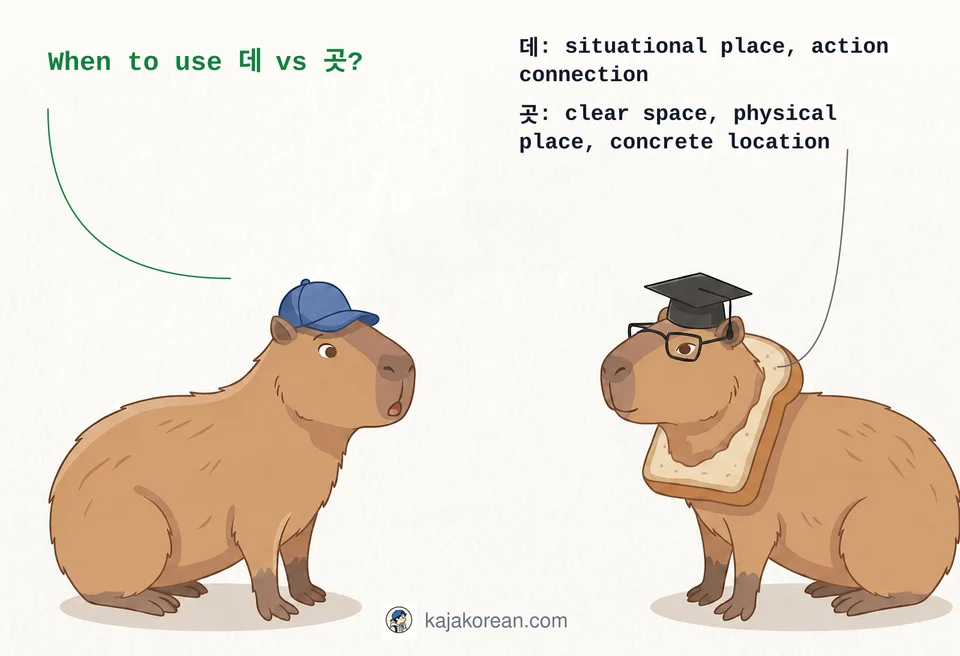
One lane per word — no nested boxes, just the gist.
Used to indicate a specific situation, environment, or abstract place
When to use
situational place, abstract environment, action connection
The nuance
'데' expresses situational or abstract places, often linked to actions or states
Used to indicate physical and concrete places or locations
When to use
physical place, concrete location, clear space
The nuance
'곳' refers to actual existing places or locations, emphasizing clear physical space
여기가 내가 자란 데야.
yeo-gi-ga nae-ga ja-ran de-ya., yeo gi ga nae ga ja ran de ya.
'데' appropriately indicates the environment where I grew up.
여기가 내가 자란 곳이야.
yeo-gi-ga nae-ga ja-ran gos-i-ya., yeo gi ga nae ga ja ran gos i ya.
'곳' suits indicating the actual physical place where I grew up.
그 데는 너무 시끄러워서 공부할 수 없어.
geu de-neun neo-mu si-kkeu-reo-wo-seo gong-bu-hal su eop-eo., geu de neun neo mu si kkeu reo wo seo gong bu hal su eop eo.
'데' naturally expresses a situational environment.
그 곳는 너무 시끄러워서 공부할 수 없어.
geu gos-neun neo-mu si-kkeu-reo-wo-seo gong-bu-hal su eop-eo., geu gos neun neo mu si kkeu reo wo seo gong bu hal su eop eo.
'곳' with the subject particle should be '곳은', so this is a grammatical error.
만날 데를 정하자.
man-nal de-reul jeong-ha-ja., man nal de reul jeong ha ja.
'데' fits abstractly expressing a place for a meeting situation.
만날 곳을 정하자.
man-nal gos-eul jeong-ha-ja., man nal gos eul jeong ha ja.
'곳' is suitable when specifically referring to the actual meeting place.
여기 데는 음식이 맛있어.
yeo-gi de-neun eum-sik-i mas-iss-eo., yeo gi de neun eum sik i mas iss eo.
'데' rarely combines directly with '여기'; '여기' or '이 데' is preferred.
여기 곳은 사람이 많다.
yeo-gi gos-eun sa-ram-i man-da., yeo gi gos eun sa ram i man da.
'곳' with '여기' is ungrammatical; use '여기' alone or '이 곳'.
Which word is appropriate to indicate a situation or environment?
Which expression is correct for an actual physical place?
Fill in the blank: '만날 ___를 정하자'
Which is correct: '여기 ___는 사람이 많다'?