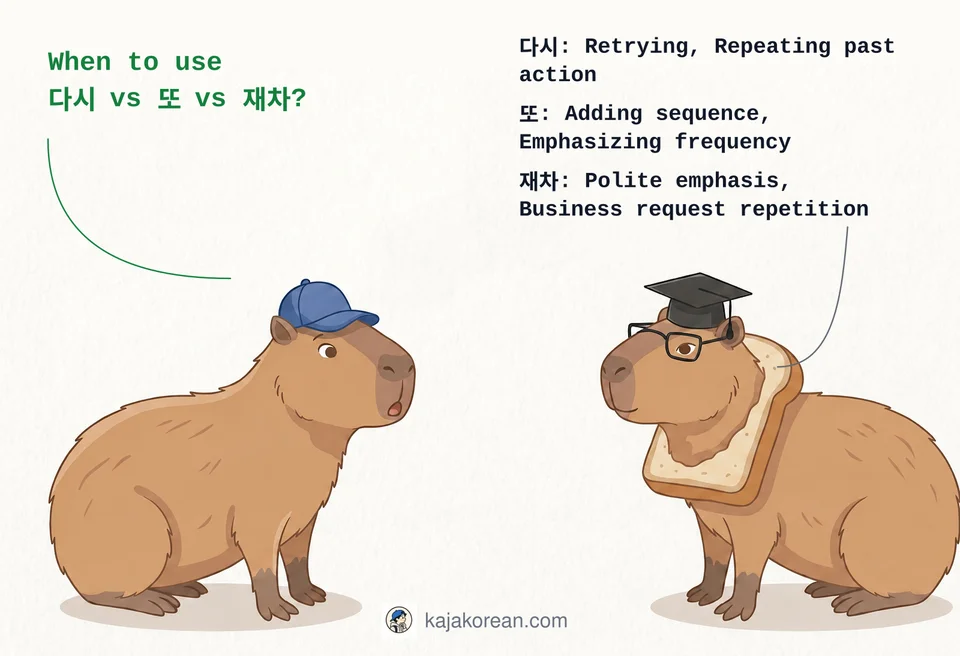
Used when repeating an action or state once more
When to use
Repeating past action, Retrying, Resuming with change of situation
The nuance
Common, natural repetition expression mainly used to indicate resuming or repeating a past action.
다시 (da-si, dasi) · 또 (tto) · 재차 (jae-cha, jaecha)
다시, 또, and 재차 all indicate repetition, but differ in usage context and formality.

One lane per word — no nested boxes, just the gist.
Used when repeating an action or state once more
When to use
Repeating past action, Retrying, Resuming with change of situation
The nuance
Common, natural repetition expression mainly used to indicate resuming or repeating a past action.
Used to add temporal order or count, emphasizing 'more' or 'again' simply
When to use
Emphasizing frequency, Adding sequence, Repeating similar action
The nuance
Used in everyday speech to emphasize frequency or sequence, not necessarily identical to the previous action.
Formal written expression used to politely repeat the same action or request multiple times
When to use
Official document repetition, Business request repetition, Polite emphasis
The nuance
Mainly used in official documents or business contexts, appropriate when politeness and emphasis on repetition are required.
다시 한번 시도해 보세요.
da-si han-beon si-do-hae bo-se-yo., da si han beon si do hae bo se yo.
Natural expression for retrying a past action.
또 한번 시도해 보세요.
tto han-beon si-do-hae bo-se-yo., tto han beon si do hae bo se yo.
Appropriate for emphasizing frequency in casual speech.
재차 한번 시도해 보세요.
jae-cha han-beon si-do-hae bo-se-yo., jae cha han beon si do hae bo se yo.
‘재차’ is formal and redundant with ‘한번’; not natural in casual retry context.
회의는 다시 내일로 연기되었습니다.
hoe-ui-neun da-si nae-il-ro yeon-gi-doe-eoss-seup-ni-da., hoe ui neun da si nae il ro yeon gi doe eoss seup ni da.
Natural expression for rescheduling or resuming.
회의는 또 내일로 연기되었습니다.
hoe-ui-neun tto nae-il-ro yeon-gi-doe-eoss-seup-ni-da., hoe ui neun tto nae il ro yeon gi doe eoss seup ni da.
‘또’ implies simple addition, inappropriate for schedule change.
재차 말씀드립니다, 제출 기한을 엄수해 주십시오.
jae-cha mal-sseum-deu-rip-ni-da, je-chul gi-han-eul eom-su-hae ju-sip-si-o., jae cha mal sseum deu rip ni da, je chul gi han eul eom su hae ju sip si o.
Suitable for formal, polite repeated requests.
다시 말씀드립니다, 제출 기한을 엄수해 주세요.
da-si mal-sseum-deu-rip-ni-da, je-chul gi-han-eul eom-su-hae ju-se-yo., da si mal sseum deu rip ni da, je chul gi han eul eom su hae ju se yo.
Acceptable as a polite, everyday expression.
또 말씀드립니다, 제출 기한을 엄수해 주세요.
tto mal-sseum-deu-rip-ni-da, je-chul gi-han-eul eom-su-hae ju-se-yo., tto mal sseum deu rip ni da, je chul gi han eul eom su hae ju se yo.
‘또’ is unnatural for repeated requests.
Which word is appropriate for politely repeating the same request in official documents?
Which word is natural when telling a friend ‘Let’s meet one more time’?
Which word fits when emphasizing frequency as in ‘He came ___’?