
만(man)
Indicates limitation to only that subject or range
When to use
simple limitation, positive sentences, numerical limitation
The nuance
만 is used to simply limit a range or subject, suitable for positive or neutral contexts.
만 (man) · 뿐 (ppun)
만 and 뿐 both mean 'only,' but 만 indicates simple limitation, while 뿐 carries nuance of emphasis and exclusion.
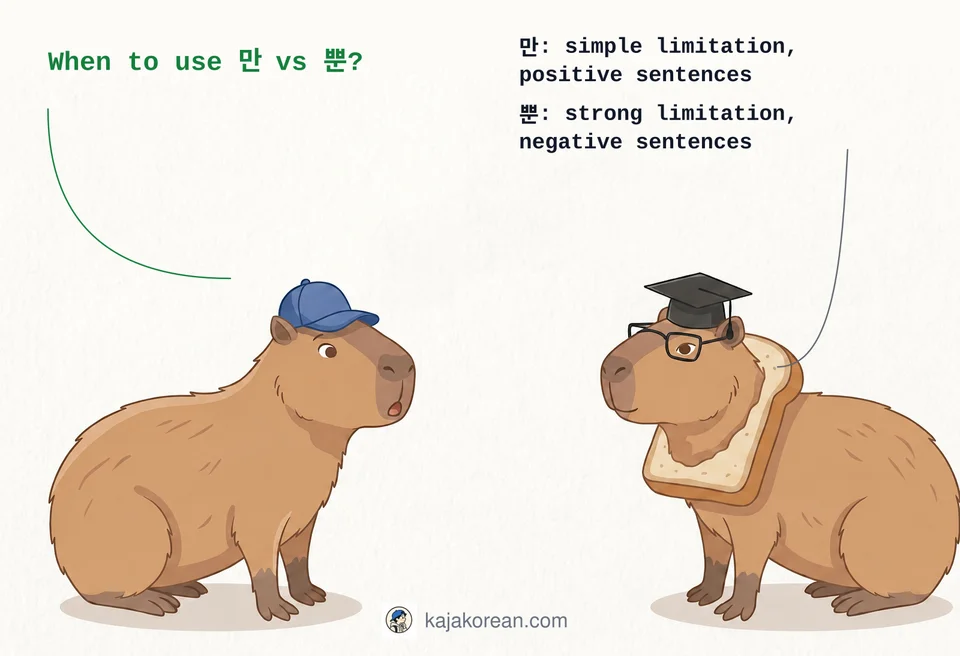
One lane per word — no nested boxes, just the gist.
Indicates limitation to only that subject or range
When to use
simple limitation, positive sentences, numerical limitation
The nuance
만 is used to simply limit a range or subject, suitable for positive or neutral contexts.
Emphasizes that only that exists or applies, with a strong sense of exclusion
When to use
emphasis and exclusion, negative sentences, strong limitation
The nuance
뿐 carries strong emphasis and exclusion, more natural in negative or restrictive contexts.
나는 사과만 먹었어요.
na-neun sa-gwa-man meok-eoss-eo-yo., na neun sa gwa man meok eoss eo yo.
Appropriate because it simply limits the subject to only apples eaten.
나는 사과뿐 먹었어요.
na-neun sa-gwa-ppun meok-eoss-eo-yo., na neun sa gwa ppun meok eoss eo yo.
Natural because it emphasizes only apples were eaten, excluding others.
그는 문제만 이해하지 못했다.
geu-neun mun-je-man i-hae-ha-ji mos-haess-da., geu neun mun je man i hae ha ji mos haess da.
Man is suitable as it simply limits the failure to understand to the problem.
이것만 하면 돼요.
i-geos-man ha-myeon dwae-yo., i geos man ha myeon dwae yo.
Man is natural for simply stating that only this needs to be done.
이것뿐 하면 돼요.
i-geos-ppun ha-myeon dwae-yo., i geos ppun ha myeon dwae yo.
Ppun is unnatural here; the sentence sounds awkward.
그녀는 친구만 왔어요.
geu-nyeo-neun chin-gu-man wass-eo-yo., geu nyeo neun chin gu man wass eo yo.
Man is appropriate for simply limiting who came to friends only.
그녀는 친구뿐 왔어요.
geu-nyeo-neun chin-gu-ppun wass-eo-yo., geu nyeo neun chin gu ppun wass eo yo.
Ppun is grammatically incorrect in this sentence.
Which is most suitable for 'simple limitation'?
Which expression strongly emphasizes and excludes?
Which fits naturally: '나는 사과___ 먹었어요.'?