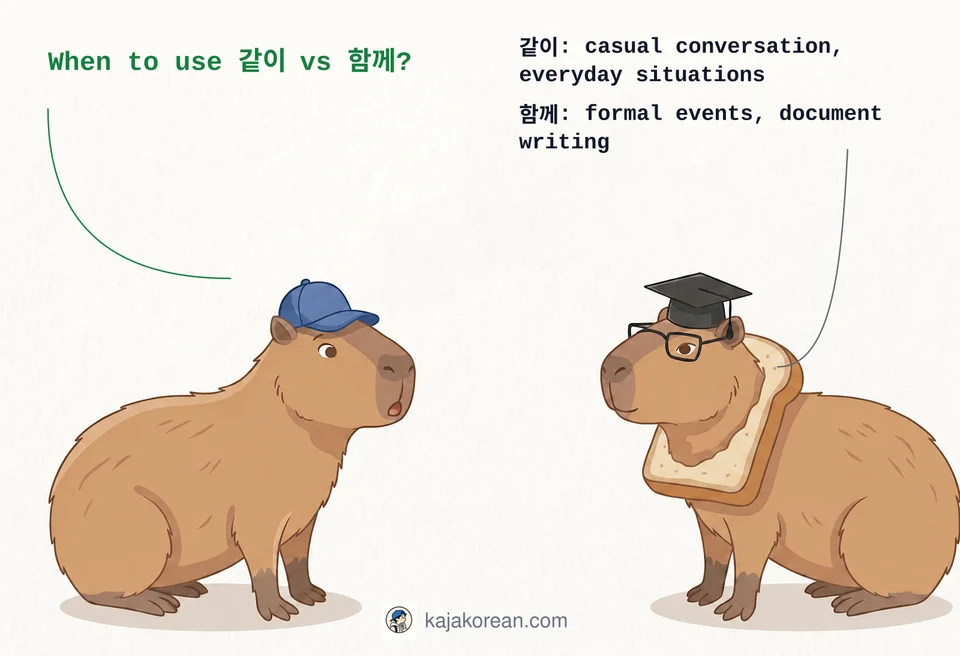
같이 vs 함께: Comparing Natural Korean Expressions for 'Together'

같이 (gat-i, gati) · 함께 (ham-kke, hamkke)

'같이' is casual and conversational, while '함께' is more formal and suited for written or polite contexts.

Comparison of Korean words 같이 and 함께 meaning 'together'

Word-by-word breakdown

One lane per word — no nested boxes, just the gist.

같이(gat-i, gati)

Used to express doing something together in a casual, everyday context.

When to use

hanging out with friends, casual conversation, everyday situations

The nuance

Primarily used when casually doing something with close people like friends or family; fits spoken and informal contexts.

함께(ham-kke, hamkke)

More formal than 같이, used in official settings or written documents.

When to use

formal events, document writing, formal presentations

The nuance

Used mainly in formal situations, written language, presentations, official documents, conveying respect.

Real-world examples

  • 우리는 같이 영화를 봤어요.

    u-ri-neun gat-i yeong-hwa-reul bwass-eo-yo., u ri neun gat i yeong hwa reul bwass eo yo.

    '같이' fits naturally for casually watching a movie with a friend.

  • 우리는 함께 영화를 봤어요.

    u-ri-neun ham-kke yeong-hwa-reul bwass-eo-yo., u ri neun ham kke yeong hwa reul bwass eo yo.

    '함께' is also correct and sounds a bit more formal, but acceptable.

  • 친구가 함께 놀자고 했어요.

    chin-gu-ga ham-kke nol-ja-go haess-eo-yo., chin gu ga ham kke nol ja go haess eo yo.

    '함께' is too formal for a casual invitation between friends.

  • 친구가 같이 놀자고 했어요.

    chin-gu-ga gat-i nol-ja-go haess-eo-yo., chin gu ga gat i nol ja go haess eo yo.

    '같이' is natural for a casual invitation among friends.

  • 회의는 같이 진행됩니다.

    hoe-ui-neun gat-i jin-haeng-doep-ni-da., hoe ui neun gat i jin haeng doep ni da.

    '같이' is inappropriate for formal meetings; '함께' should be used.

  • 회의는 함께 진행됩니다.

    hoe-ui-neun ham-kke jin-haeng-doep-ni-da., hoe ui neun ham kke jin haeng doep ni da.

    '함께' is appropriate for formal meeting contexts.

  • 우리는 함께 점심을 먹었어요.

    u-ri-neun ham-kke jeom-sim-eul meok-eoss-eo-yo., u ri neun ham kke jeom sim eul meok eoss eo yo.

    '함께' fits well even in casual sentences, sounding polite.

  • 우리는 같이 점심을 먹었어요.

    u-ri-neun gat-i jeom-sim-eul meok-eoss-eo-yo., u ri neun gat i jeom sim eul meok eoss eo yo.

    '같이' is natural in everyday situations.

Quick quiz

  1. Which word do you use when hanging out casually with friends?

    친구와 편하게 놀 때 어떤 단어를 쓰나요?(chin-gu-wapyeon-ha-genolttaeeo-tteondan-eo-reulsseu-na-yo?, chinguwapyeonhagenolttaeeotteondaneoreulsseunayo?)
  2. Which word is inappropriate to use instead of '함께' in formal documents?

    공식 문서에서 '함께' 대신 쓰기 부적절한 단어는?(gong-sikmun-seo-e-seo'ham-kke'dae-sinsseu-gibu-jeok-jeol-handan-eo-neun?, gongsikmunseoeseo'hamkke'daesinsseugibujeokjeolhandaneoneun?)
  3. Which expression suits a formal presentation?

    격식 있는 발표에서 어울리는 표현은?(gyeok-sikiss-neunbal-pyo-e-seoeo-ul-ri-neunpyo-hyeon-eun?, gyeoksikissneunbalpyoeseoeoulrineunpyohyeoneun?)

More comparisons to explore

View all word comparisons →