
만큼(man-keum, mankeum)
Used to compare two objects or states.
When to use
Exact comparison, Emphasizing equality, Comparative sentences
The nuance
‘만큼’ indicates an equal or similar degree between compared items, often in the structure ‘~만큼 ~하다’.
만큼 (man-keum, mankeum) · 정도 (jeong-do, jeongdo)
'만큼' is mainly used for comparisons, while '정도' indicates approximate quantity or degree.
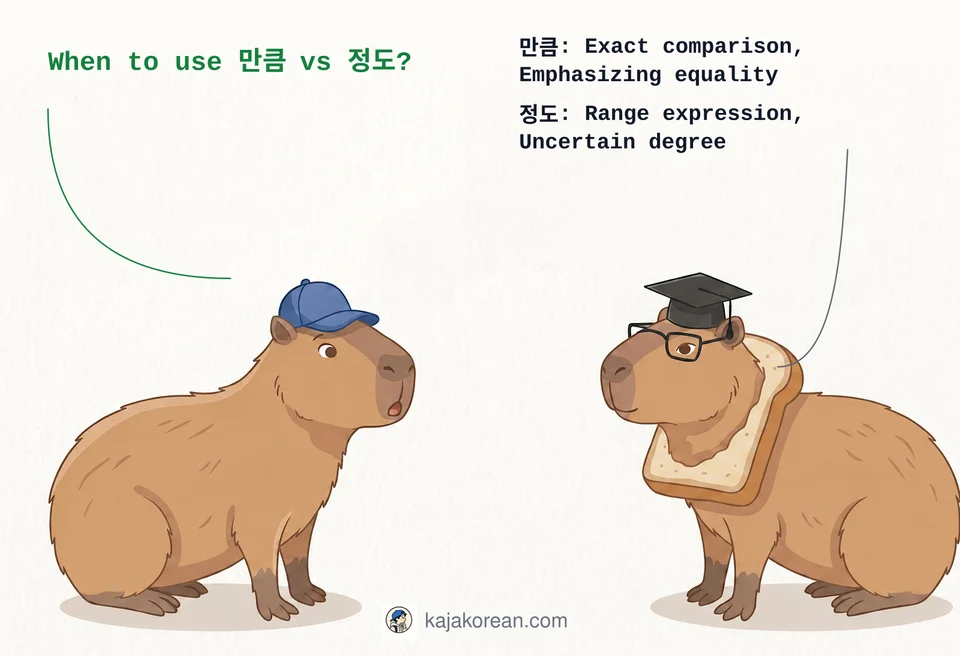
One lane per word — no nested boxes, just the gist.
Used to compare two objects or states.
When to use
Exact comparison, Emphasizing equality, Comparative sentences
The nuance
‘만큼’ indicates an equal or similar degree between compared items, often in the structure ‘~만큼 ~하다’.
Used to indicate approximate quantity or range of degree.
When to use
Approximate quantity, Range expression, Uncertain degree
The nuance
‘정도’ expresses an approximate amount or state, used in the form ‘~정도’.
그 사람만큼 열심히 일하는 사람은 없다.
geu sa-ram-man-keum yeol-sim-hi il-ha-neun sa-ram-eun eop-da., geu sa ram man keum yeol sim hi il ha neun sa ram eun eop da.
‘만큼’ properly shows an exact comparison and sounds natural.
그 사람정도 열심히 일하는 사람은 없다.
geu sa-ram-jeong-do yeol-sim-hi il-ha-neun sa-ram-eun eop-da., geu sa ram jeong do yeol sim hi il ha neun sa ram eun eop da.
‘정도’ indicates approximate quantity or range, not suitable for direct comparisons; ‘만큼’ should be used.
나는 너만큼 키가 크다.
na-neun neo-man-keum ki-ga keu-da., na neun neo man keum ki ga keu da.
This sentence uses ‘만큼’ to compare equal height, which is correct.
나는 너정도 키가 크다.
na-neun neo-jeong-do ki-ga keu-da., na neun neo jeong do ki ga keu da.
‘정도’ is inappropriate here because it does not indicate precise comparison.
회의는 한 시간 정도 걸릴 것이다.
hoe-ui-neun han si-gan jeong-do geol-ril geos-i-da., hoe ui neun han si gan jeong do geol ril geos i da.
‘정도’ is suitable for expressing approximate time.
회의는 한 시간만큼 걸릴 것이다.
hoe-ui-neun han si-gan-man-keum geol-ril geos-i-da., hoe ui neun han si gan man keum geol ril geos i da.
‘만큼’ is used for comparisons, so it sounds awkward for approximate time.
그 정도 문제는 쉽게 해결할 수 있다.
geu jeong-do mun-je-neun swip-ge hae-gyeol-hal su iss-da., geu jeong do mun je neun swip ge hae gyeol hal su iss da.
‘정도’ indicates the approximate difficulty level of the problem.
그 만큼 문제는 쉽게 해결할 수 있다.
geu man-keum mun-je-neun swip-ge hae-gyeol-hal su iss-da., geu man keum mun je neun swip ge hae gyeol hal su iss da.
‘만큼’ fits comparative sentences and sounds odd here.
Which expresses an exact comparison?
Which word fits ‘한 시간 ___ 걸릴 것이다’?
Which fits in ‘너 ___ 나보다 키가 크다’?