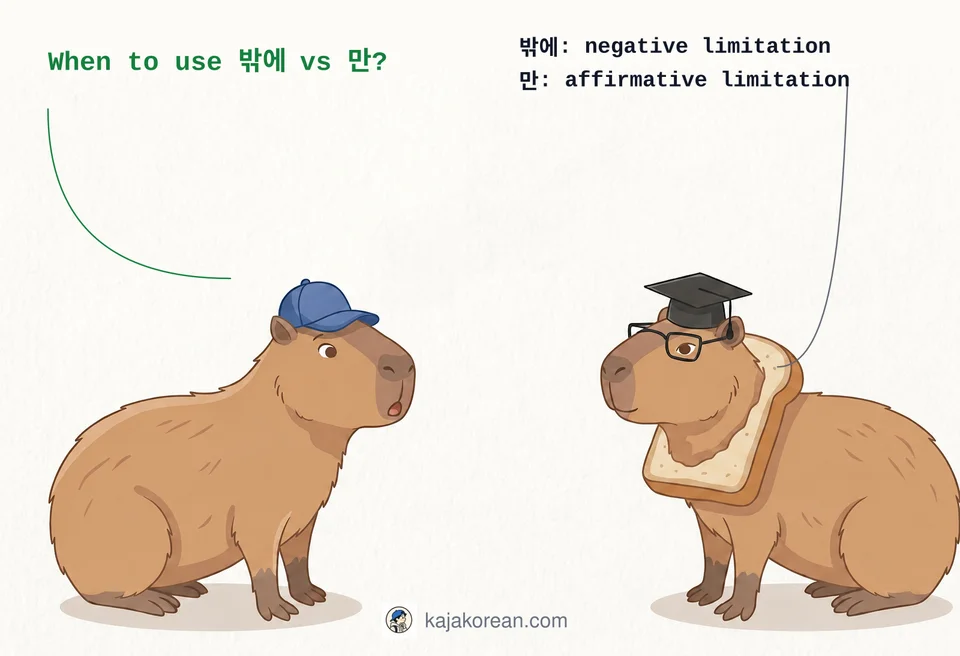
밖에 vs 만: Difference in Limiting Expressions

밖에 (bakk-e, bakke) · 만 (man)

밖에 is used mainly with negatives to emphasize 'only' or 'nothing but,' while 만 is used with affirmatives to indicate 'only' or 'just' limiting something.

Comparison of Korean particles 밖에 and 만 for expressing limitation

Word-by-word breakdown

One lane per word — no nested boxes, just the gist.

밖에(bakk-e, bakke)

A particle used with negative sentences to emphasize limitation meaning 'only' or 'nothing but'

When to use

negative limitation, quantity restriction emphasis, expressing negative contexts

The nuance

밖에 must be used with negative sentences, commonly in the pattern '~밖에 없다' to express limitation.

(man)

A particle used with affirmative sentences to indicate limitation meaning 'only' or 'just'

When to use

affirmative limitation, expressing positive contexts, simple limitation emphasis

The nuance

만 is used with affirmative sentences to simply indicate limitation or emphasis.

Real-world examples

  • 나에게는 동생밖에 없어요.

    na-e-ge-neun dong-saeng-bakk-e eop-eo-yo., na e ge neun dong saeng bakk e eop eo yo.

    Correctly uses 밖에 with the negative verb '없어요' to express 'only a younger sibling' limitation.

  • 나에게는 동생만 있어요.

    na-e-ge-neun dong-saeng-man iss-eo-yo., na e ge neun dong saeng man iss eo yo.

    Correctly uses 만 with the affirmative verb '있어요' to indicate 'only a younger sibling'.

  • 나는 사과밖에 좋아해요.

    na-neun sa-gwa-bakk-e joh-a-hae-yo., na neun sa gwa bakk e joh a hae yo.

    밖에 must be used with negative sentences; '좋아해요' is affirmative, so 만 should be used instead.

  • 나는 사과만 좋아하지 않아요.

    na-neun sa-gwa-man joh-a-ha-ji an-a-yo., na neun sa gwa man joh a ha ji an a yo.

    만 is for affirmative sentences; using it with a negative verb is incorrect. 밖에 should be used here.

  • 이 문제는 나밖에 몰라요.

    i mun-je-neun na-bakk-e mol-ra-yo., i mun je neun na bakk e mol ra yo.

    Although '몰라요' is negative in meaning, 밖에 is correctly used to emphasize 'only me'.

  • 이 문제는 나만 알아요.

    i mun-je-neun na-man al-a-yo., i mun je neun na man al a yo.

    Correctly uses 만 with affirmative verb '알아요' to indicate 'only me'.

  • 그는 10명밖에 왔어요.

    geu-neun 10myeong-bakk-e wass-eo-yo., geu neun 10myeong bakk e wass eo yo.

    밖에 must be used with negatives; '왔어요' is affirmative, so 만 should be used.

  • 그는 10명만 안 왔어요.

    geu-neun 10myeong-man an wass-eo-yo., geu neun 10myeong man an wass eo yo.

    만 is for affirmative sentences; using it with a negative verb like '안 왔어요' is incorrect.

Quick quiz

  1. Which particle is used with negative sentences to emphasize 'only' or 'nothing but'?

    부정문과 함께 쓰여 '오직 ~뿐'을 강조하는 조사로 맞는 것은?(bu-jeong-mun-gwaham-kkesseu-yeo'o-jik~ppun'eulgang-jo-ha-neunjo-sa-romaj-neungeos-eun?, bujeongmungwahamkkesseuyeo'ojik~ppun'eulgangjohaneunjosaromajneungeoseun?)
  2. Which particle is used with affirmative sentences to indicate 'only' or 'just'?

    긍정문에서 '오직 ~만'이라는 한정을 나타내는 조사로 맞는 것은?(geung-jeong-mun-e-seo'o-jik~man'i-ra-neunhan-jeong-eulna-ta-nae-neunjo-sa-romaj-neungeos-eun?, geungjeongmuneseo'ojik~man'iraneunhanjeongeulnatanaeneunjosaromajneungeoseun?)
  3. Which sentence is correct?

    다음 중 올바른 문장은?(da-eumjungol-ba-reunmun-jang-eun?, daeumjungolbareunmunjangeun?)

More comparisons to explore

View all word comparisons →