
마다(ma-da, mada)
Indicates each unit or occasion, used in repetitive contexts.
When to use
time repetition, place repetition, person repetition
The nuance
마다 attaches to units like time, place, or person to emphasize 'every single' occurrence.
마다 (ma-da, mada) · 씩 (ssik)
마다 focuses on each repeated unit or occasion, while 씩 is used to indicate equal amounts or quantities distributed per unit.
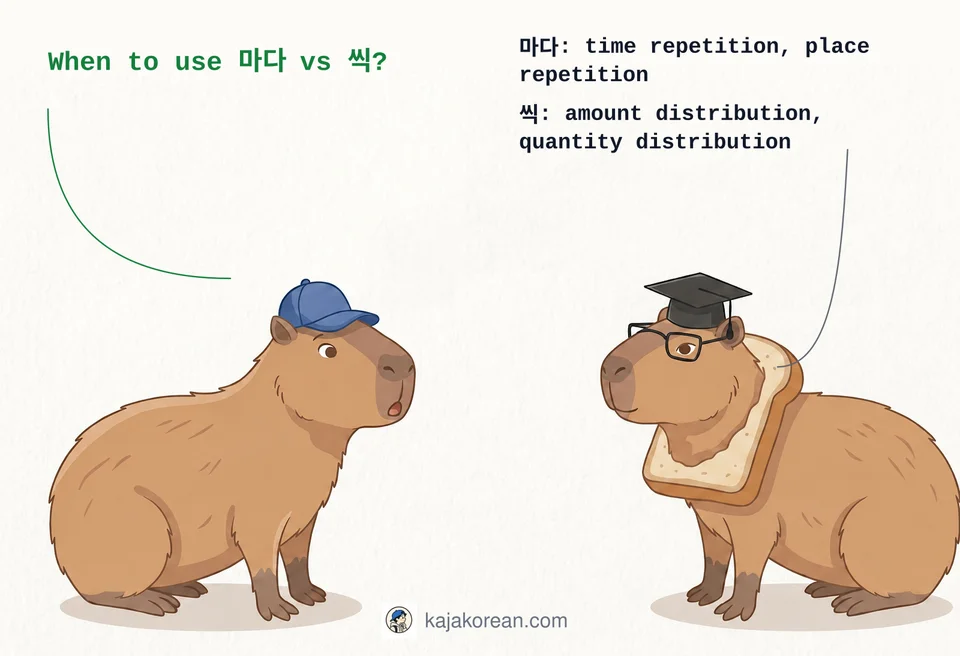
One lane per word — no nested boxes, just the gist.
Indicates each unit or occasion, used in repetitive contexts.
When to use
time repetition, place repetition, person repetition
The nuance
마다 attaches to units like time, place, or person to emphasize 'every single' occurrence.
Used when equally distributing a certain amount or quantity per unit.
When to use
quantity distribution, amount distribution, equal allocation per unit
The nuance
씩 means the same amount is allocated to each unit when dividing quantities or amounts evenly.
나는 매일마다 운동을 한다.
na-neun mae-il-ma-da un-dong-eul han-da., na neun mae il ma da un dong eul han da.
마다 is correctly used to express repetition over time.
나는 매일씩 운동을 한다.
na-neun mae-il-ssik un-dong-eul han-da., na neun mae il ssik un dong eul han da.
씩 is for quantity distribution, not time repetition; use 매일마다 instead.
학생마다 책을 한 권씩 받았다.
hak-saeng-ma-da chaek-eul han gwon-ssik bat-ass-da., hak saeng ma da chaek eul han gwon ssik bat ass da.
마다 correctly indicates each student, 씩 indicates one book per student.
학생씩 책을 한 권마다 받았다.
hak-saeng-ssik chaek-eul han gwon-ma-da bat-ass-da., hak saeng ssik chaek eul han gwon ma da bat ass da.
학생씩 is incorrect; 마다는 for each student, 씩 for quantity per unit.
한 시간마다 알람이 울린다.
han si-gan-ma-da al-ram-i ul-rin-da., han si gan ma da al ram i ul rin da.
한 시간마다 correctly expresses repetition every hour.
한 시간씩 알람이 울린다.
han si-gan-ssik al-ram-i ul-rin-da., han si gan ssik al ram i ul rin da.
씩 is for distribution, not repetition; 마다 is correct here.
사과를 세 개씩 나눠 주세요.
sa-gwa-reul se gae-ssik na-nwo ju-se-yo., sa gwa reul se gae ssik na nwo ju se yo.
씩 correctly indicates equal distribution of three apples each.
사과를 세 개마다 나눠 주세요.
sa-gwa-reul se gae-ma-da na-nwo ju-se-yo., sa gwa reul se gae ma da na nwo ju se yo.
마다 is for repetition units, not quantity distribution; 씩 is correct.
Which is correct for expressing time repetition?
Which is used when distributing equal amounts per person?
In '학생마다 책을 한 권씩 받았다.', what are the roles of 마다 and 씩?