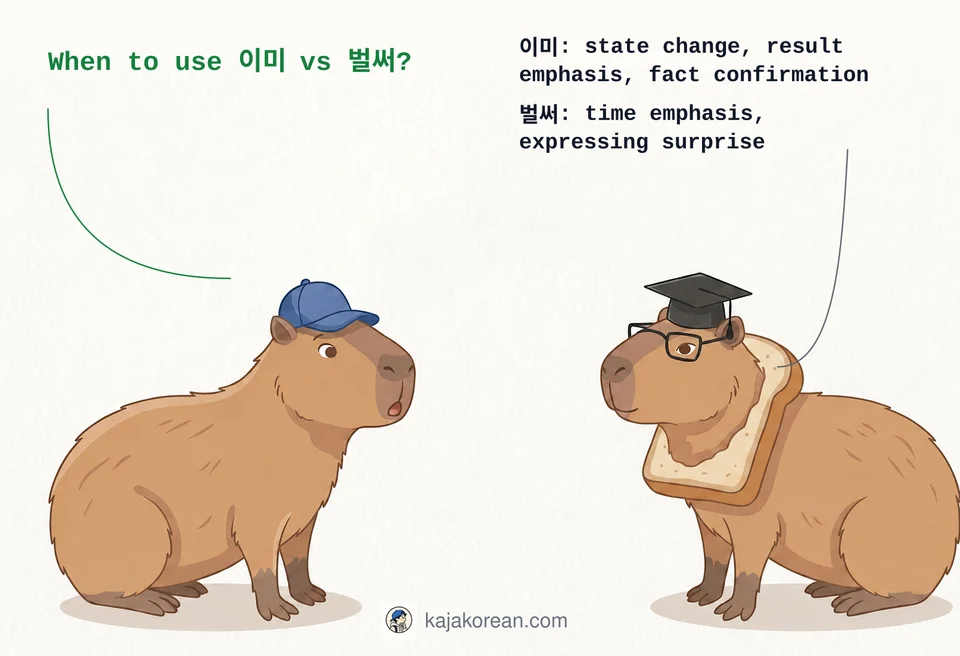
이미 vs 벌써: Nuance of Time in Korean

이미 (i-mi, imi) · 벌써 (beol-sseo, beolsseo)

Both 이미 and 벌써 indicate that something has already happened in the past, but 이미 focuses on the fact or state itself, while 벌써 emphasizes that the event occurred sooner than expected.

Comparison of Korean adverbs 이미 and 벌써 with usage examples

Word-by-word breakdown

One lane per word — no nested boxes, just the gist.

이미(i-mi, imi)

Indicates that something has already been completed or a state has changed as a fact

When to use

fact confirmation, state change, result emphasis

The nuance

이미 is used to express that a fact or state has definitely been completed. It focuses on the result or state rather than the speed of occurrence.

벌써(beol-sseo, beolsseo)

Indicates that something has been completed sooner than expected

When to use

faster than expected, time emphasis, expressing surprise

The nuance

벌써 is used to emphasize that something happened or was completed faster than expected. The focus is on the quick timing.

Real-world examples

  • 그는 이미 집에 갔어요.

    geu-neun i-mi jip-e gass-eo-yo., geu neun i mi jip e gass eo yo.

    이미 appropriately indicates the fact that he has already gone home.

  • 그는 벌써 집에 갔어요.

    geu-neun beol-sseo jip-e gass-eo-yo., geu neun beol sseo jip e gass eo yo.

    벌써 emphasizes that he went home sooner than expected, natural depending on context.

  • 나는 이미 그 영화를 봤어.

    na-neun i-mi geu yeong-hwa-reul bwass-eo., na neun i mi geu yeong hwa reul bwass eo.

    이미 fits well when stating a fact or experience clearly.

  • 나는 벌써 그 영화를 봤어.

    na-neun beol-sseo geu yeong-hwa-reul bwass-eo., na neun beol sseo geu yeong hwa reul bwass eo.

    벌써 naturally implies watching the movie earlier than expected.

  • 그는 이미 도착했는데 왜 안 왔어요?

    geu-neun i-mi do-chak-haess-neun-de wae an wass-eo-yo?, geu neun i mi do chak haess neun de wae an wass eo yo?

    Emphasizing the fact that he has already arrived is appropriate here.

  • 그는 벌써 도착했는데 왜 안 왔어요?

    geu-neun beol-sseo do-chak-haess-neun-de wae an wass-eo-yo?, geu neun beol sseo do chak haess neun de wae an wass eo yo?

    벌써 emphasizes early arrival, making the question natural.

  • 벌써 비가 왔어요?

    beol-sseo bi-ga wass-eo-yo?, beol sseo bi ga wass eo yo?

    벌써 is used to express surprise at rain arriving sooner than expected.

  • 이미 비가 왔어요?

    i-mi bi-ga wass-eo-yo?, i mi bi ga wass eo yo?

    이미 is for confirming facts, but sounds unnatural in a surprised question.

Quick quiz

  1. Which word is appropriate to emphasize something happening faster than expected?

    다음 중 예상보다 빠른 일을 강조할 때 적절한 단어는?(da-eumjungye-sang-bo-dappa-reunil-eulgang-jo-halttaejeok-jeol-handan-eo-neun?, daeumjungyesangbodappareunileulgangjohalttaejeokjeolhandaneoneun?)
  2. Which word is used to express that a fact or state has definitely been completed?

    어떤 사실이나 상태가 확실히 완료되었음을 표현할 때 쓰는 단어는?(eo-tteonsa-sil-i-nasang-tae-gahwak-sil-hiwan-ryo-doe-eoss-eum-eulpyo-hyeon-halttaesseu-neundan-eo-neun?, eotteonsasilinasangtaegahwaksilhiwanryodoeeosseumeulpyohyeonhalttaesseuneundaneoneun?)
  3. In which situation is the sentence "He 벌써 left work" appropriate?

    "그는 벌써 퇴근했어요" 문장은 어떤 상황에 적합한가?("geu-neunbeol-sseotoe-geun-haess-eo-yo"mun-jang-euneo-tteonsang-hwang-ejeok-hap-han-ga?, "geuneunbeolsseotoegeunhaesseoyo"munjangeuneotteonsanghwangejeokhaphanga?)

What does it mean?

More comparisons to explore

View all word comparisons →