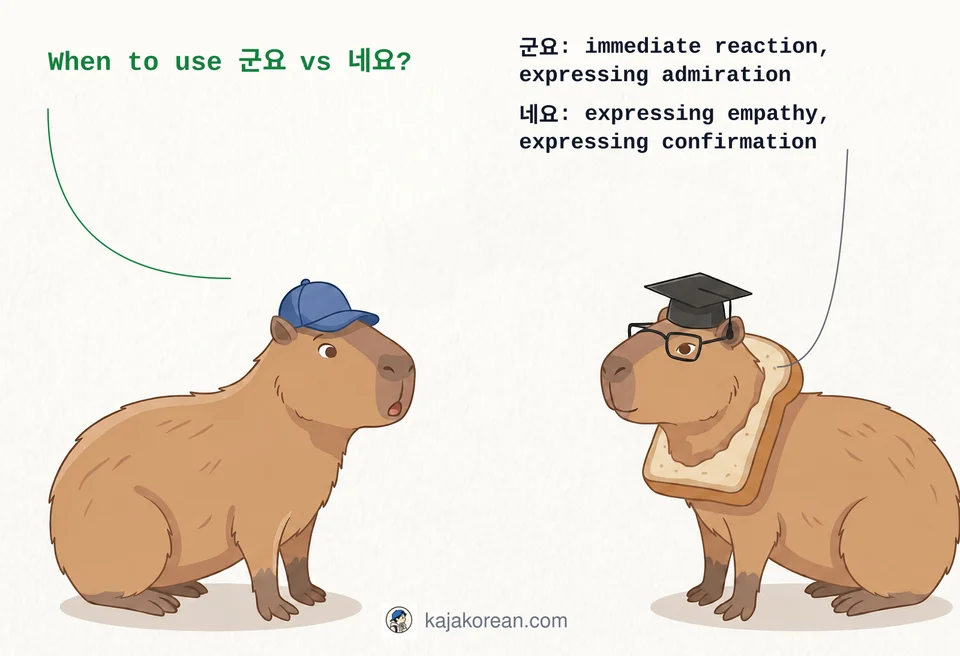
Used to express surprise or admiration about new facts or situations.
When to use
new information discovery, expressing admiration, immediate reaction
The nuance
Expresses the speaker's surprise or admiration upon learning something new.
군요 (gun-yo, gunyo) · 네요 (ne-yo, neyo)
군요 is used to express surprise or admiration about new information, while 네요 is mainly used to confirm or empathize with the other person's statement or situation.

One lane per word — no nested boxes, just the gist.
Used to express surprise or admiration about new facts or situations.
When to use
new information discovery, expressing admiration, immediate reaction
The nuance
Expresses the speaker's surprise or admiration upon learning something new.
Used to confirm or empathize with the other person's statement or situation.
When to use
expressing confirmation, expressing empathy, agreeing with other's opinion
The nuance
Used when the speaker agrees with or confirms the other person's statement or situation.
이 영화 정말 재미있군요!
i yeong-hwa jeong-mal jae-mi-iss-gun-yo!, i yeong hwa jeong mal jae mi iss gun yo!
Appropriate use of 군요 to express admiration about new information.
이 영화 정말 재미있네요!
i yeong-hwa jeong-mal jae-mi-iss-ne-yo!, i yeong hwa jeong mal jae mi iss ne yo!
Correct use of 네요 to confirm and empathize with the other person.
저 사람이 누구군요?
jeo sa-ram-i nu-gu-gun-yo?, jeo sa ram i nu gu gun yo?
Expresses surprise upon learning who the person is, appropriate for 군요.
저 사람이 누구네요?
jeo sa-ram-i nu-gu-ne-yo?, jeo sa ram i nu gu ne yo?
네요 is not suitable in questions expressing surprise; 군요 is correct.
날씨가 참 좋군요!
nal-ssi-ga cham joh-gun-yo!, nal ssi ga cham joh gun yo!
군요 is used to express admiration for new weather observation.
날씨가 참 좋네요!
nal-ssi-ga cham joh-ne-yo!, nal ssi ga cham joh ne yo!
네요 naturally expresses empathy when agreeing about the weather.
그 사람이 벌써 왔군요!
geu sa-ram-i beol-sseo wass-gun-yo!, geu sa ram i beol sseo wass gun yo!
Expresses surprise at unexpected fact, suitable for 군요.
그 사람이 벌써 왔네요!
geu sa-ram-i beol-sseo wass-ne-yo!, geu sa ram i beol sseo wass ne yo!
네요 can be used to confirm and share the fact with the listener.
Which ending is appropriate to express surprise about new information?
Which ending is mainly used to confirm or empathize with the other person's statement?
Which ending is appropriate for interrogative sentences?