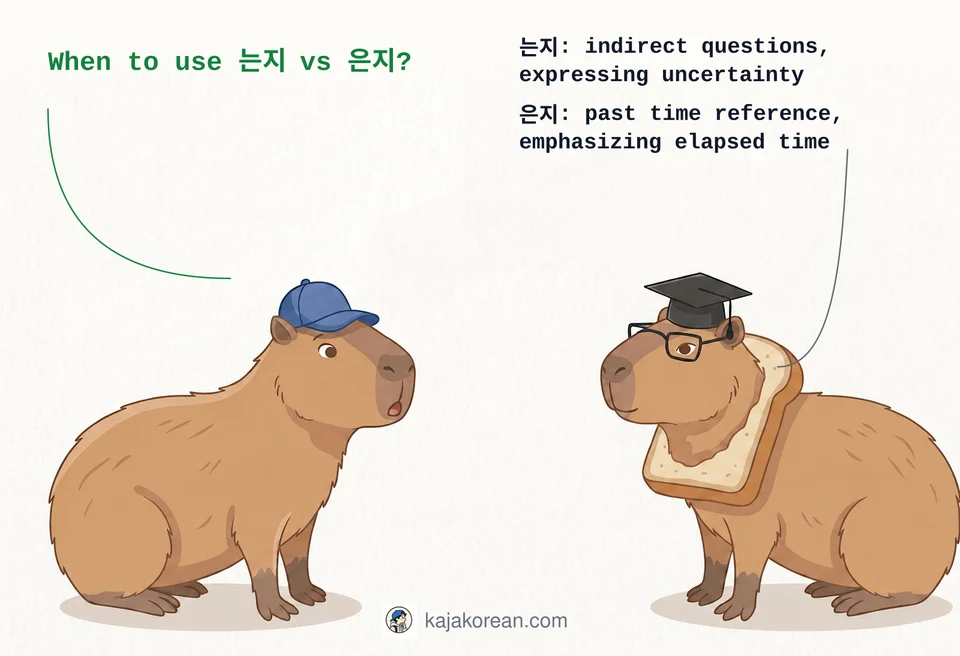
는지 vs 은지: Difference in Question and Time Reference

는지 (neun-ji, neunji) · 은지 (eun-ji, eunji)

는지 is used for indirect questions or uncertainty, while 은지 indicates a past time reference.

Comparison of Korean grammar 는지 and 은지 usage

Word-by-word breakdown

One lane per word — no nested boxes, just the gist.

는지(neun-ji, neunji)

A connective ending expressing doubt or indirect questions

When to use

indirect questions, expressing uncertainty, within questions or doubt

The nuance

Attach to verb or adjective stems to form indirect questions or express uncertainty.

은지(eun-ji, eunji)

An adverbial suffix indicating a past time point emphasizing elapsed time since then

When to use

past time reference, emphasizing elapsed time, expressing duration since event

The nuance

Attach to verb stems to indicate elapsed time since a past event or point.

Real-world examples

  • 그 사람이 어디에 사는지 알아요?

    geu sa-ram-i eo-di-e sa-neun-ji al-a-yo?, geu sa ram i eo di e sa neun ji al a yo?

    는지 correctly used for an indirect question.

  • 그 사람이 어디에 사은지 알아요?

    geu sa-ram-i eo-di-e sa-eun-ji al-a-yo?, geu sa ram i eo di e sa eun ji al a yo?

    은지 cannot be used in indirect questions.

  • 비가 올지 모르겠어요.

    bi-ga ol-ji mo-reu-gess-eo-yo., bi ga ol ji mo reu gess eo yo.

    는지 properly expresses uncertainty.

  • 비가 올은지 모르겠어요.

    bi-ga ol-eun-ji mo-reu-gess-eo-yo., bi ga ol eun ji mo reu gess eo yo.

    은지 is not used to express uncertainty.

  • 한국에 온 지 3년 되었어요.

    han-guk-e on ji 3nyeon doe-eoss-eo-yo., han guk e on ji 3nyeon doe eoss eo yo.

    은지 correctly used to indicate elapsed time since arrival.

  • 한국에 는 지 3년 되었어요.

    han-guk-e neun ji 3nyeon doe-eoss-eo-yo., han guk e neun ji 3nyeon doe eoss eo yo.

    는지 is not used to express elapsed time.

  • 그가 언제 도착했는지 기억이 안 나요.

    geu-ga eon-je do-chak-haess-neun-ji gi-eok-i an na-yo., geu ga eon je do chak haess neun ji gi eok i an na yo.

    는지 correctly used in indirect question.

  • 그가 언제 도착했은지 기억이 안 나요.

    geu-ga eon-je do-chak-haess-eun-ji gi-eok-i an na-yo., geu ga eon je do chak haess eun ji gi eok i an na yo.

    은지 cannot be used in indirect questions.

Quick quiz

  1. Which is appropriate for indirect questions?

    다음 중 간접 의문문에 적절한 표현은?(da-eumjunggan-jeopui-mun-mun-ejeok-jeol-hanpyo-hyeon-eun?, daeumjungganjeopuimunmunejeokjeolhanpyohyeoneun?)
  2. Which expression is used in '한국에 온 지 5년 됐어요.'?

    ‘한국에 온 지 5년 됐어요.’ 문장에서 쓰인 표현은?(‘han-guk-eonji5nyeondwaess-eo-yo.’mun-jang-e-seosseu-inpyo-hyeon-eun?, ‘hangukeonji5nyeondwaesseoyo.’munjangeseosseuinpyohyeoneun?)
  3. What is the role of ‘-지’ in ‘비가 올지 모르겠어요.’?

    ‘비가 올지 모르겠어요.’ 문장에서 ‘-지’의 역할은?(‘bi-gaol-jimo-reu-gess-eo-yo.’mun-jang-e-seo‘-ji’uiyeok-hal-eun?, ‘bigaoljimoreugesseoyo.’munjangeseo‘ji’uiyeokhaleun?)

More comparisons to explore

View all word comparisons →