진짜 vs 정말: Difference Between Sincerity and Emphasis

진짜 (jin-jja, jinjja) · 정말 (jeong-mal, jeongmal)

진짜 focuses more on sincerity and truth, while 정말 is mainly used for emphasis or exclamation.

Comparison of Korean words 진짜 and 정말 showing usage differences

Word-by-word breakdown

One lane per word — no nested boxes, just the gist.

진짜(jin-jja, jinjja)

Used to express truth or sincerity

When to use

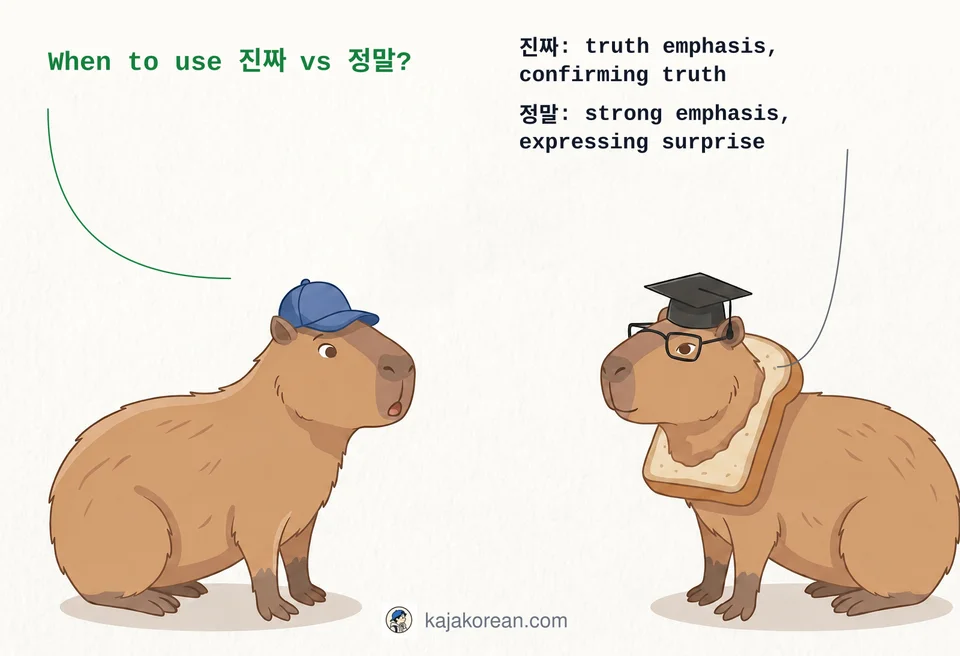
truth emphasis, expressing sincerity, confirming truth

The nuance

진짜 is used to emphasize that something is true or to express sincerity. It focuses on truthfulness, mostly in spoken language.

정말(jeong-mal, jeongmal)

Used to express emphasis, admiration, or surprise

When to use

expressing admiration, expressing surprise, strong emphasis

The nuance

정말 is used to strongly express a situation or emotion, often for admiration or surprise. It is suitable for a wider range of emotional expressions than 진짜.

Real-world examples

  • 진짜 너 오늘 열심히 일했네.

    jin-jja neo o-neul yeol-sim-hi il-haess-ne., jin jja neo o neul yeol sim hi il haess ne.

    Natural sentence emphasizing truth and sincerity.

  • 정말 너 오늘 열심히 일했네.

    jeong-mal neo o-neul yeol-sim-hi il-haess-ne., jeong mal neo o neul yeol sim hi il haess ne.

    Natural sentence expressing admiration and emphasis.

  • 진짜 예뻐!

    jin-jja ye-ppeo!, jin jja ye ppeo!

    Using 진짜 to sincerely say 'pretty'.

  • 정말 예뻐!

    jeong-mal ye-ppeo!, jeong mal ye ppeo!

    Natural expression of admiration and emphasis.

  • 진짜 감탄스럽다!

    jin-jja gam-tan-seu-reop-da!, jin jja gam tan seu reop da!

    진짜 is less suitable for admiration; use 정말 instead.

  • 정말 사실이야?

    jeong-mal sa-sil-i-ya?, jeong mal sa sil i ya?

    For confirming truth, 진짜 is more natural.

  • 진짜 놀랐어!

    jin-jja nol-rass-eo!, jin jja nol rass eo!

    For expressing surprise, 정말 is more suitable.

  • 정말 진실이야.

    jeong-mal jin-sil-i-ya., jeong mal jin sil i ya.

    For emphasizing truth, 진짜 is more natural.

Quick quiz

  1. Which word do you use to emphasize truth?

    사실을 강조하고 싶을 때 어떤 말을 쓰나요?(sa-sil-eulgang-jo-ha-gosip-eulttaeeo-tteonmal-eulsseu-na-yo?, sasileulgangjohagosipeulttaeeotteonmaleulsseunayo?)
  2. Which word is appropriate for expressing admiration or surprise?

    감탄이나 놀라움을 표현할 때 적절한 단어는?(gam-tan-i-nanol-ra-um-eulpyo-hyeon-halttaejeok-jeol-handan-eo-neun?, gamtaninanolraumeulpyohyeonhalttaejeokjeolhandaneoneun?)
  3. Fill in the blank: “___ 너 오늘 너무 멋져!”

    “___ 너 오늘 너무 멋져!”에 들어갈 말은?(“___neoo-neulneo-mumeos-jyeo!”edeul-eo-galmal-eun?, “___neooneulneomumeosjyeo!”edeuleogalmaleun?)
  4. Which word fits: “___ 그 영화 재미있었어?” to ask about truth?

    “___ 그 영화 재미있었어?” 진실 여부를 묻는 문장에 알맞은 단어는?(“___geuyeong-hwajae-mi-iss-eoss-eo?”jin-silyeo-bu-reulmut-neunmun-jang-eal-maj-eundan-eo-neun?, “___geuyeonghwajaemiisseosseo?”jinsilyeobureulmutneunmunjangealmajeundaneoneun?)

More comparisons to explore

View all word comparisons →