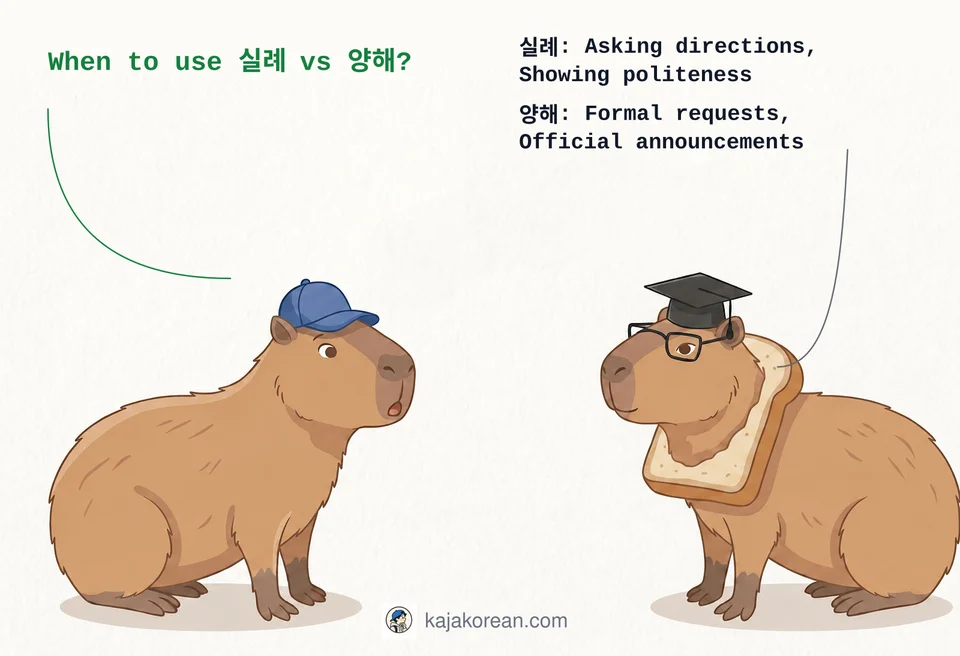
실례 vs 양해: Politeness vs Understanding

실례 (sil-rye, silrye) · 양해 (yang-hae, yanghae)

‘실례’ is used to show politeness when interrupting or inconveniencing someone, while ‘양해’ is used to ask for someone’s understanding or tolerance.

Comparison of Korean words 실례 and 양해 for politeness and understanding

Word-by-word breakdown

One lane per word — no nested boxes, just the gist.

실례(sil-rye, silrye)

Expression used to show politeness when interrupting or inconveniencing someone

When to use

Before interrupting, Showing politeness, Making phone calls, Asking directions

The nuance

‘실례’ is used to show politeness before or after an action that might inconvenience or interrupt someone. Common phrases include ‘실례합니다’ or ‘실례지만’ to politely ask for attention or permission, functioning as a soft apology or preface.

양해(yang-hae, yanghae)

Expression used to ask for someone's understanding or cooperation

When to use

Apologizing inconvenience, Formal requests, Official announcements, Notifying rule changes

The nuance

‘양해’ is used to acknowledge possible inconvenience or difficulty to the other party and politely ask for their understanding or cooperation. Commonly used in formal contexts with phrases like ‘양해 부탁드립니다’ or ‘양해해 주세요’.

Real-world examples

  • 실례합니다, 잠시 말씀 좀 여쭤봐도 될까요?

    sil-rye-hap-ni-da, jam-si mal-sseum jom yeo-jjwo-bwa-do doel-kka-yo?, sil rye hap ni da, jam si mal sseum jom yeo jjwo bwa do doel kka yo?

    Appropriate polite phrase used before interrupting someone.

  • 양해합니다, 지금 통화 중이라 나중에 다시 전화할게요.

    yang-hae-hap-ni-da, ji-geum tong-hwa jung-i-ra na-jung-e da-si jeon-hwa-hal-ge-yo., yang hae hap ni da, ji geum tong hwa jung i ra na jung e da si jeon hwa hal ge yo.

    ‘양해합니다’ is for asking understanding, not for interrupting or excusing oneself here; ‘실례합니다’ fits better.

  • 회의 시간 변경에 대해 양해 부탁드립니다.

    hoe-ui si-gan byeon-gyeong-e dae-hae yang-hae bu-tak-deu-rip-ni-da., hoe ui si gan byeon gyeong e dae hae yang hae bu tak deu rip ni da.

    Appropriate formal request for understanding about schedule change.

  • 길 좀 물어봐도 될까요? 실례지만요.

    gil jom mul-eo-bwa-do doel-kka-yo? sil-rye-ji-man-yo., gil jom mul eo bwa do doel kka yo? sil rye ji man yo.

    Natural polite phrase used when asking for directions.

  • 양해합니다, 제가 늦게 도착해서 죄송합니다.

    yang-hae-hap-ni-da, je-ga neuj-ge do-chak-hae-seo joe-song-hap-ni-da., yang hae hap ni da, je ga neuj ge do chak hae seo joe song hap ni da.

    ‘양해합니다’ is not commonly used alone here; ‘양해를 구합니다’ or ‘양해 부탁드립니다’ is correct.

  • 양해해 주세요, 오늘은 일찍 퇴근해야 해서요.

    yang-hae-hae ju-se-yo, o-neul-eun il-jjik toe-geun-hae-ya hae-seo-yo., yang hae hae ju se yo, o neul eun il jjik toe geun hae ya hae seo yo.

    Polite request for understanding about leaving early.

  • 실례해 주세요, 잠시 조용히 해 주세요.

    sil-rye-hae ju-se-yo, jam-si jo-yong-hi hae ju-se-yo., sil rye hae ju se yo, jam si jo yong hi hae ju se yo.

    ‘실례해 주세요’ is incorrect; ‘양해해 주세요’ is the proper expression to ask for understanding.

Quick quiz

  1. Which expression is used to politely start when you might interrupt someone?

    상대방에게 방해가 될 수 있어서 예의를 갖추고 말을 시작할 때 어떤 표현을 쓰나요?(sang-dae-bang-e-gebang-hae-gadoelsuiss-eo-seoye-ui-reulgaj-chu-gomal-eulsi-jak-halttaeeo-tteonpyo-hyeon-eulsseu-na-yo?, sangdaebangegebanghaegadoelsuisseoseoyeuireulgajchugomaleulsijakhalttaeeotteonpyohyeoneulsseunayo?)
  2. Which expression is appropriate to ask for understanding when announcing a meeting change?

    회의 일정 변경을 알리면서 상대방의 이해를 구할 때 적절한 표현은?(hoe-uiil-jeongbyeon-gyeong-eulal-ri-myeon-seosang-dae-bang-uii-hae-reulgu-halttaejeok-jeol-hanpyo-hyeon-eun?, hoeuiiljeongbyeongyeongeulalrimyeonseosangdaebanguiihaereulguhalttaejeokjeolhanpyohyeoneun?)
  3. What is the natural expression when asking for directions?

    길을 물어볼 때 자연스러운 표현은?(gil-eulmul-eo-bolttaeja-yeon-seu-reo-unpyo-hyeon-eun?, gileulmuleobolttaejayeonseureounpyohyeoneun?)
  4. Which is a formal way to inform inconvenience and ask for understanding?

    상대방에게 불편함을 알리고 이해를 구하는 공식적인 표현은?(sang-dae-bang-e-gebul-pyeon-ham-eulal-ri-goi-hae-reulgu-ha-neungong-sik-jeok-inpyo-hyeon-eun?, sangdaebangegebulpyeonhameulalrigoihaereulguhaneungongsikjeokinpyohyeoneun?)

More comparisons to explore

View all word comparisons →