
고마워(go-ma-wo, gomawo)
Casual and everyday expression of thanks
When to use
Thanking friends, Family thanks, Casual conversation
The nuance
Used with close friends, family, or peers in informal or casual speech.
고마워 (go-ma-wo, gomawo) · 감사 (gam-sa, gamsa)
고마워 is a casual, friendly way to say thanks, while 감사 is formal and polite, used in official or respectful contexts.
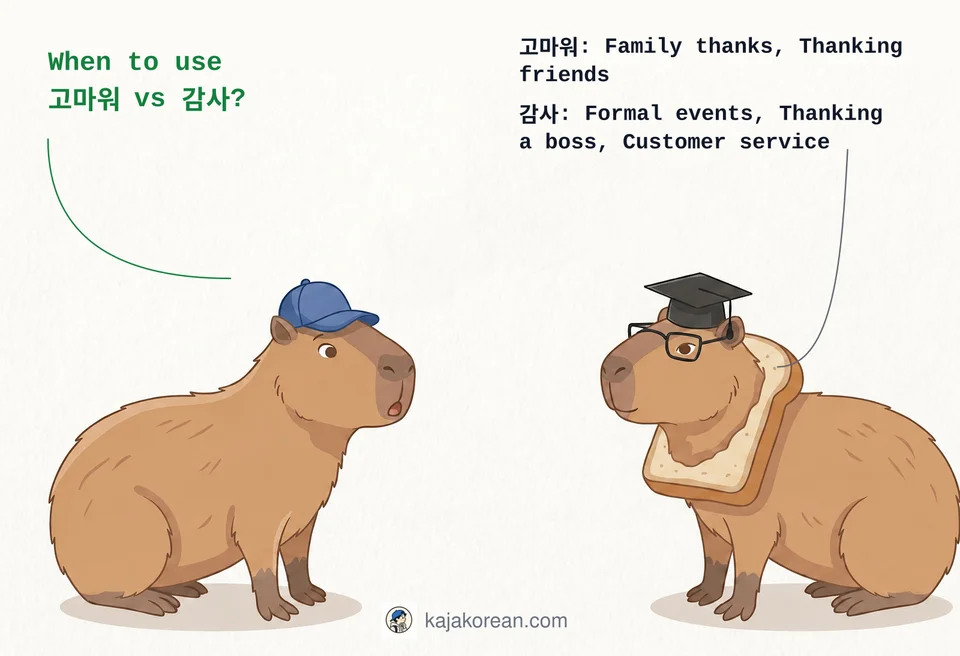
One lane per word — no nested boxes, just the gist.
Casual and everyday expression of thanks
When to use
Thanking friends, Family thanks, Casual conversation
The nuance
Used with close friends, family, or peers in informal or casual speech.
Formal and official expression of gratitude
When to use
Thanking a boss, Customer service, Formal events
The nuance
Used with superiors, clients, or in formal settings, always with honorific language.
고마워! 도와줘서 정말 고마워.
go-ma-wo! do-wa-jwo-seo jeong-mal go-ma-wo., go ma wo! do wa jwo seo jeong mal go ma wo.
Natural and appropriate when speaking to friends or close people.
감사! 도와줘서 정말 감사.
gam-sa! do-wa-jwo-seo jeong-mal gam-sa., gam sa! do wa jwo seo jeong mal gam sa.
감사 is a noun and should not be used alone or repeated; ‘감사합니다’ is correct.
선생님, 정말 감사합니다.
seon-saeng-nim, jeong-mal gam-sa-hap-ni-da., seon saeng nim, jeong mal gam sa hap ni da.
Appropriate in formal situations using honorifics.
엄마, 고마워! 맛있는 밥 해줘서 고마워.
eom-ma, go-ma-wo! mas-iss-neun bap hae-jwo-seo go-ma-wo., eom ma, go ma wo! mas iss neun bap hae jwo seo go ma wo.
Suitable casual thanks between family members.
고마워요, 고객님.
go-ma-wo-yo, go-gaek-nim., go ma wo yo, go gaek nim.
‘고마워요’ is awkward between informal and formal; use ‘감사합니다’ for customers.
감사합니다, 고객님. 문의해 주셔서 감사합니다.
gam-sa-hap-ni-da, go-gaek-nim. mun-ui-hae ju-syeo-seo gam-sa-hap-ni-da., gam sa hap ni da, go gaek nim. mun ui hae ju syeo seo gam sa hap ni da.
Appropriate formal, honorific customer service expression.
친구야, 고마워! 생일 선물 정말 고마워.
chin-gu-ya, go-ma-wo! saeng-il seon-mul jeong-mal go-ma-wo., chin gu ya, go ma wo! saeng il seon mul jeong mal go ma wo.
Natural and casual thanks between friends.
감사, 친구야.
gam-sa, chin-gu-ya., gam sa, chin gu ya.
Using ‘감사’ alone with friends is too stiff; use ‘고마워’ instead.
Which is appropriate to thank a friend?
How to thank a boss at work?
Proper thanks to a customer?
Most natural thanks to family?