
미안(mi-an, mian)
Casual, friendly apology
When to use
Apologizing to friends, Minor mistakes, Informal conversation
The nuance
Used for light apologies among friends, family, or peers. Not appropriate in formal settings or with superiors.
미안 (mi-an, mian) · 죄송 (joe-song, joesong)
Both 미안 and 죄송 express apology, but 미안 suits casual, friendly apologies, while 죄송 fits formal, respectful situations.
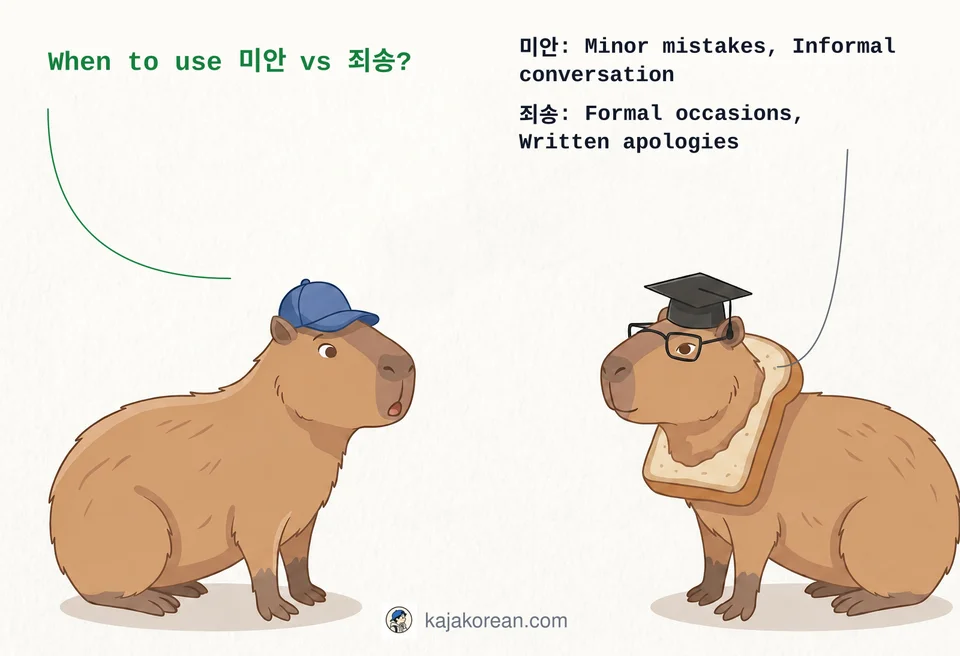
One lane per word — no nested boxes, just the gist.
Casual, friendly apology
When to use
Apologizing to friends, Minor mistakes, Informal conversation
The nuance
Used for light apologies among friends, family, or peers. Not appropriate in formal settings or with superiors.
Formal and respectful apology
When to use
Apologizing to superiors, Formal occasions, Written apologies
The nuance
Used to apologize respectfully in formal situations such as with superiors, strangers, or official contexts. Common in written formal communication.
친구에게 늦어서 미안해.
chin-gu-e-ge neuj-eo-seo mi-an-hae., chin gu e ge neuj eo seo mi an hae.
Appropriate casual apology among friends.
친구에게 늦어서 죄송해.
chin-gu-e-ge neuj-eo-seo joe-song-hae., chin gu e ge neuj eo seo joe song hae.
Too formal for friends; 미안 should be used.
상사에게 보고서를 늦게 내서 죄송합니다.
sang-sa-e-ge bo-go-seo-reul neuj-ge nae-seo joe-song-hap-ni-da., sang sa e ge bo go seo reul neuj ge nae seo joe song hap ni da.
Correct formal apology to a superior.
상사에게 보고서를 늦게 내서 미안해.
sang-sa-e-ge bo-go-seo-reul neuj-ge nae-seo mi-an-hae., sang sa e ge bo go seo reul neuj ge nae seo mi an hae.
Too casual for a superior; 죄송합니다 should be used.
처음 만난 사람에게 미안해요는 실례다.
cheo-eum man-nan sa-ram-e-ge mi-an-hae-yo-neun sil-rye-da., cheo eum man nan sa ram e ge mi an hae yo neun sil rye da.
For strangers, 죄송 is more polite than 미안.
처음 만난 사람에게 죄송해요.
cheo-eum man-nan sa-ram-e-ge joe-song-hae-yo., cheo eum man nan sa ram e ge joe song hae yo.
Appropriate formal apology to a stranger.
가벼운 실수에 미안하다고 말한다.
ga-byeo-un sil-su-e mi-an-ha-da-go mal-han-da., ga byeo un sil su e mi an ha da go mal han da.
Natural to use 미안 for minor mistakes.
가벼운 실수에 죄송하다고 말한다.
ga-byeo-un sil-su-e joe-song-ha-da-go mal-han-da., ga byeo un sil su e joe song ha da go mal han da.
Too formal for minor mistakes.
Which is appropriate to apologize to a friend for being late?
How to apologize to a boss for a late report?
Appropriate apology to a stranger?
Most natural apology for a minor mistake?