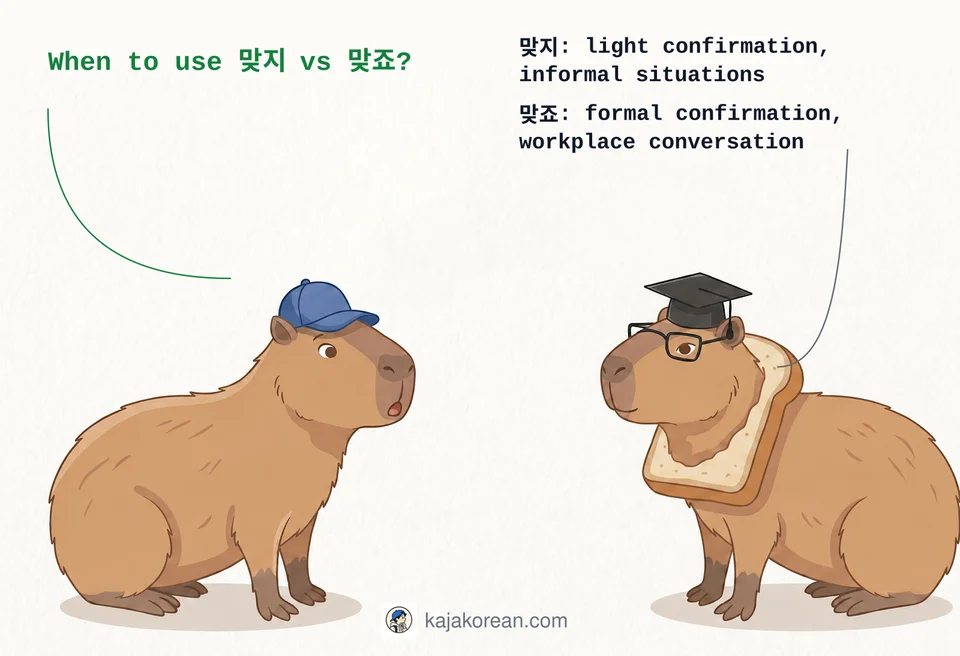
Expression used to casually seek agreement from someone
When to use
talking with friends, light confirmation, informal situations
The nuance
Used in informal or friendly contexts, attached at the end of a sentence to naturally prompt agreement.
맞지 (maj-ji, majji) · 맞죠 (maj-jyo, majjyo)
'맞지' and '맞죠' both seek agreement or confirmation, but '맞지' suits casual, friendly contexts while '맞죠' fits polite, confident confirmation.

One lane per word — no nested boxes, just the gist.
Expression used to casually seek agreement from someone
When to use
talking with friends, light confirmation, informal situations
The nuance
Used in informal or friendly contexts, attached at the end of a sentence to naturally prompt agreement.
Expression used to politely seek agreement or express confidence
When to use
workplace conversation, formal confirmation, polite speech situations
The nuance
Used in more formal or polite contexts, attached at the end of a sentence to politely request agreement.
이 문제는 어렵지, 그렇지?
i mun-je-neun eo-ryeop-ji, geu-reoh-ji?, i mun je neun eo ryeop ji, geu reoh ji?
Natural expression when casually seeking agreement among friends.
이 문제는 어렵지, 그렇죠?
i mun-je-neun eo-ryeop-ji, geu-reoh-jyo?, i mun je neun eo ryeop ji, geu reoh jyo?
Sounds overly formal among friends; '맞지' is more appropriate.
오늘 회의는 오후 3시 맞죠?
o-neul hoe-ui-neun o-hu 3si maj-jyo?, o neul hoe ui neun o hu 3si maj jyo?
Suitable for polite confirmation in formal settings like meetings.
오늘 회의는 오후 3시 맞지?
o-neul hoe-ui-neun o-hu 3si maj-ji?, o neul hoe ui neun o hu 3si maj ji?
Too casual for formal situations.
너 어제 영화 봤지?
neo eo-je yeong-hwa bwass-ji?, neo eo je yeong hwa bwass ji?
Natural for casual confirmation among friends.
너 어제 영화 봤죠?
neo eo-je yeong-hwa bwass-jyo?, neo eo je yeong hwa bwass jyo?
Too polite and awkward when speaking to close friends.
이 보고서 내용이 맞죠?
i bo-go-seo nae-yong-i maj-jyo?, i bo go seo nae yong i maj jyo?
Appropriate for polite confirmation with colleagues or superiors.
이 보고서 내용이 맞지?
i bo-go-seo nae-yong-i maj-ji?, i bo go seo nae yong i maj ji?
Sounds too casual in formal workplace settings.
Which expression is appropriate for casually seeking agreement with a friend?
Which expression is used for polite confirmation with a boss?
Which expression sounds overly polite and awkward to a friend?
What does it mean?