
보다(bo-da, boda)
The act of directly observing or looking at an object with one's eyes
When to use
direct observation, active gaze, intentional looking
The nuance
Used when the subject intentionally looks at or observes an object with their eyes.
보다 (bo-da, boda) · 보이다 (bo-i-da, boida)
'보다' refers to the act of directly looking at something, while '보이다' describes the state of something being visible or appearing to the eyes.
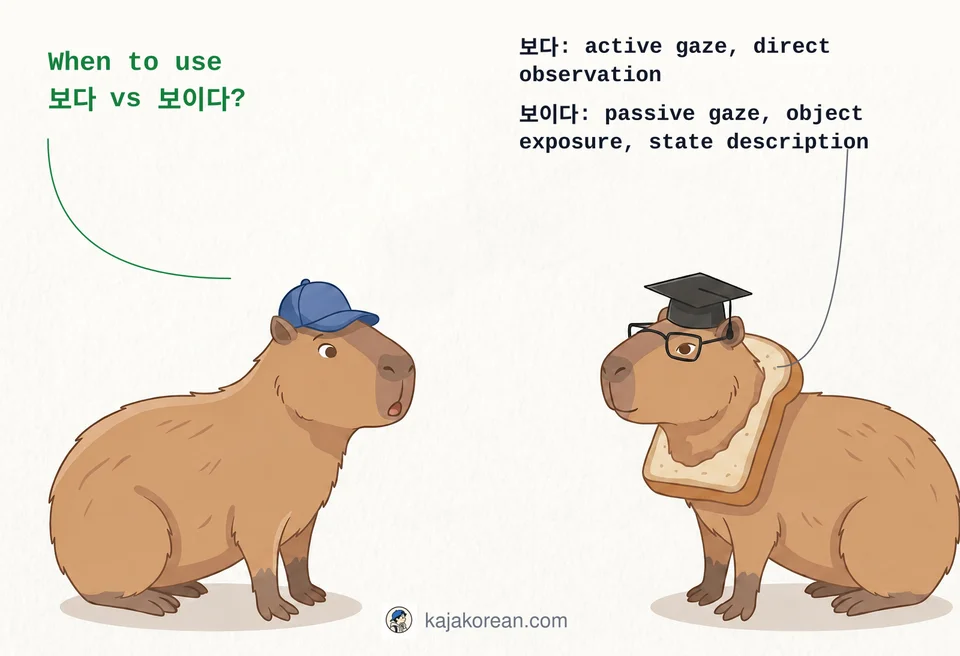
One lane per word — no nested boxes, just the gist.
The act of directly observing or looking at an object with one's eyes
When to use
direct observation, active gaze, intentional looking
The nuance
Used when the subject intentionally looks at or observes an object with their eyes.
Describes the state or phenomenon of an object being visible or appearing to the eyes
When to use
passive gaze, state description, object exposure
The nuance
Used when an object naturally comes into view or is shown to someone.
나는 산을 봤다.
na-neun san-eul bwass-da., na neun san eul bwass da.
The subject actively looked at the mountain, so '보다' is correct.
산이 잘 보여요.
san-i jal bo-yeo-yo., san i jal bo yeo yo.
The mountain naturally appears to the eyes, so '보이다' is correct.
나는 산이 보았다.
na-neun san-i bo-ass-da., na neun san i bo ass da.
'보이다' cannot have the subject as the object; it is not an active verb, so this is incorrect. Use '보였다' instead.
그림을 보인다.
geu-rim-eul bo-in-da., geu rim eul bo in da.
'보이다' expresses a state, not an active action; use '보다' for active looking.
그는 책을 봤다.
geu-neun chaek-eul bwass-da., geu neun chaek eul bwass da.
Expresses active looking or reading of a book, so '보다' is appropriate.
책이 잘 보인다.
chaek-i jal bo-in-da., chaek i jal bo in da.
Describes the book being clearly visible, so '보이다' is correct.
나는 그 사람이 보인다.
na-neun geu sa-ram-i bo-in-da., na neun geu sa ram i bo in da.
The subject cannot be the object of '보이다'; use '보여요' instead.
그 사람이 나를 봤다.
geu sa-ram-i na-reul bwass-da., geu sa ram i na reul bwass da.
The subject actively looked at me, so '보다' is correct.
Which sentence should use '보다'?
Which sentence correctly uses '보이다'?
Which sentence incorrectly uses '보이다' actively?
What does it mean?