
듣다(deut-da, deutda)
An active act of perceiving or paying attention to sound
When to use
Active listening, Intentional hearing, Listening to music, Following instructions
The nuance
Use 듣다 when the subject actively perceives or listens to a sound.
듣다 (deut-da, deutda) · 들리다 (deul-ri-da, deulrida)
'듣다' refers to actively perceiving sound, while '들리다' describes sound being passively perceived or naturally heard.
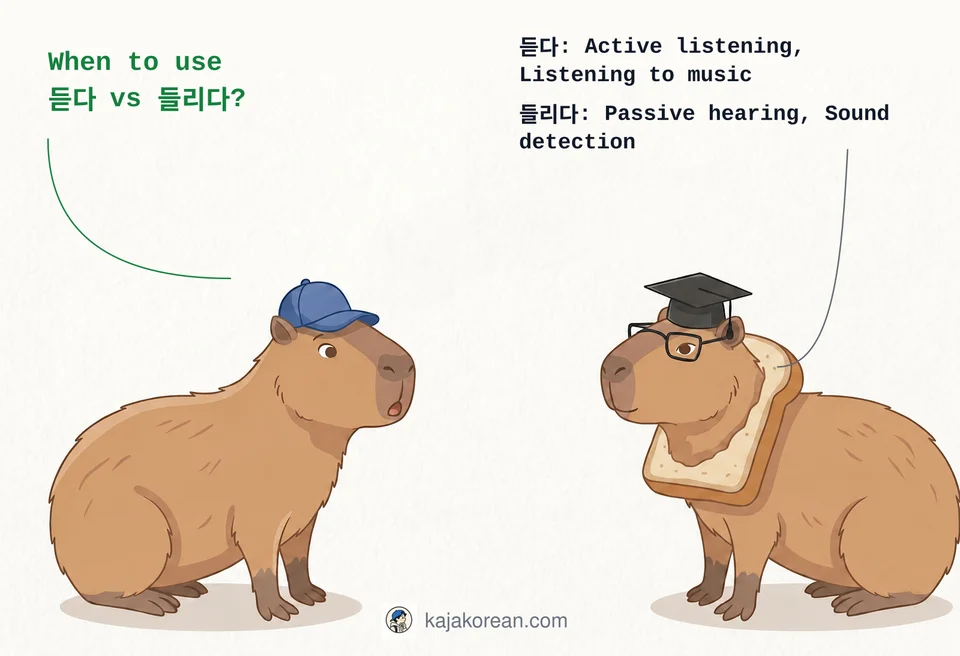
One lane per word — no nested boxes, just the gist.
An active act of perceiving or paying attention to sound
When to use
Active listening, Intentional hearing, Listening to music, Following instructions
The nuance
Use 듣다 when the subject actively perceives or listens to a sound.
A state or phenomenon where sound is passively perceived or naturally heard
When to use
Passive hearing, Sound detection, Background noise perception, Noise recognition
The nuance
Use 들리다 when sound is passively perceived or naturally heard by the subject.
나는 음악을 듣고 있어요.
na-neun eum-ak-eul deut-go iss-eo-yo., na neun eum ak eul deut go iss eo yo.
The subject is actively listening to music, so '듣다' is correct.
나는 음악이 들리고 있어요.
na-neun eum-ak-i deul-ri-go iss-eo-yo., na neun eum ak i deul ri go iss eo yo.
The music sound is naturally being heard, so '들리다' is appropriate.
그는 내 말을 잘 들려요.
geu-neun nae mal-eul jal deul-ryeo-yo., geu neun nae mal eul jal deul ryeo yo.
'들리다' is for passive perception; active listening requires '듣다'.
그는 내 말을 잘 들어요.
geu-neun nae mal-eul jal deul-eo-yo., geu neun nae mal eul jal deul eo yo.
The subject actively listens to my words, so '듣다' is correct.
바람 소리가 들려요.
ba-ram so-ri-ga deul-ryeo-yo., ba ram so ri ga deul ryeo yo.
Wind sound is naturally perceived, so '들리다' fits.
바람 소리를 듣고 있어요.
ba-ram so-ri-reul deut-go iss-eo-yo., ba ram so ri reul deut go iss eo yo.
Actively listening to wind sound is unnatural; use '들리다' for natural perception.
선생님의 지시를 듣고 있어요.
seon-saeng-nim-ui ji-si-reul deut-go iss-eo-yo., seon saeng nim ui ji si reul deut go iss eo yo.
Actively listening to instructions calls for '듣다'.
선생님의 지시가 들려요.
seon-saeng-nim-ui ji-si-ga deul-ryeo-yo., seon saeng nim ui ji si ga deul ryeo yo.
Instructions require active listening; '들리다' is inappropriate.
Which expression indicates active perception of sound?
Fill in the blank: '바람 소리가 ___.'
Choose the correct word: '그는 내 말을 잘 ___.'
What does it mean?