
씻다(ssis-da, ssisda)
To wash parts of the body or objects
When to use
washing hands, washing food ingredients, washing face
The nuance
Use 씻다 when washing specific parts like hands, face, or objects; it does not imply washing the whole body.
씻다 (ssis-da, ssisda) · 목욕하다 (mok-yok-ha-da, mokyokhada)
‘씻다’ means to wash parts of the body or objects, while ‘목욕하다’ refers to bathing the whole body by immersing or washing thoroughly.
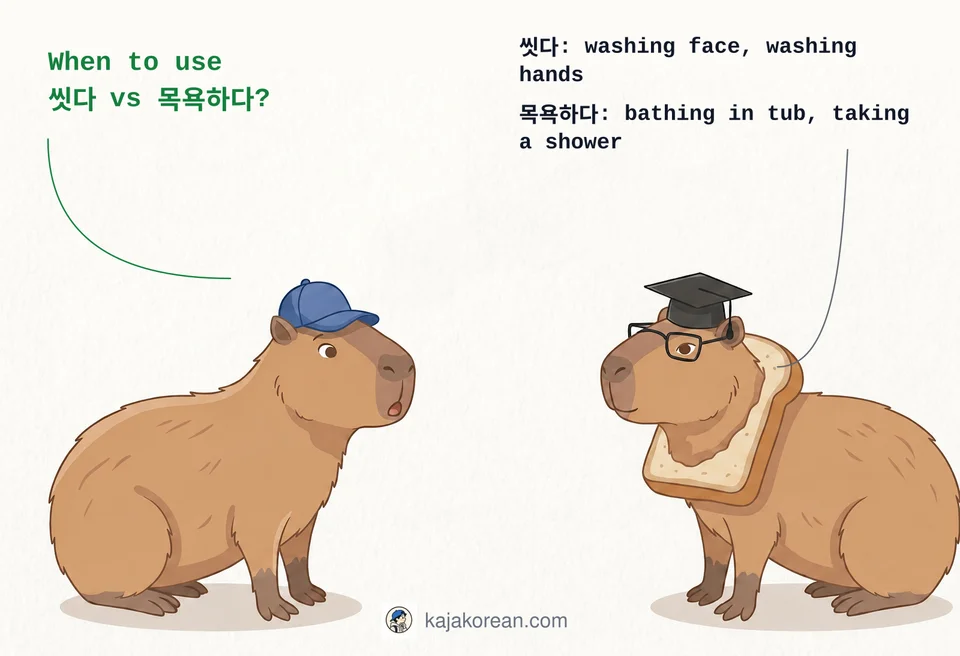
One lane per word — no nested boxes, just the gist.
To wash parts of the body or objects
When to use
washing hands, washing food ingredients, washing face
The nuance
Use 씻다 when washing specific parts like hands, face, or objects; it does not imply washing the whole body.
To bathe the whole body by immersing or washing
When to use
bathing in tub, taking a shower, whole body cleanliness
The nuance
Use 목욕하다 to describe bathing the whole body, usually by soaking in a tub or washing thoroughly.
손을 깨끗이 씻으세요.
son-eul kkae-kkeus-i ssis-eu-se-yo., son eul kkae kkeus i ssis eu se yo.
Hands are a part of the body, so 씻다 is appropriate.
저는 매일 목욕해요.
jeo-neun mae-il mok-yok-hae-yo., jeo neun mae il mok yok hae yo.
Bathing the whole body fits 목욕하다.
채소를 목욕해요.
chae-so-reul mok-yok-hae-yo., chae so reul mok yok hae yo.
You wash vegetables (씻다), not bathe them (목욕하다).
얼굴을 목욕했어요.
eol-gul-eul mok-yok-haess-eo-yo., eol gul eul mok yok haess eo yo.
Face is a part, so 씻다 is correct, not 목욕하다.
아이를 목욕시켰어요.
a-i-reul mok-yok-si-kyeoss-eo-yo., a i reul mok yok si kyeoss eo yo.
Bathing the whole child's body uses 목욕하다.
발을 목욕했어요.
bal-eul mok-yok-haess-eo-yo., bal eul mok yok haess eo yo.
Washing only feet uses 씻다, not 목욕하다.
음식을 먹기 전에 손을 씻으세요.
eum-sik-eul meok-gi jeon-e son-eul ssis-eu-se-yo., eum sik eul meok gi jeon e son eul ssis eu se yo.
Washing hands before eating is 씻다.
매일 아침 욕조에서 씻어요.
mae-il a-chim yok-jo-e-seo ssis-eo-yo., mae il a chim yok jo e seo ssis eo yo.
Bathing in a tub requires 목욕하다, not 씻다.
Which word fits: ‘손을 깨끗이 ___.’?
Which word fits: ‘아이를 ___ 시켰어요.’?
Which word fits: ‘채소를 ___.’?
Which word fits: ‘욕조에서 ___.’?