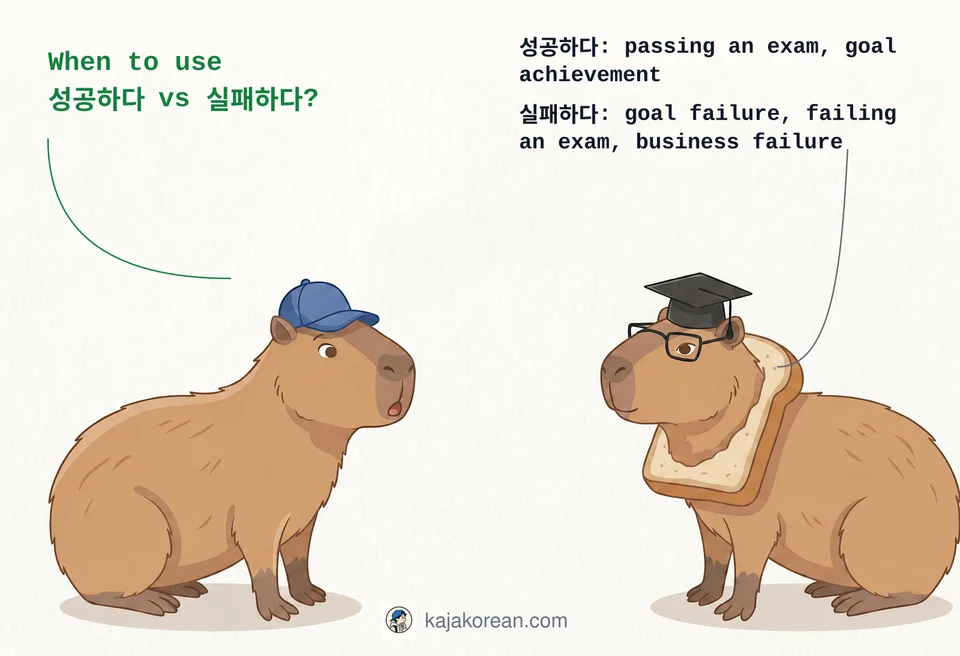
To achieve a goal or plan successfully; to get the desired result
When to use
goal achievement, business success, passing an exam
The nuance
성공하다 indicates a positive outcome when an attempt or effort bears fruit.
성공하다 (seong-gong-ha-da, seonggonghada) · 실패하다 (sil-pae-ha-da, silpaehada)
성공하다 and 실패하다 are verbs indicating whether something was achieved well or not, clearly distinguishing positive and negative outcomes.

One lane per word — no nested boxes, just the gist.
To achieve a goal or plan successfully; to get the desired result
When to use
goal achievement, business success, passing an exam
The nuance
성공하다 indicates a positive outcome when an attempt or effort bears fruit.
To fail to achieve a goal or plan; to not get the desired result
When to use
goal failure, business failure, failing an exam
The nuance
실패하다 indicates a negative outcome when an attempt or effort does not meet the desired result.
그는 이번 프로젝트에서 성공했다.
geu-neun i-beon peu-ro-jek-teu-e-seo seong-gong-haess-da., geu neun i beon peu ro jek teu e seo seong gong haess da.
The project goal was achieved well, so 성공하다 is correct.
그녀는 시험에 실패했다.
geu-nyeo-neun si-heom-e sil-pae-haess-da., geu nyeo neun si heom e sil pae haess da.
She did not get the desired result in the exam, so 실패하다 is appropriate.
우리는 실패해서 기뻤다.
u-ri-neun sil-pae-hae-seo gi-ppeoss-da., u ri neun sil pae hae seo gi ppeoss da.
Failure is a negative outcome and is not used with joy; 성공했다 should be used instead.
그는 사업에 성공하지 못했다.
geu-neun sa-eop-e seong-gong-ha-ji mos-haess-da., geu neun sa eop e seong gong ha ji mos haess da.
He did not achieve the business goal, so 성공하지 못했다 is correct.
나는 성공해서 슬펐다.
na-neun seong-gong-hae-seo seul-peoss-da., na neun seong gong hae seo seul peoss da.
Success is positive and does not fit with sadness; 실패했다 should be used.
그 프로젝트는 실패했다.
geu peu-ro-jek-teu-neun sil-pae-haess-da., geu peu ro jek teu neun sil pae haess da.
The project failed to meet its goal, so 실패했다 is correct.
시험에 성공했다.
si-heom-e seong-gong-haess-da., si heom e seong gong haess da.
In exams, '합격했다' is natural; '성공했다' is rarely used. Use 합격했다 or 시험에 통과했다 instead.
그녀는 목표를 실패했다.
geu-nyeo-neun mok-pyo-reul sil-pae-haess-da., geu nyeo neun mok pyo reul sil pae haess da.
'Failing a goal' is expressed as '목표를 달성하지 못했다' or '실패했다'; '목표를 실패했다' is grammatically incorrect.
Which sentence correctly uses '성공하다'?
Which sentence appropriately uses '실패하다'?
Which word indicates a positive outcome, '성공하다' or '실패하다'?