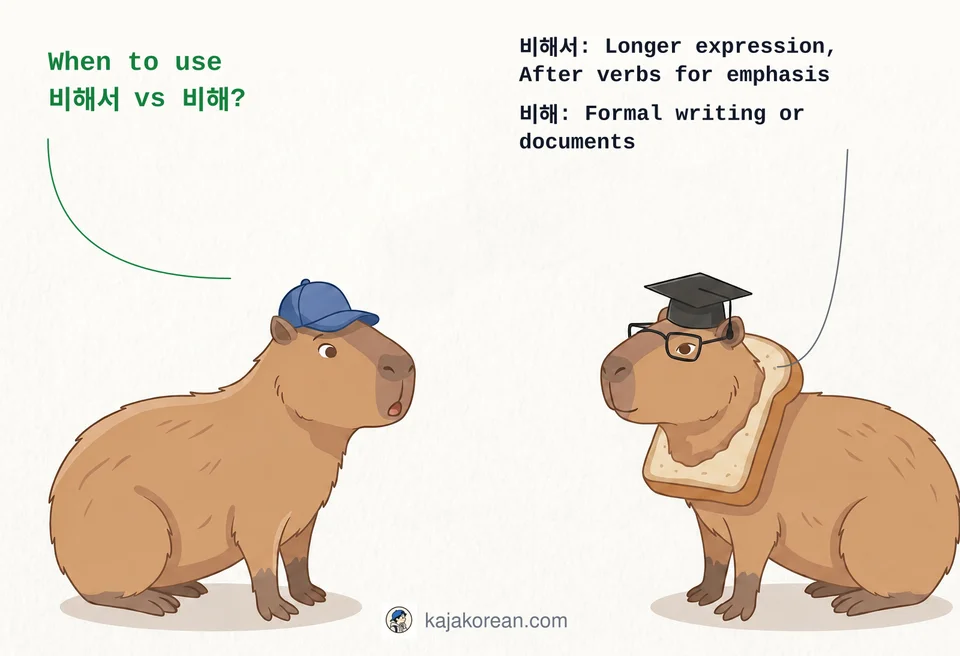
Compared to ~, mainly used after verbs for comparison
When to use
After verbs for emphasis, Clarifying comparison target, Longer expression
The nuance
Used after verbs to clearly specify the comparison target, usually with ‘~에’.
비해서 (bi-hae-seo, bihaeseo) · 비해 (bi-hae, bihae)
비해서 is mainly used after verbs to mean 'compared to', while 비해 is used after nouns for a concise 'compared with' expression.

One lane per word — no nested boxes, just the gist.
Compared to ~, mainly used after verbs for comparison
When to use
After verbs for emphasis, Clarifying comparison target, Longer expression
The nuance
Used after verbs to clearly specify the comparison target, usually with ‘~에’.
Compared with ~, used after nouns for concise comparison
When to use
After nouns for concise comparison, Formal writing or documents, Briefly expressing comparison
The nuance
Attached directly after nouns for concise comparison; ‘~에’ can be omitted.
이 제품은 이전 모델에 비해서 성능이 많이 향상되었다.
i je-pum-eun i-jeon mo-del-e bi-hae-seo seong-neung-i man-i hyang-sang-doe-eoss-da., i je pum eun i jeon mo del e bi hae seo seong neung i man i hyang sang doe eoss da.
‘비해서’ is correctly used after the verb ‘향상되었다’ to specify comparison target.
이 제품은 이전 모델 비해 성능이 많이 향상되었다.
i je-pum-eun i-jeon mo-del bi-hae seong-neung-i man-i hyang-sang-doe-eoss-da., i je pum eun i jeon mo del bi hae seong neung i man i hyang sang doe eoss da.
Using ‘비해’ after a verb is unnatural; ‘비해서’ should be used.
작년 매출에 비해 올해 매출이 증가했다.
jak-nyeon mae-chul-e bi-hae ol-hae mae-chul-i jeung-ga-haess-da., jak nyeon mae chul e bi hae ol hae mae chul i jeung ga haess da.
‘비해’ is correctly attached after the noun ‘작년 매출’ for concise comparison.
작년 매출에 비해서 올해 매출이 증가했다.
jak-nyeon mae-chul-e bi-hae-seo ol-hae mae-chul-i jeung-ga-haess-da., jak nyeon mae chul e bi hae seo ol hae mae chul i jeung ga haess da.
‘비해서’ is awkward after a noun; ‘비해’ is preferred.
그는 동료들에 비해서 일을 빨리 끝낸다.
geu-neun dong-ryo-deul-e bi-hae-seo il-eul ppal-ri kkeut-naen-da., geu neun dong ryo deul e bi hae seo il eul ppal ri kkeut naen da.
‘비해서’ is properly used after the verb ‘끝낸다’.
그는 동료들 비해 일을 빨리 끝낸다.
geu-neun dong-ryo-deul bi-hae il-eul ppal-ri kkeut-naen-da., geu neun dong ryo deul bi hae il eul ppal ri kkeut naen da.
‘비해’ after a verb sounds unnatural.
이번 달 매출은 지난 달 매출에 비해 줄었다.
i-beon dal mae-chul-eun ji-nan dal mae-chul-e bi-hae jul-eoss-da., i beon dal mae chul eun ji nan dal mae chul e bi hae jul eoss da.
‘비해’ is correctly used after a noun for concise comparison.
이번 달 매출은 지난 달 매출에 비해서 줄었다.
i-beon dal mae-chul-eun ji-nan dal mae-chul-e bi-hae-seo jul-eoss-da., i beon dal mae chul eun ji nan dal mae chul e bi hae seo jul eoss da.
‘비해서’ is unnatural after a noun.
Which is correct after a verb?
Which can follow ‘작년 매출’?
When is ‘비해’ appropriate?
When should you use ‘비해서’?