
습니다(seup-ni-da, seupnida)
Formal and official polite sentence ending
When to use
formal presentation, news report, business report, job interview
The nuance
Used in formal situations like documents, presentations, and news.
습니다 (seup-ni-da, seupnida) · 세요 (se-yo, seyo)
습니다 and 세요 are both polite sentence endings, but differ in formality and friendliness.
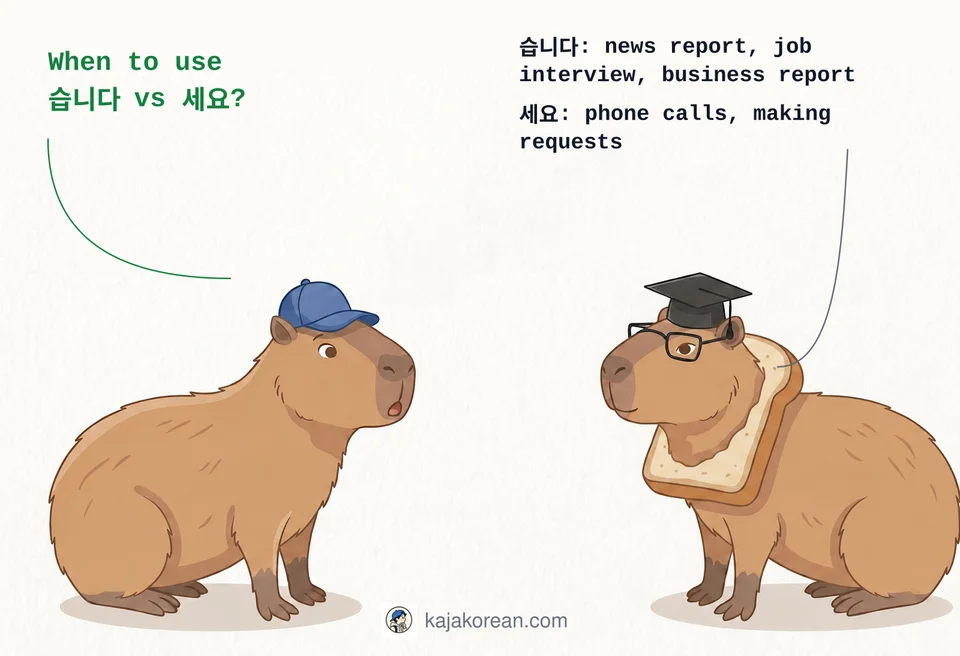
One lane per word — no nested boxes, just the gist.
Formal and official polite sentence ending
When to use
formal presentation, news report, business report, job interview
The nuance
Used in formal situations like documents, presentations, and news.
Casual and friendly polite sentence ending
When to use
talking with friends, ordering in a store, making requests, phone calls
The nuance
Used mainly in everyday conversations, service settings, and requests.
안녕하세요?
an-nyeong-ha-se-yo?, an nyeong ha se yo?
세요 is natural and common in greetings.
안녕하십니까?
an-nyeong-ha-sip-ni-kka?, an nyeong ha sip ni kka?
습니다 form is official and formal for greetings.
이것은 책입니다.
i-geos-eun chaek-ip-ni-da., i geos eun chaek ip ni da.
습니다 is suitable for formal sentences.
이것은 책세요.
i-geos-eun chaek-se-yo., i geos eun chaek se yo.
Attaching 세요 to a noun like '책' is grammatically incorrect.
가세요.
ga-se-yo., ga se yo.
세요 is appropriate to politely tell someone to go.
갑니다.
gap-ni-da., gap ni da.
갑니다 is correct in formal situations.
보고서 작성합니다.
bo-go-seo jak-seong-hap-ni-da., bo go seo jak seong hap ni da.
습니다 form is used in reports or official documents.
보고서 작성하세요.
bo-go-seo jak-seong-ha-se-yo., bo go seo jak seong ha se yo.
Using 세요 for report writing is informal and inappropriate.
Which ending is appropriate for politely asking a friend?
Which ending is used in formal presentations?
Which expression is appropriate when ordering in a store?