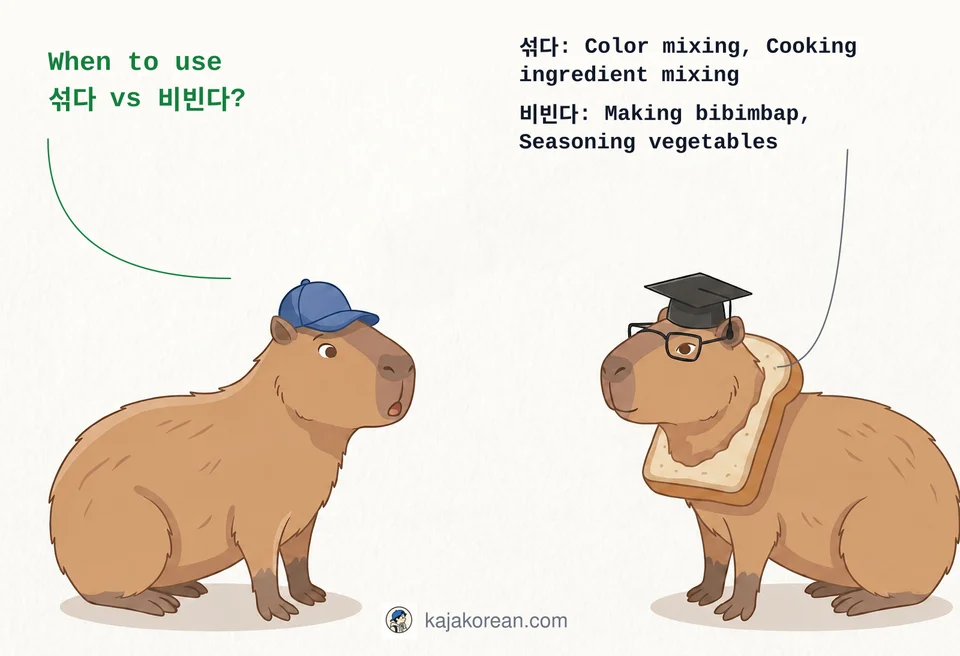
General action of combining multiple ingredients or substances into one
When to use
Cooking ingredient mixing, Color mixing, Mixing ingredients with machine
The nuance
Use 섞다 when combining ingredients evenly by any method—hand, tool, or machine.
섞다 (seokk-da, seokkda) · 비빈다 (bi-bin-da, bibinda)
'섞다' refers to the general action of combining ingredients, while '비빈다' specifically means mixing by rubbing or stirring, often with hands or utensils, especially in food contexts.

One lane per word — no nested boxes, just the gist.
General action of combining multiple ingredients or substances into one
When to use
Cooking ingredient mixing, Color mixing, Mixing ingredients with machine
The nuance
Use 섞다 when combining ingredients evenly by any method—hand, tool, or machine.
Action of mixing by rubbing or stirring with hands or chopsticks, mainly used for food like rice or seasoned vegetables
When to use
Making bibimbap, Seasoning vegetables, Mixing rice and sauce
The nuance
Use 비빈다 when mixing by rubbing or stirring with hands or utensils, mainly limited to food contexts.
나는 샐러드 재료를 잘 섞었다.
na-neun sael-reo-deu jae-ryo-reul jal seokk-eoss-da., na neun sael reo deu jae ryo reul jal seokk eoss da.
Salad is a general combination of ingredients, so '섞다' is appropriate.
나는 샐러드 재료를 비볐다.
na-neun sael-reo-deu jae-ryo-reul bi-byeoss-da., na neun sael reo deu jae ryo reul bi byeoss da.
비비다 is mainly for rubbing food ingredients by hand; salad is better described with '섞다'.
엄마가 비빔밥을 맛있게 비볐다.
eom-ma-ga bi-bim-bap-eul mas-iss-ge bi-byeoss-da., eom ma ga bi bim bap eul mas iss ge bi byeoss da.
Bibimbap is a typical dish where ingredients are mixed by rubbing with hands or chopsticks.
엄마가 비빔밥을 섞었다.
eom-ma-ga bi-bim-bap-eul seokk-eoss-da., eom ma ga bi bim bap eul seokk eoss da.
For bibimbap, '비비다' is natural; '섞다' sounds awkward.
색깔을 섞어서 새로운 색을 만들었다.
saek-kkal-eul seokk-eo-seo sae-ro-un saek-eul man-deul-eoss-da., saek kkal eul seokk eo seo sae ro un saek eul man deul eoss da.
Mixing colors is a general combination, so '섞다' fits.
색깔을 비벼서 새로운 색을 만들었다.
saek-kkal-eul bi-byeo-seo sae-ro-un saek-eul man-deul-eoss-da., saek kkal eul bi byeo seo sae ro un saek eul man deul eoss da.
Colors are not mixed by rubbing hands, so '비비다' is inappropriate.
나물이 양념과 잘 비벼졌다.
na-mul-i yang-nyeom-gwa jal bi-byeo-jyeoss-da., na mul i yang nyeom gwa jal bi byeo jyeoss da.
Mixing seasoned vegetables by rubbing is correctly expressed with '비비다'.
나물이 양념과 잘 섞였다.
na-mul-i yang-nyeom-gwa jal seokk-yeoss-da., na mul i yang nyeom gwa jal seokk yeoss da.
For foods like seasoned vegetables mixed by hand, '비비다' is natural.
Which word should you use when making bibimbap?
What is the natural expression when combining colors?
Which verb is appropriate when mixing seasoned vegetables by hand?