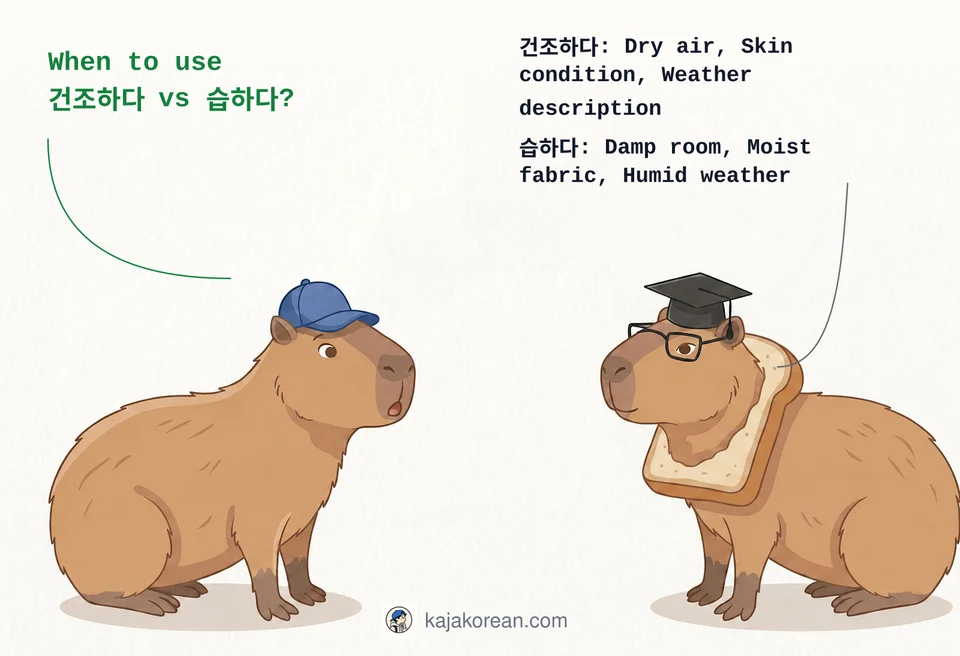
건조하다 vs 습하다: Understanding the Difference in Humidity

건조하다 (geon-jo-ha-da, geonjohada) · 습하다 (seup-ha-da, seuphada)

건조하다 and 습하다 both describe humidity levels, but 건조하다 means dry with little moisture, while 습하다 means humid or damp with a lot of moisture.

Comparison of Korean words 건조하다 and 습하다 describing dry and humid conditions

Word-by-word breakdown

One lane per word — no nested boxes, just the gist.

건조하다(geon-jo-ha-da, geonjohada)

Describes an environment or air that is dry with very little moisture.

When to use

Weather description, Skin condition, Dry air

The nuance

Use 건조하다 when the moisture level is low or almost absent. Suitable for describing dry skin, weather, or air.

습하다(seup-ha-da, seuphada)

Describes an environment or air that is humid, damp, or moist.

When to use

Humid weather, Damp room, Moist fabric

The nuance

Use 습하다 when there is a lot of moisture causing dampness. Appropriate for weather, rooms, or fabrics that feel moist or clammy.

Real-world examples

  • 오늘 날씨가 너무 건조해서 피부가 가려워요.

    o-neul nal-ssi-ga neo-mu geon-jo-hae-seo pi-bu-ga ga-ryeo-wo-yo., o neul nal ssi ga neo mu geon jo hae seo pi bu ga ga ryeo wo yo.

    Appropriate to describe dry weather causing dry skin.

  • 오늘 날씨가 너무 습해서 피부가 가려워요.

    o-neul nal-ssi-ga neo-mu seup-hae-seo pi-bu-ga ga-ryeo-wo-yo., o neul nal ssi ga neo mu seup hae seo pi bu ga ga ryeo wo yo.

    Natural expression when humid weather affects the skin.

  • 방 안이 건조해서 벽에 곰팡이가 피었어요.

    bang an-i geon-jo-hae-seo byeok-e gom-pang-i-ga pi-eoss-eo-yo., bang an i geon jo hae seo byeok e gom pang i ga pi eoss eo yo.

    Mold grows in humid environments, so '습하다' should be used.

  • 방 안이 습해서 벽에 곰팡이가 피었어요.

    bang an-i seup-hae-seo byeok-e gom-pang-i-ga pi-eoss-eo-yo., bang an i seup hae seo byeok e gom pang i ga pi eoss eo yo.

    Appropriate for mold growing in a damp room environment.

  • 옷이 건조해서 눅눅해졌어요.

    os-i geon-jo-hae-seo nuk-nuk-hae-jyeoss-eo-yo., os i geon jo hae seo nuk nuk hae jyeoss eo yo.

    Dampness indicates moisture, so '습하다' should be used.

  • 옷이 습해서 눅눅해졌어요.

    os-i seup-hae-seo nuk-nuk-hae-jyeoss-eo-yo., os i seup hae seo nuk nuk hae jyeoss eo yo.

    Accurately describes clothes becoming damp due to moisture.

  • 겨울에는 공기가 건조하니까 가습기를 사용해요.

    gyeo-ul-e-neun gong-gi-ga geon-jo-ha-ni-kka ga-seup-gi-reul sa-yong-hae-yo., gyeo ul e neun gong gi ga geon jo ha ni kka ga seup gi reul sa yong hae yo.

    Proper expression to describe dry air in winter.

  • 겨울에는 공기가 습하니까 가습기를 사용해요.

    gyeo-ul-e-neun gong-gi-ga seup-ha-ni-kka ga-seup-gi-reul sa-yong-hae-yo., gyeo ul e neun gong gi ga seup ha ni kka ga seup gi reul sa yong hae yo.

    Winter air is usually dry, so this does not match the use of a humidifier.

Quick quiz

  1. Which sentence should use '습하다'?

    다음 중 '습하다'를 써야 하는 문장은?(da-eumjung'seup-ha-da'reulsseo-yaha-neunmun-jang-eun?, daeumjung'seuphada'reulsseoyahaneunmunjangeun?)
  2. When is '건조하다' appropriate?

    '건조하다'가 적절한 상황은?('geon-jo-ha-da'gajeok-jeol-hansang-hwang-eun?, 'geonjohada'gajeokjeolhansanghwangeun?)

More comparisons to explore

View all word comparisons →