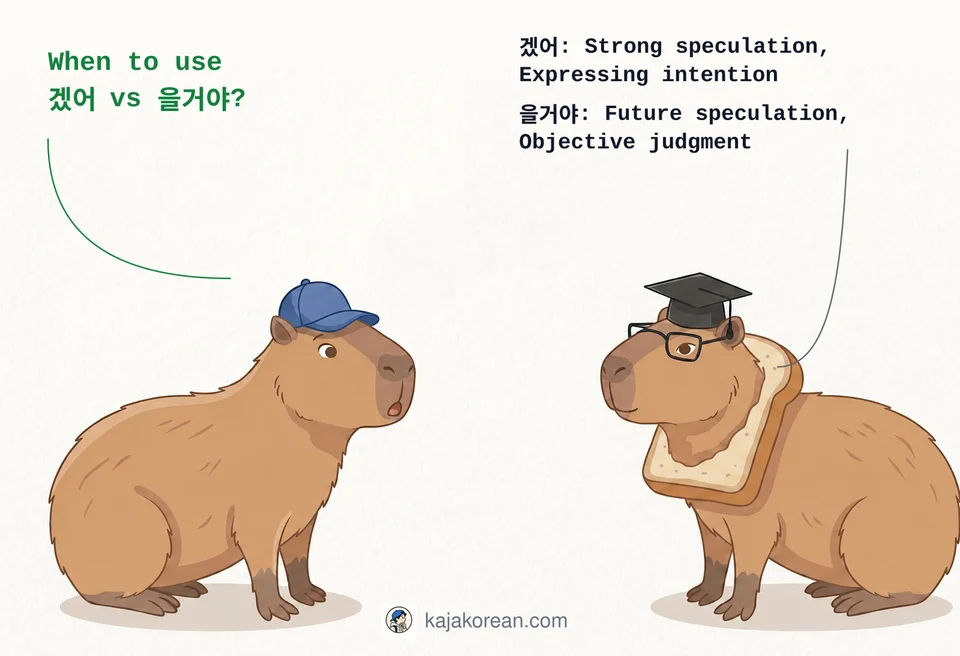
겠어 vs 을거야: Subtle Differences in Future Intention and Guessing

겠어 (gess-eo, gesseo) · 을거야 (eul-geo-ya, eulgeoya)

'겠어' emphasizes the speaker's intention or will, while '을거야' is mainly used to express speculation or certainty about future situations.

Comparison of Korean future tense endings 겠어 and 을거야

Word-by-word breakdown

One lane per word — no nested boxes, just the gist.

겠어(gess-eo, gesseo)

Future expression indicating the speaker's intention, determination, or strong guess

When to use

Expressing intention, Declaring determination, Strong speculation

The nuance

'겠어' is used when the speaker directly expresses intention or strong speculation about a situation. It is mainly used in spoken language to express will or determination.

을거야(eul-geo-ya, eulgeoya)

Expression used to speculate or be certain about future events

When to use

Future speculation, Expressing certainty, Objective judgment

The nuance

'을거야' is used to express speculation or certainty about the future, leaning more towards objective judgment than the speaker's will.

Real-world examples

  • 내일 비가 오겠어.

    nae-il bi-ga o-gess-eo., nae il bi ga o gess eo.

    '겠어' naturally expresses strong speculation here.

  • 내일 비가 올거야.

    nae-il bi-ga ol-geo-ya., nae il bi ga ol geo ya.

    '을거야' correctly expresses certainty or speculation about the future.

  • 내가 하겠어!

    nae-ga ha-gess-eo!, nae ga ha gess eo!

    Natural expression of the speaker's strong intention and determination.

  • 내가 할거야!

    nae-ga hal-geo-ya!, nae ga hal geo ya!

    '할거야' is more about speculation than intention, so it's inappropriate to emphasize will here.

  • 그 사람이 지금 집에 있겠어?

    geu sa-ram-i ji-geum jip-e iss-gess-eo?, geu sa ram i ji geum jip e iss gess eo?

    A natural question expressing strong speculation by the speaker.

  • 그 사람이 지금 집에 있을거야?

    geu sa-ram-i ji-geum jip-e iss-eul-geo-ya?, geu sa ram i ji geum jip e iss eul geo ya?

    '을거야' suits objective speculation but sounds less natural for strong speculation in a question.

  • 내가 도와주겠어.

    nae-ga do-wa-ju-gess-eo., nae ga do wa ju gess eo.

    A natural sentence expressing willingness to help.

  • 내가 도울거야.

    nae-ga do-ul-geo-ya., nae ga do ul geo ya.

    '겠어' is more appropriate to express willingness to help.

Quick quiz

  1. Which sentence best expresses the speaker's intention?

    다음 중 화자의 의지를 가장 잘 표현한 문장은?(da-eumjunghwa-ja-uiui-ji-reulga-jangjalpyo-hyeon-hanmun-jang-eun?, daeumjunghwajauiuijireulgajangjalpyohyeonhanmunjangeun?)
  2. Which expression is appropriate for speculation about the future?

    미래에 대한 추측을 표현할 때 적절한 표현은?(mi-rae-edae-hanchu-cheuk-eulpyo-hyeon-halttaejeok-jeol-hanpyo-hyeon-eun?, miraeedaehanchucheukeulpyohyeonhalttaejeokjeolhanpyohyeoneun?)
  3. Which sentence is inappropriate for expressing intention?

    의지 표현에 부적절한 문장은?(ui-jipyo-hyeon-ebu-jeok-jeol-hanmun-jang-eun?, uijipyohyeonebujeokjeolhanmunjangeun?)

More comparisons to explore

View all word comparisons →