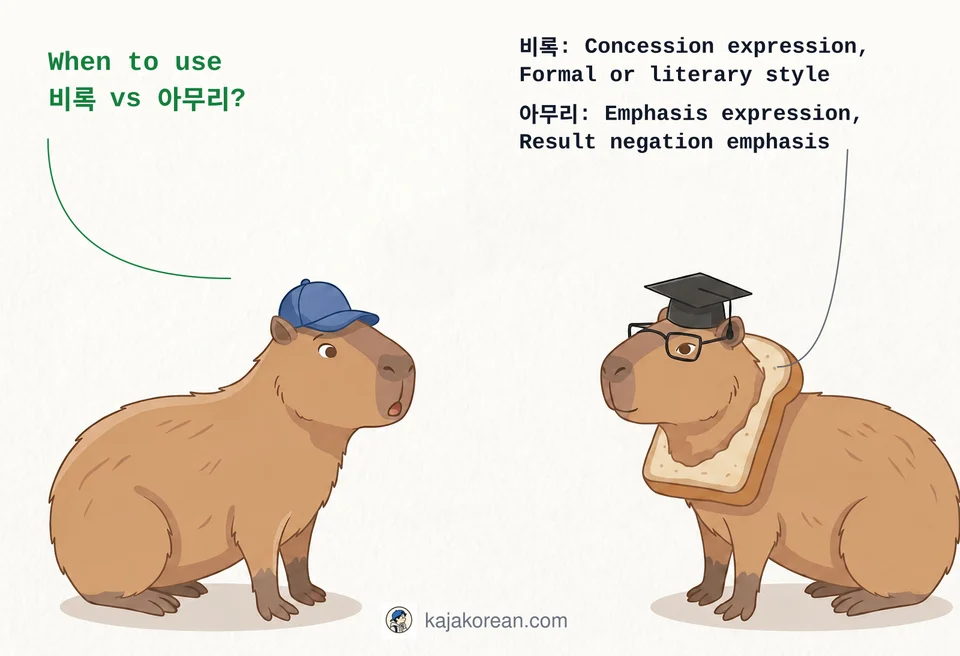
비록 vs 아무리: Contrast of Concession and Emphasis

비록 (bi-rok, birok) · 아무리 (a-mu-ri, amuri)

비록 expresses concession, while 아무리 emphasizes degree or limits of a situation.

Comparison of Korean words 비록 and 아무리 with examples and usage rules

Word-by-word breakdown

One lane per word — no nested boxes, just the gist.

비록(bi-rok, birok)

Used to concede or acknowledge a fact despite reality

When to use

Concession expression, Fact acknowledgment with contrast, Formal or literary style

The nuance

비록 is mainly used in the form ‘비록 ~지만/더라도’ to acknowledge the fact in the first clause while contrasting or conceding in the following clause.

아무리(a-mu-ri, amuri)

Used to emphasize extreme degree or situation

When to use

Emphasis expression, Result negation emphasis, Both casual and formal speech

The nuance

아무리 is used in the form ‘아무리 ~아/어도’ to emphasize that no matter how much something is done, the result does not change or is unexpected.

Real-world examples

  • 비록 날씨가 안 좋지만, 우리는 여행을 갈 거예요.

    bi-rok nal-ssi-ga an joh-ji-man, u-ri-neun yeo-haeng-eul gal geo-ye-yo., bi rok nal ssi ga an joh ji man, u ri neun yeo haeng eul gal geo ye yo.

    Natural use of 비록 ~지만 to express concession.

  • 비록 아무리 힘들어도 포기하지 마세요.

    bi-rok a-mu-ri him-deul-eo-do po-gi-ha-ji ma-se-yo., bi rok a mu ri him deul eo do po gi ha ji ma se yo.

    비록 and 아무리 express different nuances; ‘아무리 힘들어도’ is correct here.

  • 아무리 노력해도 시험에 떨어졌어요.

    a-mu-ri no-ryeok-hae-do si-heom-e tteol-eo-jyeoss-eo-yo., a mu ri no ryeok hae do si heom e tteol eo jyeoss eo yo.

    Correct use of 아무리 ~아/어도 emphasizing unchanged result.

  • 아무리 비가 와도 우리는 밖에 나가요.

    a-mu-ri bi-ga wa-do u-ri-neun bakk-e na-ga-yo., a mu ri bi ga wa do u ri neun bakk e na ga yo.

    Correct use of 아무리 ~아/어도 to emphasize action regardless of condition.

  • 비록 열심히 공부했어도 시험에 떨어졌어요.

    bi-rok yeol-sim-hi gong-bu-haess-eo-do si-heom-e tteol-eo-jyeoss-eo-yo., bi rok yeol sim hi gong bu haess eo do si heom e tteol eo jyeoss eo yo.

    ‘비록’ pairs with ‘~지만/더라도’, not ‘~했어도’; use ‘비록 열심히 공부했지만’.

  • 아무리 비가 와지만, 우리는 갈 거예요.

    a-mu-ri bi-ga wa-ji-man, u-ri-neun gal geo-ye-yo., a mu ri bi ga wa ji man, u ri neun gal geo ye yo.

    ‘아무리’ must be paired with ‘~아/어도’, not ‘~지만’.

  • 비록 어려워도 포기하지 말자.

    bi-rok eo-ryeo-wo-do po-gi-ha-ji mal-ja., bi rok eo ryeo wo do po gi ha ji mal ja.

    Correct use of 비록 ~어도 to express concession naturally.

  • 아무리 바빠도 친구를 만나야 해요.

    a-mu-ri ba-ppa-do chin-gu-reul man-na-ya hae-yo., a mu ri ba ppa do chin gu reul man na ya hae yo.

    Correct use of 아무리 ~아/어도 to emphasize regardless of condition.

Quick quiz

  1. Which sentence correctly uses ‘비록’?

    다음 중 ‘비록’을 올바르게 사용한 문장은?(da-eumjung‘bi-rok’eulol-ba-reu-gesa-yong-hanmun-jang-eun?, daeumjung‘birok’eulolbareugesayonghanmunjangeun?)
  2. Which sentence correctly uses ‘아무리’?

    ‘아무리’가 잘 쓰인 문장은?(‘a-mu-ri’gajalsseu-inmun-jang-eun?, ‘amuri’gajalsseuinmunjangeun?)
  3. Which sentence correctly uses both ‘비록’ and ‘아무리’?

    ‘비록’과 ‘아무리’를 함께 쓸 때 올바른 문장은?(‘bi-rok’gwa‘a-mu-ri’reulham-kkesseulttaeol-ba-reunmun-jang-eun?, ‘birok’gwa‘amuri’reulhamkkesseulttaeolbareunmunjangeun?)

More comparisons to explore

View all word comparisons →