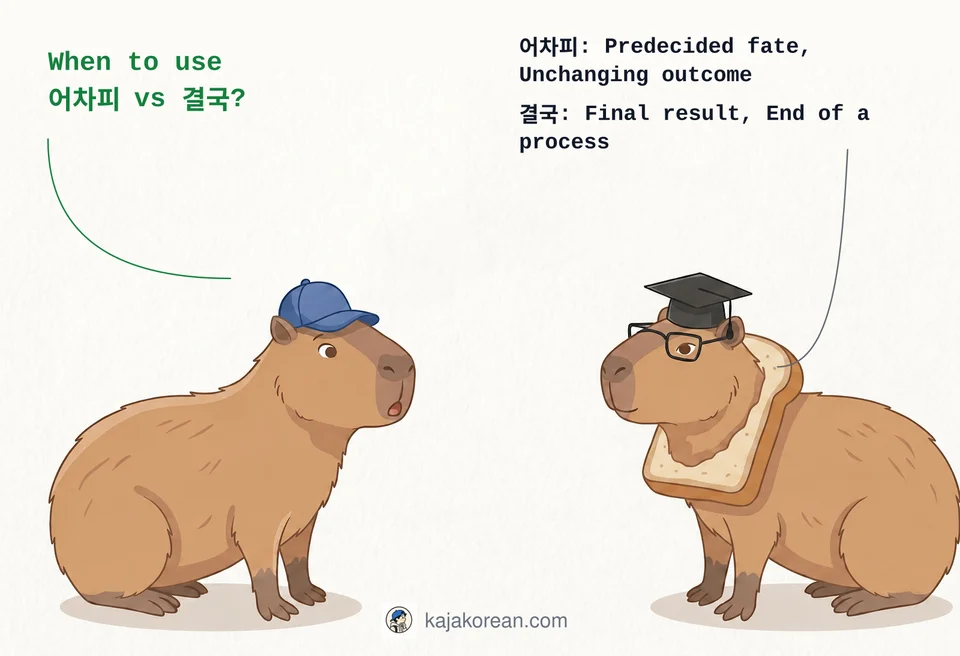
어차피 vs 결국: Difference Between Inevitable and Final Outcome

어차피 (eo-cha-pi, eochapi) · 결국 (gyeol-guk, gyeolguk)

어차피 emphasizes an inevitable situation where the outcome won't change, while 결국 indicates the final result reached after some time.

Comparison of Korean words 어차피 and 결국 showing their usage differences

Word-by-word breakdown

One lane per word — no nested boxes, just the gist.

어차피(eo-cha-pi, eochapi)

An adverb used when a situation or outcome is already decided and won't change

When to use

Inevitable situation, Unchanging outcome, Predecided fate

The nuance

Use 어차피 to emphasize an unavoidable fact that a situation or action will not change in the future.

결국(gyeol-guk, gyeolguk)

An adverb indicating the final result or conclusion reached after some time passes

When to use

Final result, Conclusion after time, End of a process

The nuance

Use 결국 to describe the final outcome or conclusion after a process or passage of time.

Real-world examples

  • 어차피 오늘 비가 올 거니까 우산을 챙겨 가자.

    eo-cha-pi o-neul bi-ga ol geo-ni-kka u-san-eul chaeng-gyeo ga-ja., eo cha pi o neul bi ga ol geo ni kka u san eul chaeng gyeo ga ja.

    Correct because 어차피 emphasizes the inevitable fact that it will rain today.

  • 어차피 네가 늦을 테니까 먼저 시작할게.

    eo-cha-pi ne-ga neuj-eul te-ni-kka meon-jeo si-jak-hal-ge., eo cha pi ne ga neuj eul te ni kka meon jeo si jak hal ge.

    Correct because 어차피 is used to stress the unavoidable lateness.

  • 어차피 시험에 합격해서 너무 기뻐.

    eo-cha-pi si-heom-e hap-gyeok-hae-seo neo-mu gi-ppeo., eo cha pi si heom e hap gyeok hae seo neo mu gi ppeo.

    Incorrect because passing the exam is not an inevitable fact yet, so 어차피 is inappropriate.

  • 결국 그는 약속을 지켰다.

    gyeol-guk geu-neun yak-sok-eul ji-kyeoss-da., gyeol guk geu neun yak sok eul ji kyeoss da.

    Correct because 결국 indicates the final outcome after some time.

  • 결국 내일 비가 올 거니까 우산을 챙겨 가자.

    gyeol-guk nae-il bi-ga ol geo-ni-kka u-san-eul chaeng-gyeo ga-ja., gyeol guk nae il bi ga ol geo ni kka u san eul chaeng gyeo ga ja.

    Incorrect because 결국 is for final outcomes after time, not for emphasizing future certainty like 어차피.

  • 결국 네가 늦을 테니까 먼저 시작할게.

    gyeol-guk ne-ga neuj-eul te-ni-kka meon-jeo si-jak-hal-ge., gyeol guk ne ga neuj eul te ni kka meon jeo si jak hal ge.

    Incorrect because lateness as an inevitable fact requires 어차피, not 결국.

  • 어차피 노력했으니 후회는 없다.

    eo-cha-pi no-ryeok-haess-eu-ni hu-hoe-neun eop-da., eo cha pi no ryeok haess eu ni hu hoe neun eop da.

    Correct because 어차피 emphasizes the unchangeable fact of having tried.

  • 결국 노력한 만큼 좋은 결과를 얻었다.

    gyeol-guk no-ryeok-han man-keum joh-eun gyeol-gwa-reul eot-eoss-da., gyeol guk no ryeok han man keum joh eun gyeol gwa reul eot eoss da.

    Correct because 결국 shows the final result after effort.

Quick quiz

  1. When should you use 어차피?

    어떤 상황에서 어차피를 써야 할까요?(eo-tteonsang-hwang-e-seoeo-cha-pi-reulsseo-yahal-kka-yo?, eotteonsanghwangeseoeochapireulsseoyahalkkayo?)
  2. Which sentence correctly uses 결국?

    결국이 적절한 문장은?(gyeol-guk-ijeok-jeol-hanmun-jang-eun?, gyeolgukijeokjeolhanmunjangeun?)
  3. Which sentence misuses 어차피?

    다음 중 어차피를 잘못 쓴 문장은?(da-eumjungeo-cha-pi-reuljal-mossseunmun-jang-eun?, daeumjungeochapireuljalmossseunmunjangeun?)

More comparisons to explore

View all word comparisons →