
빨리(ppal-ri, ppalri)
Used to indicate doing something quickly or when time is tight.
When to use
urgent situations, demand for quick action, time pressure
The nuance
Used when the action or movement is fast, or to express urgency in time.
빨리 (ppal-ri, ppalri) · 천천히 (cheon-cheon-hi, cheoncheonhi) · 제때 (je-ttae, jettae)
빨리 (ppalli), 천천히 (cheoncheonhi), and 제때 (jetae) differ as 빨리 means quickly, 천천히 means slowly, and 제때 means at the right or proper time, each used in distinct timing or speed contexts.
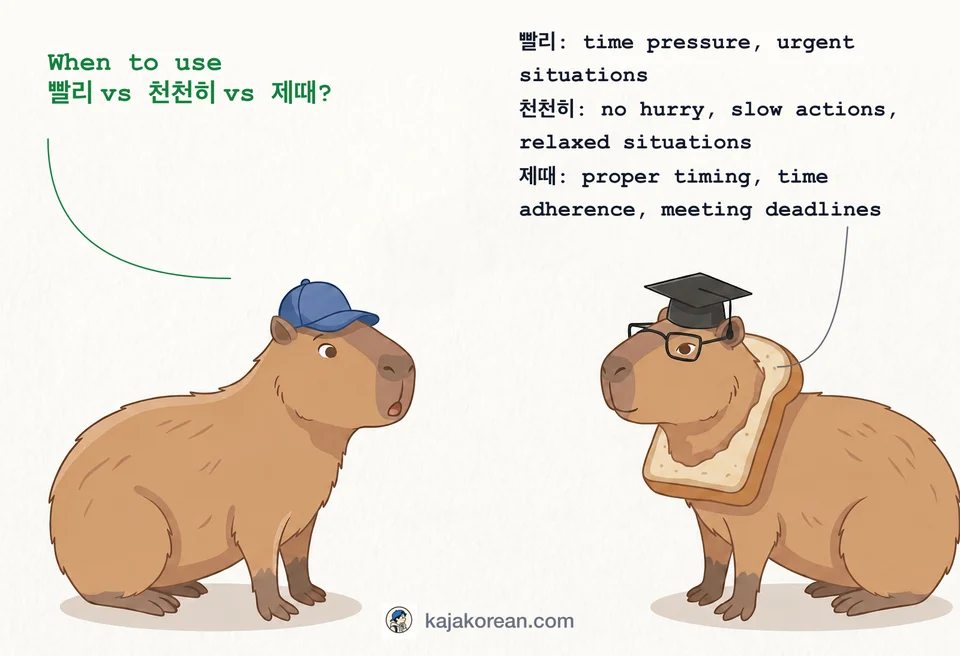
One lane per word — no nested boxes, just the gist.
Used to indicate doing something quickly or when time is tight.
When to use
urgent situations, demand for quick action, time pressure
The nuance
Used when the action or movement is fast, or to express urgency in time.
Used to indicate doing something slowly or at a relaxed pace.
When to use
slow actions, relaxed situations, no hurry
The nuance
Used when the speed is slow or the action is done leisurely, suitable for non-urgent situations.
Used to indicate doing something at the proper or scheduled time.
When to use
meeting deadlines, proper timing, time adherence
The nuance
Emphasizes temporal appropriateness or a set time, meaning the exact timing without being early or late.
빨리 출발해야 해요.
ppal-ri chul-bal-hae-ya hae-yo., ppal ri chul bal hae ya hae yo.
'빨리' fits as quick action is needed due to time pressure.
빨리 천천히 걸어요.
ppal-ri cheon-cheon-hi geol-eo-yo., ppal ri cheon cheon hi geol eo yo.
Contradictory use of '빨리' and '천천히' together is incorrect.
천천히 말해 주세요.
cheon-cheon-hi mal-hae ju-se-yo., cheon cheon hi mal hae ju se yo.
'천천히' is correct to request slower speaking.
천천히 준비해도 돼요.
cheon-cheon-hi jun-bi-hae-do dwae-yo., cheon cheon hi jun bi hae do dwae yo.
Appropriate for relaxed preparation without hurry.
제때 도착하지 못했어요.
je-ttae do-chak-ha-ji mos-haess-eo-yo., je ttae do chak ha ji mos haess eo yo.
'제때' correctly expresses failing to meet the scheduled time.
제때 빨리 왔어요.
je-ttae ppal-ri wass-eo-yo., je ttae ppal ri wass eo yo.
Combining '제때' and '빨리' causes confusing meaning, so incorrect.
빨리 천천히 걷지 마세요.
ppal-ri cheon-cheon-hi geot-ji ma-se-yo., ppal ri cheon cheon hi geot ji ma se yo.
Conflicting adverbs used together create an illogical sentence.
제때 약을 먹어야 해요.
je-ttae yak-eul meok-eo-ya hae-yo., je ttae yak eul meok eo ya hae yo.
'제때' is suitable for indicating taking medicine at the correct time.
When is it appropriate to use '빨리'?
In which situation is '천천히' appropriate?
Which sentence should use '제때'?