근처 vs 부근 vs 주변: Subtle Differences in Location Expressions

근처 (geun-cheo, geuncheo) · 부근 (bu-geun, bugeun) · 주변 (ju-byeon, jubyeon)

근처, 부근, and 주변 all mean 'near a place,' but 근처 is concrete and casual, 부근 is formal and wider area, and 주변 emphasizes the environment around a target.

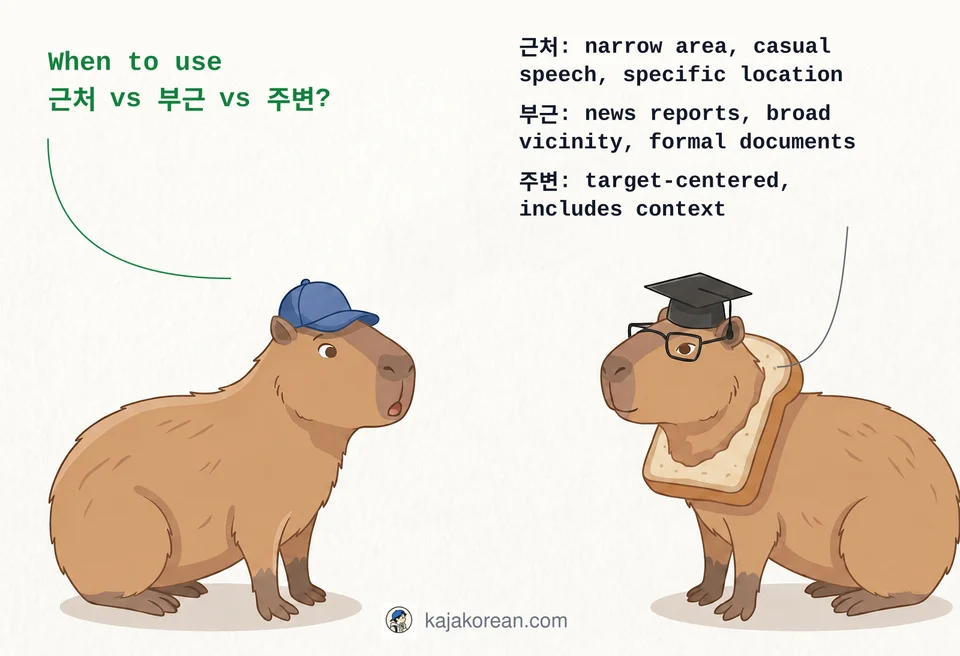
Comparison of Korean location words 근처, 부근, 주변 with usage examples

Word-by-word breakdown

One lane per word — no nested boxes, just the gist.

근처(geun-cheo, geuncheo)

A casual expression indicating a place near a specific location.

When to use

casual speech, specific location, narrow area

The nuance

근처 is used for a specific, relatively narrow nearby location and is common in everyday conversation.

부근(bu-geun, bugeun)

A formal and broader term referring to the vicinity or surrounding area of a place.

When to use

formal documents, news reports, broad vicinity

The nuance

부근 is used in formal contexts like documents or news to express a broad vicinity rather than an exact spot.

주변(ju-byeon, jubyeon)

An expression emphasizing the environment or entire area surrounding a target or place.

When to use

environment emphasis, target-centered, includes context

The nuance

주변 emphasizes the environment or entire space around a target, including not just location but also context or surroundings.

Real-world examples

  • 학교 근처에 맛집이 많아요.

    hak-gyo geun-cheo-e mas-jip-i man-a-yo., hak gyo geun cheo e mas jip i man a yo.

    근처 naturally refers to a specific nearby location, like near the school.

  • 학교 부근에 맛집이 많아요.

    hak-gyo bu-geun-e mas-jip-i man-a-yo., hak gyo bu geun e mas jip i man a yo.

    부근 refers to the wider vicinity around the school, suitable for formal contexts.

  • 학교 주변에 맛집이 많아요.

    hak-gyo ju-byeon-e mas-jip-i man-a-yo., hak gyo ju byeon e mas jip i man a yo.

    주변 emphasizes the environment around the school, appropriate here.

  • 지하철 근처에 대형 쇼핑몰이 있어요.

    ji-ha-cheol geun-cheo-e dae-hyeong syo-ping-mol-i iss-eo-yo., ji ha cheol geun cheo e dae hyeong syo ping mol i iss eo yo.

    근처 indicates a location very close to the subway, which is natural.

  • 지하철 주변에 대형 쇼핑몰이 있어요.

    ji-ha-cheol ju-byeon-e dae-hyeong syo-ping-mol-i iss-eo-yo., ji ha cheol ju byeon e dae hyeong syo ping mol i iss eo yo.

    주변 fits when emphasizing the entire area around the subway.

  • 지하철 부근에 대형 쇼핑몰이 있어요.

    ji-ha-cheol bu-geun-e dae-hyeong syo-ping-mol-i iss-eo-yo., ji ha cheol bu geun e dae hyeong syo ping mol i iss eo yo.

    부근 suits formal or broad vicinity contexts like news or guides.

  • 공원 부근에 사람들이 많이 모였어요.

    gong-won bu-geun-e sa-ram-deul-i man-i mo-yeoss-eo-yo., gong won bu geun e sa ram deul i man i mo yeoss eo yo.

    부근 means the broad vicinity of the park, fitting formal expression.

  • 공원 근처에 사람들이 많이 모였어요.

    gong-won geun-cheo-e sa-ram-deul-i man-i mo-yeoss-eo-yo., gong won geun cheo e sa ram deul i man i mo yeoss eo yo.

    근처 refers to a location very close to the park, natural here.

Quick quiz

  1. Which is most suitable for a formal document?

    다음 중 공식 문서에 가장 적합한 표현은?(da-eumjunggong-sikmun-seo-ega-jangjeok-hap-hanpyo-hyeon-eun?, daeumjunggongsikmunseoegajangjeokhaphanpyohyeoneun?)
  2. Which word fits naturally in '학교 ___에 맛집이 많아요.'?

    '학교 ___에 맛집이 많아요.'에 자연스러운 단어는?('hak-gyo___emas-jip-iman-a-yo.'eja-yeon-seu-reo-undan-eo-neun?, 'hakgyo___emasjipimanayo.'ejayeonseureoundaneoneun?)
  3. Which word emphasizes the environment around a target?

    대상을 중심으로 그 환경 전체를 강조할 때 쓰는 단어는?(dae-sang-euljung-sim-eu-rogeuhwan-gyeongjeon-che-reulgang-jo-halttaesseu-neundan-eo-neun?, daesangeuljungsimeurogeuhwangyeongjeonchereulgangjohalttaesseuneundaneoneun?)

More comparisons to explore

View all word comparisons →