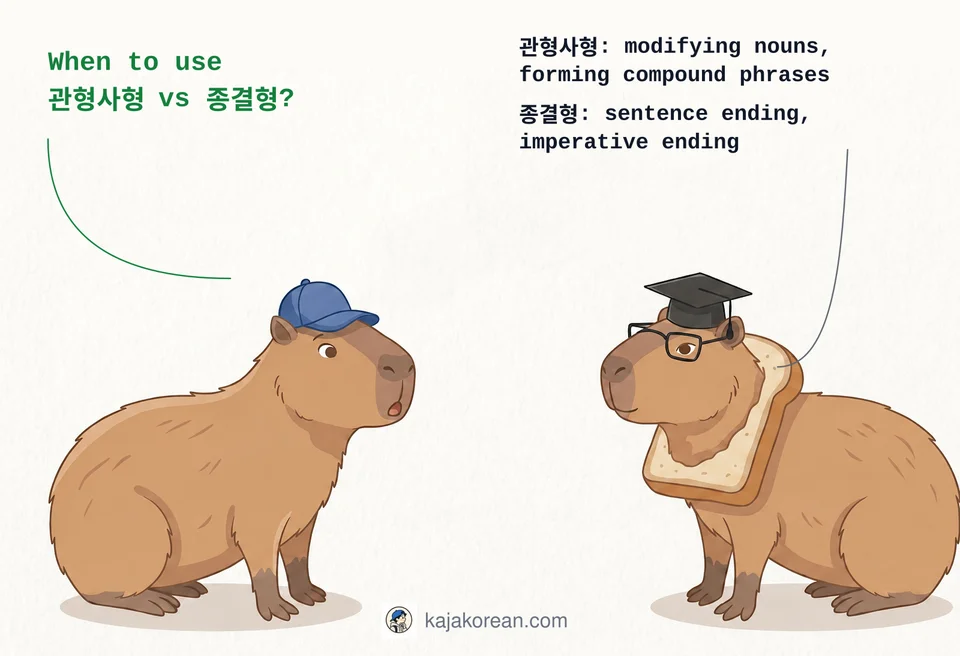
A verb or adjective form that modifies a noun
When to use
modifying nouns, forming compound phrases, adjective function as modifier
The nuance
관형사형 must be followed by a noun and only modifies that noun.
관형사형 (gwan-hyeong-sa-hyeong, gwanhyeongsahyeong) · 종결형 (jong-gyeol-hyeong, jonggyeolhyeong)
관형사형 modifies nouns, while 종결형 ends sentences; this clear functional difference guides their usage.

One lane per word — no nested boxes, just the gist.
A verb or adjective form that modifies a noun
When to use
modifying nouns, forming compound phrases, adjective function as modifier
The nuance
관형사형 must be followed by a noun and only modifies that noun.
A verb or adjective form that ends a sentence
When to use
sentence ending, declarative ending, interrogative ending, imperative ending
The nuance
종결형 appears at the end of a sentence to complete it, commonly used in declarative, interrogative, or imperative sentences.
예쁜 꽃이 피었다.
ye-ppeun kkoch-i pi-eoss-da., ye ppeun kkoch i pi eoss da.
‘예쁜’ is a 관형사형 modifying ‘꽃’, which is correct.
예쁘다 꽃이 피었다.
ye-ppeu-da kkoch-i pi-eoss-da., ye ppeu da kkoch i pi eoss da.
‘예쁘다’ is a 종결형 and cannot modify a noun, so this is incorrect.
나는 밥을 먹었다.
na-neun bap-eul meok-eoss-da., na neun bap eul meok eoss da.
‘먹었다’ is a 종결형 ending the sentence properly.
나는 밥을 먹는.
na-neun bap-eul meok-neun., na neun bap eul meok neun.
‘먹는’ is a 관형사형 but lacks a following noun, so incorrect.
달콤한 사과를 먹었다.
dal-kom-han sa-gwa-reul meok-eoss-da., dal kom han sa gwa reul meok eoss da.
‘달콤한’ is a 관형사형 modifying ‘사과’, correct usage.
달콤하다 사과를 먹었다.
dal-kom-ha-da sa-gwa-reul meok-eoss-da., dal kom ha da sa gwa reul meok eoss da.
‘달콤하다’ is a 종결형 and cannot precede a noun.
그는 학교에 갔다.
geu-neun hak-gyo-e gass-da., geu neun hak gyo e gass da.
‘갔다’ is a 종결형 completing the sentence.
그는 학교에 가는.
geu-neun hak-gyo-e ga-neun., geu neun hak gyo e ga neun.
‘가는’ is a 관형사형 but missing the noun it should modify.
Which form modifies a noun: ‘먹는’ or ‘먹었다’?
Which form is used to end a sentence?
In ‘예쁜 꽃’, what form is ‘예쁜’?