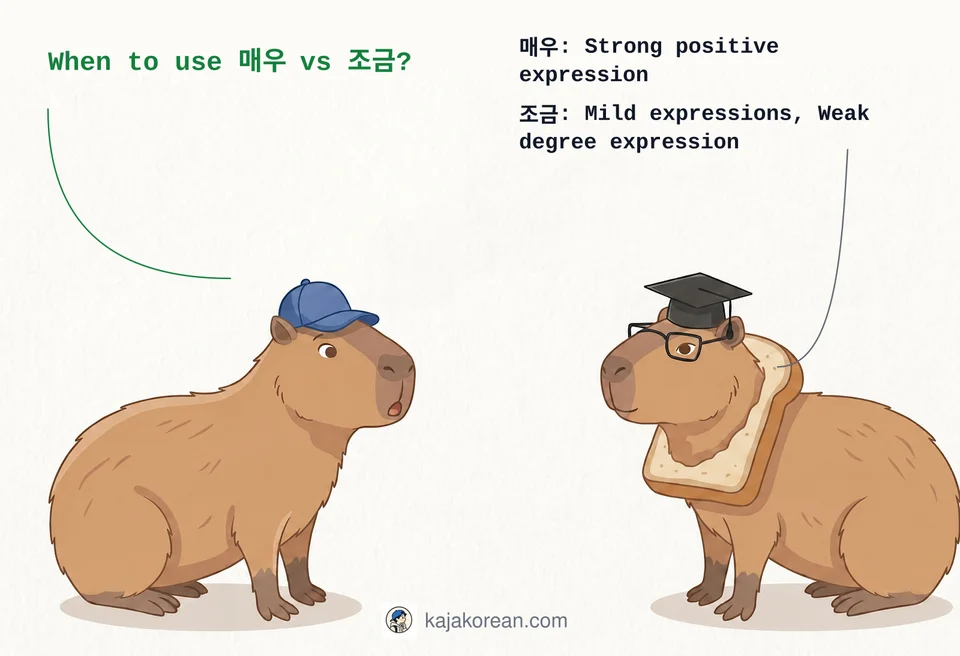
매우 vs 조금: Understanding Intensity Differences

매우 (mae-u, maeu) · 조금 (jo-geum, jogeum)

'매우' expresses strong intensity, while '조금' indicates weak intensity; choosing the right one depends on context.

Comparison of Korean adverbs 매우 and 조금 for intensity

Word-by-word breakdown

One lane per word — no nested boxes, just the gist.

매우(mae-u, maeu)

Indicates a very strong degree or intense state

When to use

Strong positive expression, Strong negative expression, Important emphasis situations

The nuance

Used to emphasize adjectives or adverbs, suitable for expressing strong positive or negative feelings.

조금(jo-geum, jogeum)

Indicates a small amount or degree, meaning slightly or partially

When to use

Weak degree expression, Small quantity situations, Mild expressions

The nuance

Used when degree or amount is small, suitable for soft or mild expressions.

Real-world examples

  • 이 음식은 매우 맛있어요.

    i eum-sik-eun mae-u mas-iss-eo-yo., i eum sik eun mae u mas iss eo yo.

    '매우' is used when the taste is very strong or good.

  • 이 음식은 조금 맛있어요.

    i eum-sik-eun jo-geum mas-iss-eo-yo., i eum sik eun jo geum mas iss eo yo.

    '조금' fits when the taste is slight or less intense.

  • 그 영화는 매우 재미없었어요.

    geu yeong-hwa-neun mae-u jae-mi-eop-eoss-eo-yo., geu yeong hwa neun mae u jae mi eop eoss eo yo.

    '매우' is appropriate to strongly express negative feelings.

  • 그 영화는 조금 재미없었어요.

    geu yeong-hwa-neun jo-geum jae-mi-eop-eoss-eo-yo., geu yeong hwa neun jo geum jae mi eop eoss eo yo.

    '조금' is used when the negative degree is mild.

  • 나는 매우 피곤해요.

    na-neun mae-u pi-gon-hae-yo., na neun mae u pi gon hae yo.

    '매우' is used to express strong fatigue.

  • 나는 조금 피곤해요.

    na-neun jo-geum pi-gon-hae-yo., na neun jo geum pi gon hae yo.

    '조금' suits when indicating slight tiredness.

  • 그는 매우 조금 먹었어요.

    geu-neun mae-u jo-geum meok-eoss-eo-yo., geu neun mae u jo geum meok eoss eo yo.

    '매우' and '조금' are not used together; only '조금' should be used.

  • 나는 조금 매우 행복해요.

    na-neun jo-geum mae-u haeng-bok-hae-yo., na neun jo geum mae u haeng bok hae yo.

    Using both adverbs together is awkward and contradictory.

Quick quiz

  1. Which is appropriate for expressing strong positive feelings?

    다음 중 강한 긍정을 표현할 때 적절한 단어는?(da-eumjunggang-hangeung-jeong-eulpyo-hyeon-halttaejeok-jeol-handan-eo-neun?, daeumjungganghangeungjeongeulpyohyeonhalttaejeokjeolhandaneoneun?)
  2. Which expression fits slight tiredness?

    피곤함이 약간 있을 때 쓸 수 있는 표현은?(pi-gon-ham-iyak-ganiss-eulttaesseulsuiss-neunpyo-hyeon-eun?, pigonhamiyakganisseulttaesseulsuissneunpyohyeoneun?)
  3. Fill in the blank: 'That movie was ___ boring.'

    '그 영화는 ___ 재미없었어요.'에 들어갈 알맞은 단어는?('geuyeong-hwa-neun___jae-mi-eop-eoss-eo-yo.'edeul-eo-galal-maj-eundan-eo-neun?, 'geuyeonghwaneun___jaemieopeosseoyo.'edeuleogalalmajeundaneoneun?)
  4. Which sentence is incorrect?

    다음 중 잘못된 문장은?(da-eumjungjal-mos-doenmun-jang-eun?, daeumjungjalmosdoenmunjangeun?)

What does it mean?

More comparisons to explore

View all word comparisons →